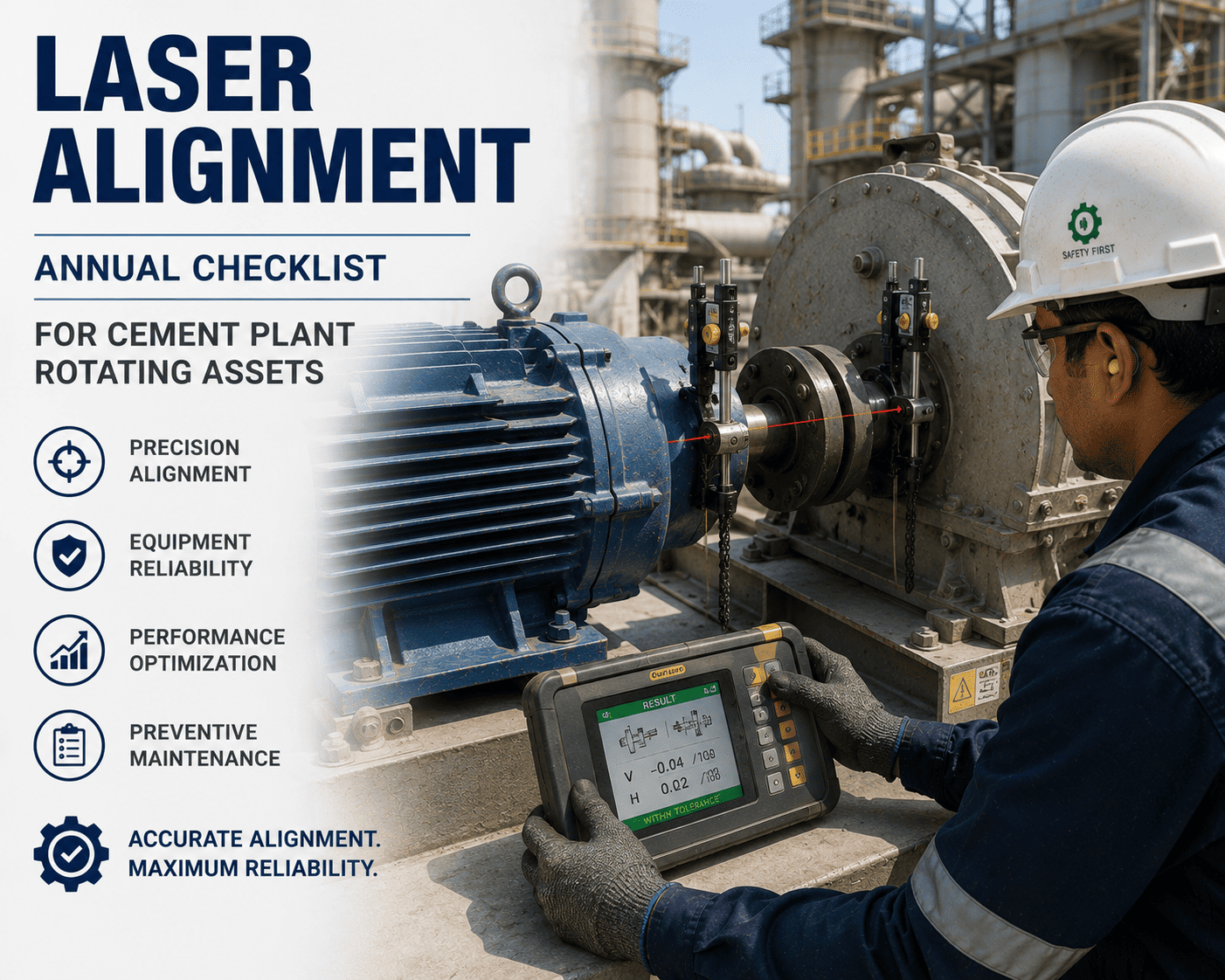
Bearing failures on a motor-gearbox-fan train almost never start as a bearing problem. They start as a shaft that was never quite lined up, running fine for months while a few thousandths of an inch of offset quietly cuts the bearing's life in half. Sign up to log as-found and as-left alignment readings on every rotating train, and catch a foundation or pipe strain problem before it takes out a coupling and a bearing at once.
Why It Matters
More than half of unplanned rotating equipment breakdowns trace back to shaft misalignment somewhere in the drive train. An annual laser alignment check on every critical motor, gearbox, and fan train catches the drift a foundation, a soft foot, or thermal growth introduces long before it turns into a coupling failure.
The Annual Alignment Sequence
1
Inspect and clean mounting surfaces
Clear dirt, rust, or old paint from under the feet of every machine in the train, since debris under a foot reads as misalignment the laser can't distinguish from a real fault.
2
Run the soft foot check first
Correct any foot that doesn't sit flat before touching the coupling alignment, since a soft foot distorts the frame the moment bolts are tightened and invalidates every reading taken afterward.
3
Mount the laser and measure offset and angle
Capture offset and angularity at the coupling in both vertical and horizontal planes, recording the as-found reading before any correction is applied.
4
Enter thermal growth compensation
Apply a cold offset for each machine so the train lands in tolerance once it reaches normal operating temperature, not just in its cold, at-rest position.
5
Shim, verify, and record as-left values
Correct to within the RPM-based tolerance target, torque the hold-down bolts, and log the final as-left reading against the asset record.
As-Found And As-Left, On Every Train
Oxmaint attaches alignment readings to each motor, gearbox, and fan as part of its asset history, schedules the annual recheck automatically, and flags a train that's drifted out again since its last alignment. Sign up for a free trial to run it on your own rotating assets, or book a demo to see it configured for your plant.
Soft Foot vs Thermal Growth
Soft Foot
One foot doesn't sit flat against the base, so tightening the bolts distorts the frame and cocks the bearing housing. Shows up as an alignment that never seems to hold, no matter how carefully it's corrected.
Thermal Growth
As the motor heats up during operation, the casing and shaft expand and shift the alignment from its cold, at-rest position. A train aligned perfectly cold can run out of tolerance once it's fully loaded and hot.
Why A Passing Train Drifts Back Out
An alignment that was correct six months ago and is badly out again isn't a sign the first job was done wrong, it's a sign something upstream is moving. A foundation settles unevenly under the weight of a fan train and slowly rotates the baseplate out of level. Pipe strain from a connected duct or conveyor chute pulls a machine off center as thermal expansion works on the ductwork over a full production cycle. A coupling wears unevenly and starts introducing its own offset that no amount of shimming at the feet can correct. The as-found reading at the start of each annual check is the real diagnostic value, since a train that keeps drifting back the same direction points straight at the root cause instead of just the symptom.
Tolerance Reference By Machine Speed
| Speed Range |
Typical Asset |
Alignment Priority |
| Under 1,000 RPM |
Kiln drive, mill gearbox |
Wider tolerance band, still critical due to load |
| 1,000 to 3,000 RPM |
Process fan, ID fan motor train |
Tighter tolerance, thermal growth compensation required |
| Over 3,000 RPM |
High-speed blower, compressor drive |
Tightest tolerance, misalignment has outsized vibration impact |
Frequently Asked Questions
Q
Why check soft foot before correcting alignment?
Tightening bolts on a machine with a soft foot distorts the frame and can cock the bearing housing, producing an alignment reading that looks correct but isn't. Correcting soft foot first means every reading taken afterward reflects the real coupling alignment, not a distorted frame.
Q
Does a cold alignment guarantee a hot alignment?
No. A train aligned to zero tolerance at rest can shift out of tolerance once the motor reaches full operating temperature, because the motor casing typically runs hotter than the driven machine and grows more. Thermal growth compensation applied during the cold alignment is what closes that gap.
Q
What does it mean if a train keeps drifting out of alignment?
A train that's badly out again shortly after a good alignment usually points to a root cause upstream of the coupling, a settling foundation, pipe strain, or a worn coupling, rather than a poorly performed correction. Comparing as-found readings year over year is what surfaces that pattern.
Stop Losing Bearings To Alignment You Can't See
Oxmaint keeps as-found and as-left alignment readings on every motor, gearbox, and fan train, schedules the annual recheck without anyone having to remember it, and surfaces the trains that keep drifting back out. Sign up for a free trial to run it on your own rotating assets, or book a demo to see it configured for your plant.