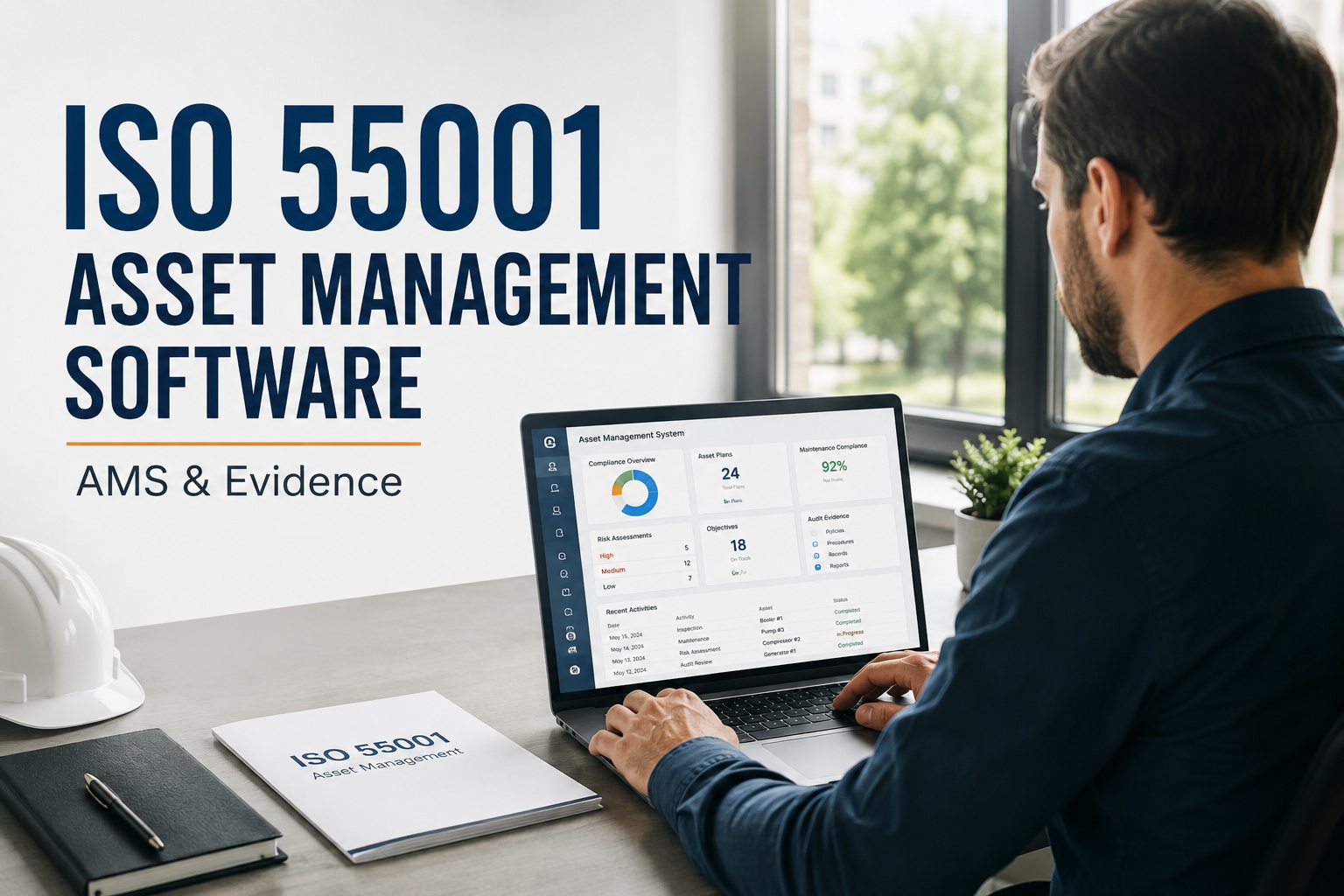
ISO 55001 is one of the most misunderstood standards in UK asset management. It doesn't say how to maintain a pump or prescribe a CMMS. What it requires is that the entire chain — corporate objectives down to individual work orders, back up through performance evidence — is documented, traceable and continually improved. Organisations that pass audit smoothly are the ones where line of sight from strategic asset management plan to daily inspection actually holds together in one platform. Book a demo to see line-of-sight AM workflows in action.
◆ ISO 55001 · SAMP · ASSET MANAGEMENT SYSTEM · CONTINUAL IMPROVEMENT
ISO 55001 asks one question: does your line of sight from corporate objective to daily work order actually hold together?
Every SAMP, every asset plan, every risk, every work order, every performance record — traceable in one asset management system.
GOVERNANCE LINE OF SIGHT · TOP-DOWN AND BOTTOM-UP
01
Organisational Objectives
Strategic goals · Board level
02
Asset Management Policy
Principles · Commitments · Framework
03
Strategic Asset Management Plan (SAMP)
How AM delivers organisational objectives
04
Asset Management Objectives
Measurable AM-specific targets
05
Asset Management Plans
Per-asset lifecycle plans
06
Operational Work & Evidence
Work orders · Inspections · Records · KPIs
10
ISO 55001 clauses · Every one evidenced in the AMS
39
IAM subject areas covered by a working CMMS-backed AMS
6-9mo
Typical time to audit-ready from CMMS-integrated deployment
The 10 Clauses — What ISO 55001 Actually Requires
ISO 55001 is structured around ten clauses, but only clauses 4 through 10 contain auditable requirements. The disciplined organisations map each clause to specific evidence generated by the AMS — not to policy documents sitting in filing cabinets. The mapping below is what a Registrar auditor will actually ask for during certification. Sign up free to map ISO 55001 clauses to your operational evidence chain.
ISO 55001 CLAUSE MAP
Clause → Requirement → Evidence in AMS
4
Context of the Organisation
Stakeholder needs, scope of AMS, boundary of asset portfolio
Scope statement · Asset register boundary
5
Leadership
Top management commitment, AM policy, roles and responsibilities
Policy document · RACI · Sign-off records
6
Planning
SAMP, AM objectives, risk management, asset management plans per asset class
SAMP · Objectives · Risk register · AMPs
7
Support
Resources, competence, awareness, communication, information systems
Competence records · CMMS as information system
8
Operation
Operational planning and control, change management, outsourcing
Work orders · PPM · Change register · Contractor MoC
9
Performance Evaluation
Monitoring, measurement, analysis, evaluation, internal audit, management review
KPI dashboards · Audit records · Review minutes
10
Improvement
Nonconformity, corrective action, continual improvement, preventive action
NCR log · CAR tracking · Improvement register
The Evidence Pyramid — What Auditors Actually Read
ISO 55001 auditors don't audit intent; they audit evidence. And they don't read everything — they sample. The evidence pyramid below shows what a certification auditor typically examines, in the order they examine it. Getting the base layers right makes the top layers easy to defend. Book a demo to see the evidence pyramid live in the platform.
STRATEGIC
SAMP & AM Policy
Document review · 1-2 hours of audit time · Foundation for everything below
2 hrs
TACTICAL
Asset Management Plans
Per-asset-class lifecycle plans · Objectives cascade · Risk-based prioritisation
4 hrs
OPERATIONAL
Work Orders & Records
The evidence engine · Sampled work orders traced back to plans and objectives · Where most auditor time is spent
12 hrs
PERFORMANCE
KPIs & Reviews
Reliability metrics · Management review outputs · Continual improvement action closure
3 hrs
GOVERNANCE
Internal Audit & NCR
Self-audit evidence · Non-conformity register · Corrective action closure loop
3 hrs
Continual Improvement — The PDCA Cycle in AM Practice
ISO 55001 requires demonstrable continual improvement, not just improvement stated in policy. Auditors want to see the Plan-Do-Check-Act cycle running against real asset performance data — actions raised from KPI deviations, closed through work order execution, verified in the next review cycle. The AMS must capture the whole loop.
PLAN
Set the Direction
SAMP & AM objectives set
Asset plans structured
Risks identified · Priority ranked
Resources allocated
DO
Execute the Work
Work orders executed
Inspections completed
Records captured on mobile
Changes managed through MoC
CHECK
Measure the Outcome
KPIs monitored per AMP
Internal audit against clauses
Management review conducted
NCRs raised on deviations
ACT
Close the Loop
Corrective actions issued
Preventive actions identified
Improvement register updated
SAMP revisions fed back
◆ ISO 55001 ASSET MANAGEMENT DEMO
See the Full AMS Workflow in 30 Minutes
SAMP-to-work-order line of sight, ISO 55001 clause-mapped evidence chain, IAM 39-subject-area coverage, PDCA continual improvement loop, NCR/CAR workflow and audit-ready packs for Registrar certification.
IAM 39 Subject Areas — Where a CMMS-Backed AMS Delivers
The Institute of Asset Management maps the AM landscape into 39 subject areas across 6 groups. A well-implemented CMMS-backed AMS delivers direct evidence for 30+ of those subject areas, and structural support for most of the rest. The coverage below shows where the platform sits in the IAM landscape. Sign up free to map IAM subject areas to your operational evidence.
GROUP 1
Strategy & Planning
7 of 7 covered
SAMP · AM objectives · Strategic planning · Contingency planning
GROUP 2
Asset Management Decision-Making
6 of 6 covered
Capital investment · Operations · Maintenance decisions · Lifecycle value
GROUP 3
Lifecycle Delivery
10 of 12 covered
Technical standards · Asset creation · Systems engineering · Configuration
GROUP 4
Asset Information
4 of 4 covered
Asset information strategy · Data standards · Configuration management
GROUP 5
Organisation & People
3 of 5 covered
Procurement · Resource management · Competence · Organisational culture
GROUP 6
Risk & Review
5 of 5 covered
Risk management · Continual improvement · Assurance · Management review
Expert Perspective — Why ISO 55001 Rewards Disciplined AMS Foundations
"
Every UK organisation that has been through ISO 55001 certification learns the same lesson. The standard isn't difficult to understand — the ten clauses are clear, the requirements are well documented, the Institute of Asset Management publishes excellent supporting guidance. What proves difficult is generating and holding the evidence chain end-to-end, from strategic asset management plan through operational work orders through performance review through corrective action. Organisations that already run a disciplined CMMS with proper asset hierarchies, criticality classification, work order lifecycles and KPI capture find that 70-80 percent of the evidence they need is already being produced as a natural output of daily maintenance work. Organisations that don't have that foundation face a genuinely hard reconstruction project — trying to retro-fit evidence for activities that were never structured. The critical strategic insight is that ISO 55001 doesn't require a new system or a new methodology; it requires the systems and methodologies you already use to actually be disciplined enough to produce traceable evidence. That's ultimately a CMMS quality question dressed up as a certification project.
— UK ISO 55001 & Institute of Asset Management Practice
01
Line-of-sight architecture
SAMP → AM objectives → asset plans → work orders → KPIs → review · One chain, one platform, traceable both ways.
02
Clause-mapped evidence
Every ISO 55001 clause 4-10 mapped to specific AMS evidence · No document scramble at audit time.
03
PDCA loop closure
Plan-Do-Check-Act cycle runs against real performance data · NCR/CAR workflow structural to closure.
04
IAM 39-area coverage
Direct coverage for 30+ of the 39 IAM subject areas · Structural support for the remainder.
Who Uses Oxmaint for UK ISO 55001 Asset Management
The platform is used by the UK roles delivering asset management to ISO 55001 standard: heads of asset management preparing for certification or maintaining certified status, asset managers responsible for strategic and tactical planning, reliability engineering directors owning performance evidence, quality and compliance directors maintaining the AMS across multi-site operations, chartered engineers pursuing IAM Certificate and Diploma qualifications, internal auditors preparing for surveillance audits, infrastructure operators (water, energy, transport, telecoms) where ISO 55001 is a regulatory expectation, and public-sector asset owners where the standard is embedded in procurement requirements.
Getting an ISO 55001-Aligned AMS Live in 3-6 Months
Deployment sequences to match ISO 55001 certification readiness. Month 1-2: asset register with criticality classification, SAMP structure, AM policy configuration and clause 4-5 evidence capture. Month 2-4: asset management plans per asset class, risk register integration, PPM cycle configuration and clause 6-7 evidence. Month 4-5: work order lifecycle with mobile execution, MoC workflow and clause 8 evidence. Month 5-6: KPI dashboards, internal audit workflow, management review structure and clauses 9-10 evidence. Most UK organisations reach audit-ready state within 6-9 months, with certification typically achievable within 12 months from disciplined deployment. Sign up free to scope your ISO 55001 deployment.
◆ ONE STANDARD. ONE EVIDENCE CHAIN. ONE PLATFORM.
Certify. Evidence. Continually Improve.
Oxmaint gives UK asset management teams the complete ISO 55001-aligned AMS — SAMP-to-work-order line of sight, clause-mapped evidence chain, IAM 39-area coverage, PDCA continual improvement loop and audit-ready certification workflow.
Frequently Asked Questions
What is ISO 55001 asset management software?
ISO 55001 asset management software is a CMMS-backed asset management system (AMS) configured to deliver the line-of-sight and evidence chain that ISO 55001 requires. It holds the Strategic Asset Management Plan (SAMP), AM policy, AM objectives, per-asset-class management plans, risk register, work order lifecycle with mobile execution, competence records, KPI dashboards, internal audit workflow, management review outputs and non-conformity/corrective action tracking. Every ISO 55001 clause 4-10 maps to specific evidence produced as a natural output of operational maintenance work — not as separate documentation. This is what turns ISO 55001 certification from a one-off documentation project into a structural quality of everyday asset management practice.
How does the platform map to the 10 ISO 55001 clauses?
Clauses 1-3 are scope, references and terms — no auditable requirements. Clause 4 (Context) maps to the AMS scope statement and asset register boundary. Clause 5 (Leadership) maps to AM policy, RACI and top management sign-off records. Clause 6 (Planning) maps to SAMP, AM objectives, risk register and asset management plans per class. Clause 7 (Support) maps to competence records and the CMMS itself as the required information system. Clause 8 (Operation) maps to work orders, PPM cycles, change management and contractor MoC. Clause 9 (Performance Evaluation) maps to KPI dashboards, internal audit records and management review minutes. Clause 10 (Improvement) maps to NCR/CAR workflow and the improvement register. Every clause produces evidence from operational activity — not from separate documentation exercises.
Does it support the IAM 39 subject areas?
The Institute of Asset Management maps the AM landscape into 39 subject areas across 6 groups. Oxmaint delivers direct evidence for approximately 30 of the 39 areas as a structural output of operational activity, and structural support for most of the rest. Group 1 (Strategy & Planning, 7 areas) is fully covered through SAMP and AM objectives. Group 2 (Decision-Making, 6 areas) through capital, operations, maintenance and lifecycle-value workflows. Group 3 (Lifecycle Delivery, 12 areas) through 10 direct coverages including technical standards, asset creation and configuration. Group 4 (Asset Information, 4 areas) fully covered through the asset information strategy and data standards workflow. Groups 5 and 6 cover procurement, resource management, risk, continual improvement and assurance. Organisation-and-people coverage completes through separate HR, learning and culture platforms interfaced to the CMMS.
Do we still need documented policies if the CMMS holds the evidence?
Yes — ISO 55001 requires documented AM policy (clause 5.2), SAMP (clause 4.4) and asset management plans (clause 6.2.2). The documents don't need to be lengthy — a well-scoped SAMP can run to 15-25 pages and an AM policy to 2-3 pages. The critical requirement isn't document volume; it's that the documented commitments are operationally deliverable and that evidence of delivery flows back into the AMS. What the CMMS-backed AMS eliminates is the parallel documentation universe where policy commitments live in one place and operational activity lives in another with no traceable link. When SAMP objectives map directly to asset management plan targets which map directly to work order priorities which map directly to KPI reporting, the documentation becomes the operational reality rather than a parallel exercise.
How long does it take to reach ISO 55001 certification readiness?
A UK organisation starting from a disciplined CMMS foundation typically reaches audit-ready state within 6-9 months and achieves certification within 12 months. The sequence: months 1-2 configure asset register with criticality classification, SAMP structure, AM policy and clause 4-5 evidence. Months 2-4 build asset management plans per asset class, integrate risk register, configure PPM cycles and generate clause 6-7 evidence. Months 4-5 activate work order lifecycle with mobile execution and MoC workflow for clause 8. Months 5-6 stand up KPI dashboards, internal audit workflow and management review structure for clauses 9-10. Organisations starting from a weak CMMS foundation or paper-based systems typically add 6-12 months for the foundation work, since the CMMS quality is genuinely the constraint — not the ISO 55001 documentation itself.