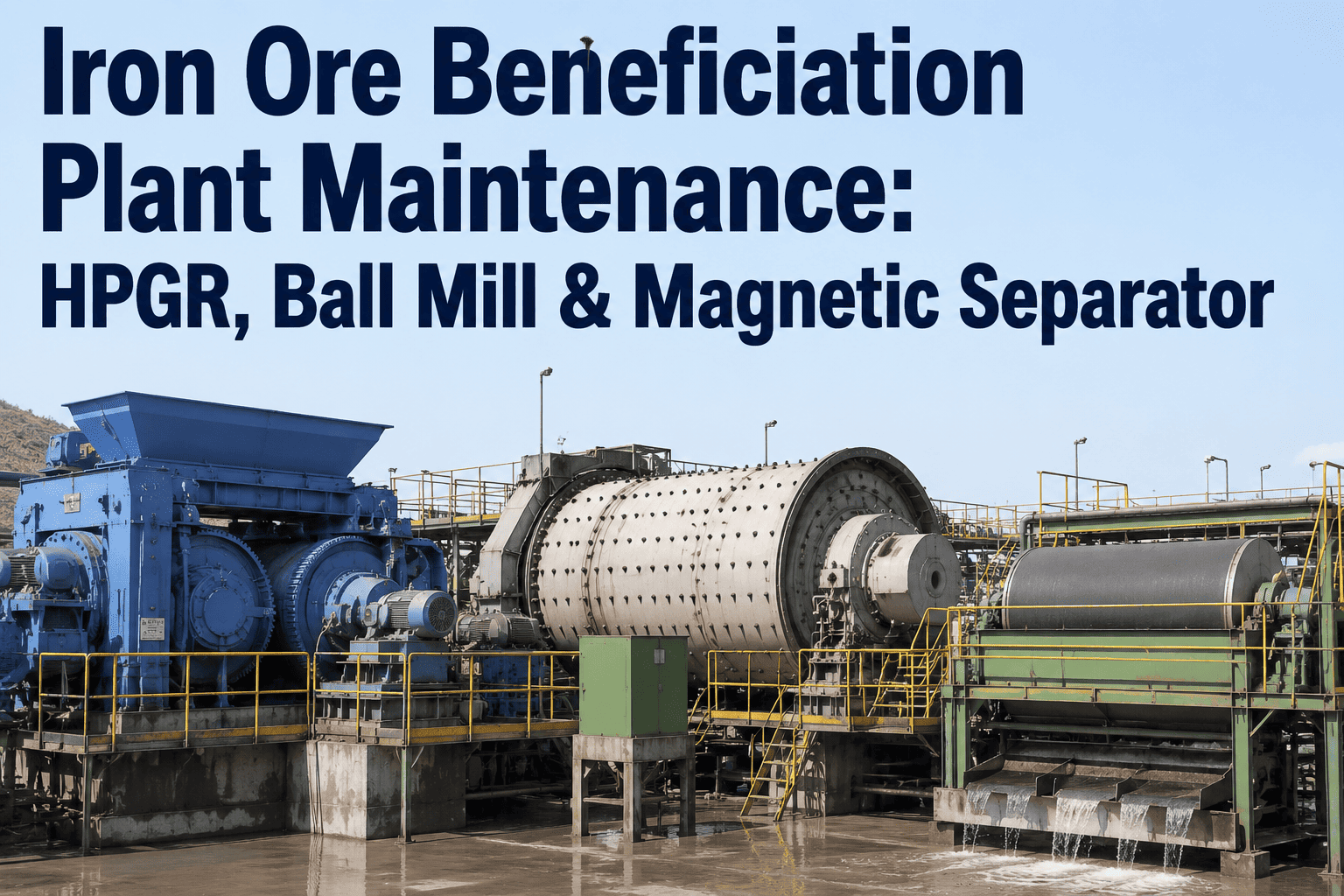
Beneficiation is where low-grade ore either becomes a saleable concentrate or a costly reject pile, and three machines carry almost all of that risk. A worn HPGR roll surface loses its grinding efficiency gradually, a ball mill liner past its wear limit changes grind size distribution, and a magnetic separator drum with a weak field lets valuable iron slip straight into the tailings. Sign up to see how Oxmaint tracks HPGR, ball mills and magnetic separators across your beneficiation plant in one place.
Concentrate Grade Is Decided Stage by Stage
A beneficiation circuit is a chain of stages, each one only as effective as the equipment condition feeding it. An HPGR producing an inconsistent particle size passes that inconsistency straight to the ball mill, which then struggles to hit its target grind size no matter how well the mill itself is running. That off-target grind then reaches the magnetic separator as feed the equipment was not tuned for, and separation efficiency drops even though the separator has no fault of its own. Tracking condition data stage by stage is what makes it possible to trace a grade drop back to its actual source.
Where Wear Actually Shows Up
Stud and tire wear on the roll surface reduces compression efficiency over time, gradually shifting the particle size distribution leaving the press even when hydraulic pressure looks normal.
Liner wear and grinding media consumption change mill filling and impact energy, altering grind size distribution well before a liner visibly needs replacement.
Magnet field strength decay and drum shell wear reduce separation efficiency gradually, letting recoverable iron slip into the tailings stream without any obvious mechanical fault.
Component Checks Across the Circuit
Oxmaint registers HPGR rolls, ball mill liners, trunnion bearings and magnetic separator drums as tracked assets with their own inspection history, so a concentrate grade drop can be traced back to the exact stage that caused it. Sign up for a free trial to see it against your own beneficiation plant, or book a demo and we will walk through your circuit.
Calendar-Based Servicing vs Condition-Based Maintenance
Grade drops usually caught only at concentrate assay, after the fact
Each machine serviced in isolation, without cross-stage context
A grade drop traced back to the specific stage and asset behind it
Servicing timed to actual wear, cutting both downtime and premature part changes
Oxmaint tracks HPGR rolls, ball mill liners, trunnion bearings, magnetic separator drums and slurry pumps as individual assets, logging inspection readings and wear trends against each one across the full circuit. A liner nearing its wear limit or a separator field reading below baseline triggers a work order early, before it ever shows up as a lower concentrate grade. Book a demo to see it mapped against your own beneficiation plant.
Frequently Asked Questions
Catch Grade Loss Before It Reaches the Concentrate Assay
Oxmaint gives beneficiation plant teams HPGR roll tracking, ball mill liner monitoring, magnetic separator condition checks and predictive maintenance across the entire circuit. Sign up for a free trial to explore it yourself, or book a demo and we will walk through it against your own plant.