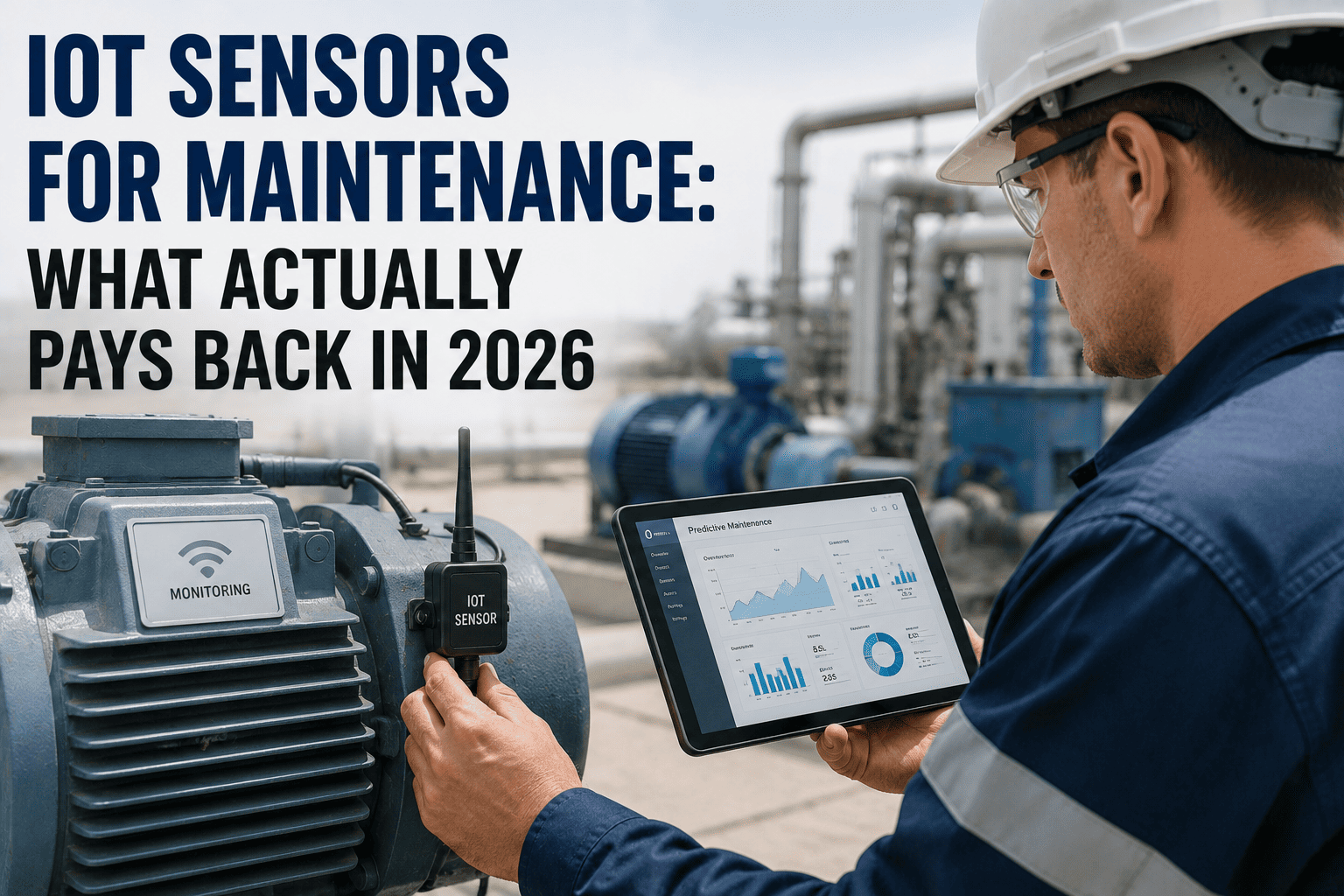
Every vendor stand at a maintenance conference in 2026 is selling a sensor that promises to predict failure before it happens. Most of them will work, technically. Whether they pay back is a different question, and it depends less on the sensor itself than on the connectivity choice underneath it, the failure mode it's actually watching for, and whether the plant has the gateway coverage to get the data out in the first place. This is the pragmatic version of that conversation — which sensor classes are paying back fastest right now, and which parts of the IoT stack still aren't quite there. A CMMS like OxMaint ingests data across protocols into one place, so the pilot's success doesn't depend on which vendor's sensor won the trial.
One Platform for Every Sensor Protocol on the Floor
Multi-protocol ingestion, sensor health monitoring, and per-asset alarm tuning — so your IoT pilot scales without becoming a different dashboard for every vendor.
The Connectivity Choice: What Actually Fits Your Plant
The sensor is rarely the bottleneck. Getting its data reliably off the plant floor is. Each connectivity option trades range, battery life, and data rate differently, and picking the wrong one is the single most common reason a pilot stalls before it scales.
| Connectivity | Range | Battery Life | Best Fit |
|---|---|---|---|
| LoRaWAN | Long — kilometres outdoors | 1–3 years typical | Large sites, low-frequency readings |
| NB-IoT / Cellular | Very long, carrier-dependent | Shorter than LoRaWAN | Remote assets without site infrastructure |
| Bluetooth Mesh | Short — building-scale | Months to a year | Dense sensor clusters, single building |
| Wired / Fieldbus | Unlimited, cable-dependent | N/A — powered | High-frequency, high-criticality assets |
Sensor Classes Ranked by Payback Speed
Vibration
Fastest payback class in 2026 — mature fault libraries and a large installed base mean alarms are reliable out of the box on rotating equipment.
Temperature
Cheap, simple, and effective on motors, bearings, and electrical connections — the easiest sensor class to justify on cost alone.
Ultrasonic Level & Leak
Strong payback on compressed air and tank level applications, though placement precision matters more than with vibration sensors.
Current & Power
Good for load monitoring and motor health, but slower payback since the fault signature is less mature than vibration analysis.
What's Not Ready Yet in 2026
Extreme Heat Still Hurts
Wireless sensor batteries in high-ambient-temperature environments still fall well short of vendor-quoted life. Budget for more frequent swaps in hot process areas.
Cabling Still Adds Up
Wired retrofits on older plant remain expensive relative to wireless, even where wired would otherwise be the more reliable long-term choice.
Needs Labelled Failure Data
Pure anomaly-detection models still struggle without a history of labelled failures to train against — rule-based alarms remain more reliable for most plants today.
From Pilot to Plant-Wide: The Rollout Path
Pick One Failure Mode
Choose a single, well-understood failure mode on a known asset group rather than trying to monitor everything at once.
Pilot on 10–20 Assets
A small, representative group is enough to prove connectivity, alarm accuracy, and workflow before committing to fleet-wide spend.
Validate Alarm Accuracy
Check false-positive and false-negative rates against real maintenance outcomes before trusting the alarm thresholds at scale.
Scale Gateway Coverage
Extend network coverage deliberately, asset group by asset group, rather than assuming pilot-area coverage extends site-wide.
The Numbers Worth Knowing Before You Commit
Most pilots don't fail because the sensor was wrong. They fail because the data had nowhere useful to go once it left the sensor. Sign up free to see multi-protocol sensor data landing in one alarm and work order system instead of a different app per vendor.
How OxMaint Supports a Multi-Vendor IoT Rollout
Multi-Protocol Ingestion
LoRaWAN, NB-IoT, Bluetooth mesh, and wired sensor data all land in the same asset record, regardless of vendor.
Sensor Health Monitoring
Battery level and signal strength are tracked per sensor, so a dying battery is flagged before it silently stops reporting.
Per-Asset Alarm Tuning
Alarm thresholds are set per asset type rather than a single generic band, reducing false positives as the pilot scales.
Pilot Dashboard for Reporting
Pilot results — alarm accuracy, coverage, and early savings — are packaged for reporting back to the business without manual rebuild.
Stop Juggling a Dashboard Per Sensor Vendor
Multi-protocol ingestion, sensor health tracking, and per-asset alarm tuning — built so your IoT pilot scales cleanly into a plant-wide programme.
Frequently Asked Questions
Should I choose LoRaWAN or NB-IoT for a large site?
LoRaWAN generally suits large sites with existing gateway infrastructure and lower data-rate needs, while NB-IoT fits remote or isolated assets without site network coverage, at the cost of shorter battery life and ongoing carrier fees.
Why do vibration sensors pay back faster than newer sensor classes?
Vibration analysis has decades of established fault frequency libraries and a large installed base of proven use cases, so alarm accuracy is more reliable from day one than in newer or less-mature sensor categories.
Is wireless always cheaper than wired sensors?
Not for every asset. Wireless avoids cabling cost upfront, but ongoing battery replacement and gateway maintenance add cost over time. For the highest-criticality assets, wired can still work out more cost-effective over a multi-year horizon.
How many assets should an initial IoT pilot cover?
A pilot of roughly 10 to 20 representative assets is generally enough to validate connectivity, alarm accuracy, and workflow before scaling, without committing significant budget upfront.
Can AI anomaly detection replace rule-based alarms yet?
Not reliably in most plants as of 2026. AI anomaly detection performs best where a history of labelled failures exists to train against; without that history, rule-based thresholds remain the more dependable starting point.