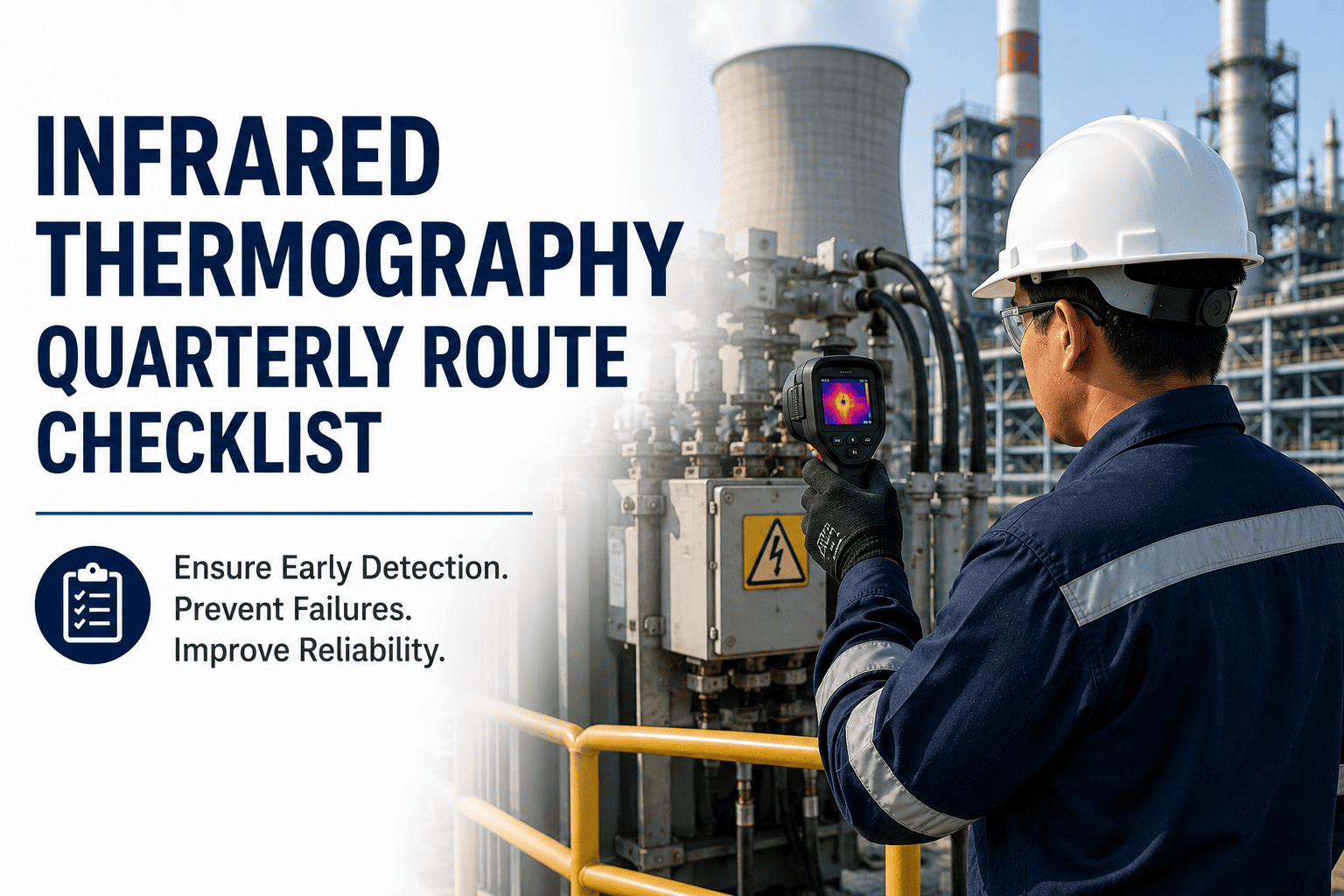
A loose connection inside a switchgear cabinet gives almost no warning before it arcs — except heat. Long before the fault shows on any other reading, the joint runs hotter than its neighbours, and a thermal camera catches it in seconds. A quarterly IR route across switchgear, MCCs, motors, and transformer bushings is one of the highest-value inspections a station runs, precisely because it's non-contact and takes the system down zero times to perform.
Why Delta-T, Not Absolute Temperature
A connection running at 60°C isn't automatically a problem — a connection running 25°C hotter than an identical one right next to it, carrying the same load, is. Every thermography reading should be compared against a matched reference point, not a fixed number.
Where The Camera Goes On A Standard Route
Each asset class has its own hot spots worth checking every quarter.
Switchgear
Bus bar joints, breaker contacts, and cable lugs behind the IR-viewing window.
MCCs
Starter contactors, overload relays, and incoming feeder terminations per bucket.
Motors
Terminal box connections and frame temperature compared against bearing readings.
Transformer Bushings
Bushing caps and connector points, checked across all three phases for imbalance.
Classifying The Temperature Rise
| Severity |
Delta-T vs Reference |
Action |
| Normal |
Under 5°C |
No action, continue routine monitoring |
| Minor |
5°C – 20°C |
Log and re-check at next scheduled route |
| Serious |
20°C – 40°C |
Schedule repair within days, not months |
| Critical |
Above 40°C |
De-energise and repair immediately |
Getting A Reading You Can Trust
Load Matters
Scan under at least 40% load — a lightly loaded circuit hides real hot spots.
Emissivity
Set correctly for the surface, or a reflective panel will report a false-low reading.
Same Angle, Every Time
Shooting from a different distance or angle each quarter breaks the trend comparison.
A folder of unlabeled thermal images is hard to trend three quarters later. Teams that sign up for Oxmaint attach every thermal image directly to the asset record, with delta-T logged against the last route and Serious or Critical findings pushed straight into a work order — or book a demo to see a live thermography route on the platform.
Q
Is quarterly frequent enough for switchgear thermography?
For most balance-of-plant switchgear, yes. Any panel showing a Serious or Critical finding should move to a monthly re-check until the repair is confirmed and the delta-T returns to normal.
Q
Can the route be done through closed switchgear doors?
Only if the cabinet has an IR-transparent viewing window fitted. Without one, the panel has to be opened under a live-work permit, which is exactly why most stations retrofit windows on critical gear first.
Q
Who needs to see a Critical finding right away?
The electrical maintenance lead and shift control room, at minimum — a Critical delta-T is close to a fire and arc-flash risk, not something that waits for the next planning meeting.
Catch The Hot Spot Before It Becomes A Fault
Every switchgear, MCC, motor, and bushing scan logged with delta-T against the last route, and Serious or Critical findings turned into work orders instantly. Sign up for a free trial to set up your first thermography route, or book a demo to see the trend dashboard live.