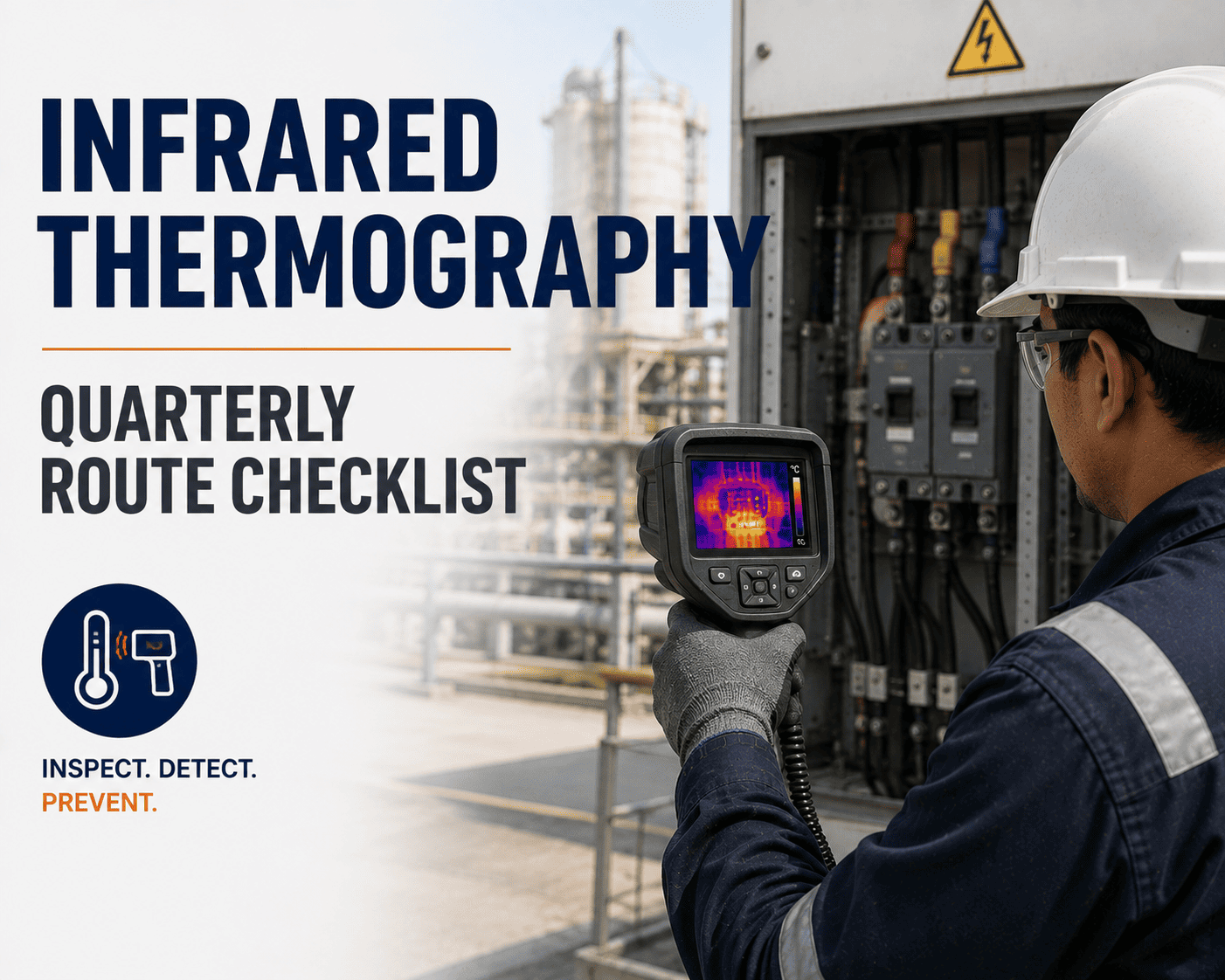
An overheating connection doesn't trip a breaker until it's already failing. A bearing losing lubrication doesn't seize on the first day it runs dry. A kiln shell doesn't show a hot spot until the refractory behind it has already thinned. Infrared thermography is what catches all three while they're still a temperature difference on a screen, not a shutdown. Sign up to log every quarterly scan against its Delta T threshold, and turn a rising hot spot into a scheduled repair instead of an emergency.
Why It Matters
Refractory failure remains the leading cause of unplanned kiln stops, and most of those failures show a detectable precursor at the previous inspection. The same physics applies to electrical connections and rotating equipment, a measurable temperature difference almost always appears before the actual failure does.
Three Routes, One Scan Each Quarter
Electrical
Switchgear, MCC panels, terminations, and busbar connections scanned under normal load, since a loose connection generates heat only while current is flowing through it.
Mechanical
Motor bearings, gearbox casings, and coupling guards scanned to catch lubrication loss or developing misalignment before it reaches vibration failure thresholds.
Refractory
Kiln shell and cooler wall scanned for hot spots that reveal thinning brick lining from the outside, since the inside can never be inspected directly while running.
Running The Quarterly Scan
Confirm normal operating load before scanning: electrical and mechanical anomalies often only appear once equipment is under real current or torque, not at idle
Set the correct reference for Delta T: compare against ambient air, an identical component under the same load, or the component's rated maximum, depending on what's being scanned
Capture and label every exception found: image, location, Delta T value, and load condition logged together so the finding can be re-verified next quarter
Classify severity and route accordingly: a minor rise gets scheduled into the next planned outage, a severe exception gets escalated for immediate correction
Re-scan corrected points at the next route: confirming a repair actually resolved the temperature difference closes the loop on the finding
Every Scan, Every Zone, One Record
Oxmaint logs every electrical, mechanical, and refractory scan against its Delta T threshold, tracks each exception through repair and re-verification, and keeps a full thermal history for every asset. Sign up for a free trial to run it on your own thermography route, or book a demo to see it configured for your plant.
Why The Reference Point Changes The Story
The same 20°C reading means something completely different depending on what it's being compared against. A breaker terminal reading 20°C above ambient air might be within normal limits at full load, while the identical terminal reading 20°C above a matching phase on the same panel is a clear sign of developing resistance and should be treated as urgent. A kiln shell hot spot has no useful ambient comparison at all, since the whole shell runs hot by design, so it's read against the plant's own baseline scan for that section instead. Picking the wrong reference is the most common reason a genuine finding gets waved off as normal, or a normal reading gets escalated as an emergency.
Delta T Severity Reference
| Severity |
General Guidance |
Recommended Action |
| Minor |
Small rise above reference, within advisory range |
Note and monitor at the next quarterly scan |
| Serious |
Clear rise indicating an active developing fault |
Schedule correction at next planned outage |
| Critical |
Severe rise, component failure considered imminent |
Stop and correct immediately, notify responsible party |
Frequently Asked Questions
Q
Why does the scan need to happen under load?
A loose electrical connection or a bearing losing lubrication generates a detectable temperature rise only once current or friction is actually present. Scanning equipment at idle or during a shutdown can miss the exact fault the route was designed to catch.
Q
Can thermography see inside a kiln's refractory lining?
No, the interior can't be scanned directly while the kiln is running. Thermography reads the outer shell temperature, and a hot spot on that surface is what reveals thinning refractory behind it, which is why the outer scan is the only practical early-warning method available while the kiln is in operation.
Q
What's the most common mistake on a thermography route?
Comparing a reading against the wrong reference point is the most frequent error, since the same absolute temperature can be perfectly normal or seriously abnormal depending on whether it's judged against ambient air, a matching phase, or the component's own rated limit.
Turn Every Hot Spot Into A Scheduled Fix, Not A Shutdown
Oxmaint keeps every electrical, mechanical, and refractory scan tied to its Delta T history, classifies severity automatically, and routes critical findings straight to a work order. Sign up for a free trial to run it on your own thermography route, or book a demo to see it configured for your plant.