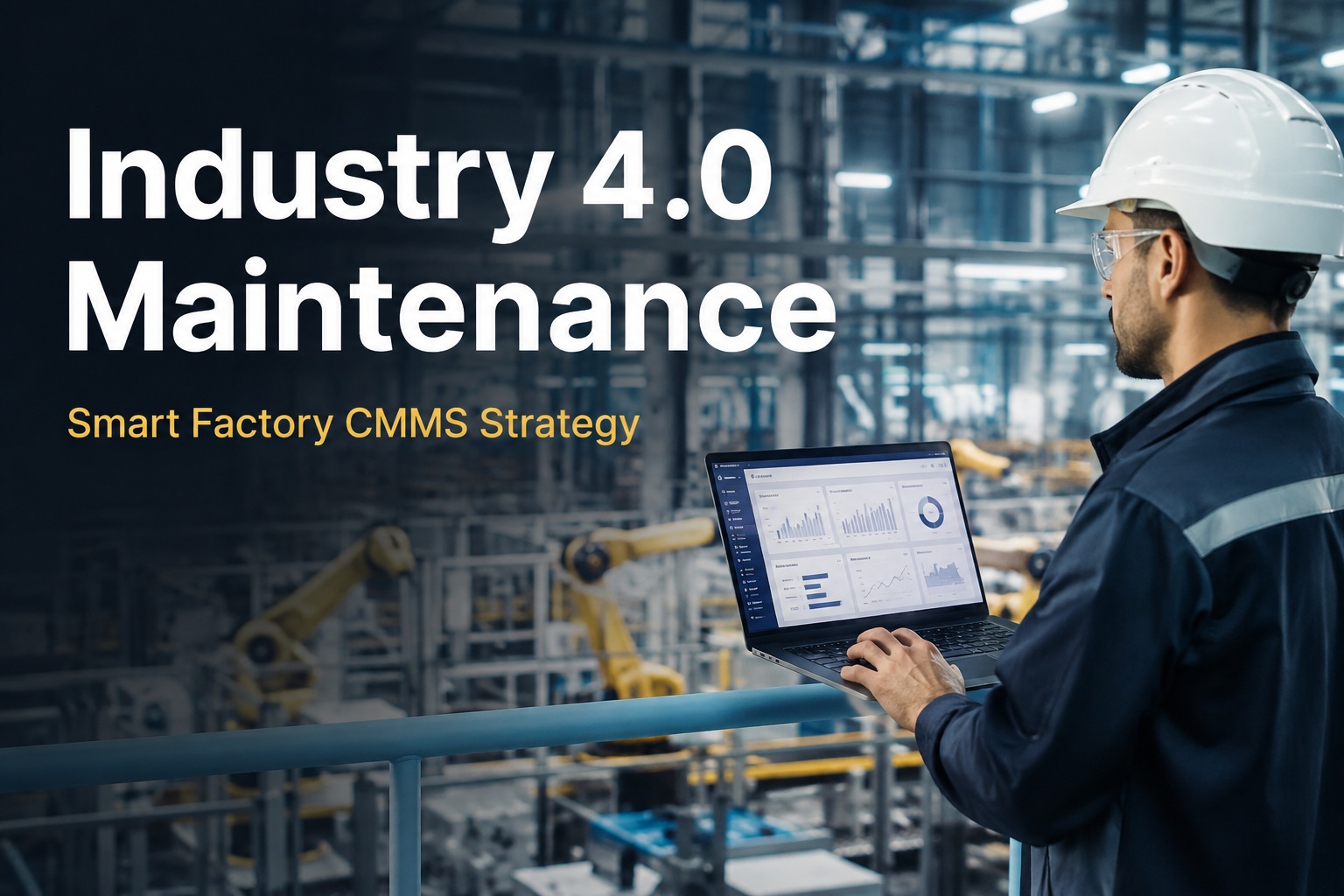
Industry 4.0 in UK maintenance has spent a decade being oversold. Vendor keynotes promise autonomous factories; the actual factory floor still runs on breakdowns and spreadsheets. The gap between promise and reality isn't technology — sensors, connectivity and analytics all work. The gap is strategy: which assets to instrument first, what data to actually act on, and how to fit it to a CMMS that people use every day. Plants making Industry 4.0 pay build layered smart-maintenance stacks with clear ROI at every rung. Book a demo to see the smart maintenance stack in action.
◆ SMART MAINTENANCE · IIoT · CONDITION MONITORING · CMMS INTEGRATION
Industry 4.0 delivers when it's layered — not when it's launched. Every layer earns its cost before the next unlocks.
Every connected asset, every sensor stream, every predictive alert, every automated work order — stacked into one operational spine.
SMART MAINTENANCE STACK · WHERE EACH LAYER PAYS BACK
05
Autonomous Optimisation
AI-driven asset lifecycle · Self-tuning cycles
FUTURE
04
Predictive Analytics
ML models · Anomaly detection · Failure forecast
YEAR 2
03
Condition Monitoring
Vibration · Temperature · Oil analysis · Trend triggers
YEAR 1
02
Connected Assets
IIoT gateways · Machine data · Real-time status
MONTHS 3-6
01
CMMS Foundation
Asset register · PPM · Mobile work orders · KPIs
MONTH 1
73%
UK I4.0 pilots stall before Layer 3 · Reason: no CMMS spine
4-6×
ROI multiple when stack layers are built in order
18mo
Typical CMMS → predictive path when disciplined
The Real Problem — Data Islands Without a Spine
Walk into most UK plants attempting Industry 4.0 and you'll find the same pattern: three separate condition monitoring pilots, a BMS collecting data no one reads, an OEE dashboard on a screen no one looks at, and a CMMS running independently of all of them. Each system works. None of them connect. Nothing acts on the data. The transformation isn't installing more sensors — it's giving all that data a single operational spine that generates work. Sign up free to connect your data islands into a working spine.
SENSOR → CMMS → ACTION
Data Flow Architecture · The Only Way I4.0 Actually Pays
DATA SOURCES
Vibration sensors
Thermal imaging
Oil analysis
Machine PLC data
BMS telemetry
Operator inspection
→
CMMS SPINE
Asset register
Threshold rules
Alert classification
Auto-triage logic
Failure library
Work order engine
→
DECISIONS & WORK
Alerts to engineer
Auto work orders
Mobile execution
Root cause capture
Reliability trend
Continuous learning
The Hype-vs-Value Curve — Which Technologies Actually Pay Back
Not every Industry 4.0 technology has the same maturity or the same payback. The horizontal axis below plots UK adoption maturity; the vertical axis plots realistic 3-year value delivery for a mid-size plant. The technologies clustered top-right are where discipline earns money. The ones bottom-right are still expensive demonstrations. Book a demo to see which technologies fit your plant's stack today.
TECHNOLOGY MATURITY vs VALUE
Where to Invest Now · Where to Wait
VALUE DELIVERED →
EMERGING · HIGH VALUE
Digital twins · AR-guided repair · Autonomous inspection
Watch closely · Pilot select assets
MATURE · HIGH VALUE
Vibration monitoring · Mobile CMMS · Predictive analytics · IIoT gateways
INVEST NOW
EMERGING · LOW VALUE
Blockchain maintenance · VR training at scale · Cobot maintenance
Skip for now
MATURE · LOW VALUE
Legacy SCADA-only reporting · Standalone dashboards
Modernise or replace
MATURITY →
The Adoption Sequence — What to Build When
Every plant that has delivered Industry 4.0 successfully has followed roughly the same sequence — starting with the CMMS foundation and adding data-connected layers as the discipline to act on them develops. Skipping stages doesn't accelerate the outcome; it just guarantees stalled pilots and wasted investment.
MONTHS 0-3
Phase 1 · Foundation
CMMS live · Asset register complete · Mobile work orders on the floor · PPM cycles running · Baseline KPIs captured · The spine is in place before anything connects to it
Break-even
MONTHS 3-9
Phase 2 · Connect
Machine PLC data ingested · BMS telemetry linked · IIoT gateways on 20-30 critical assets · Real-time asset status visible · Machine data drives operator inspection prompts
2-3× ROI
MONTHS 9-18
Phase 3 · Monitor & Trigger
Vibration and temperature sensors on critical rotating equipment · Threshold-based auto work order generation · Alert classification against failure library · The point where predictive discipline starts paying
4-5× ROI
MONTHS 18-30
Phase 4 · Predict
ML anomaly detection on top of trend data · Failure-mode forecasting · Root-cause analytics · Reliability engineering becomes data-driven rather than reactive
5-7× ROI
MONTHS 30+
Phase 5 · Optimise
Full digital twin models on critical assets · AR-supported repair · Autonomous inspection routines · Continuous optimisation loop closed at plant level
Compounding
◆ INDUSTRY 4.0 TRANSFORMATION CALL
See a Layered Smart Maintenance Stack Live
Foundation CMMS, IIoT integration architecture, condition monitoring workflow, predictive alert routing and phase-by-phase adoption sequence tuned to your plant's actual starting maturity.
Where Pilots Actually Stall — And How to Avoid It
The industry data on Industry 4.0 pilots is grim: roughly seven in ten stall before reaching production. The failure modes are predictable, and they all trace back to a common root — technology got installed without an operational spine to act on its output. Understanding the failure patterns is how new pilots avoid them. Sign up free to build your smart maintenance stack on a real CMMS foundation.
STALL MODE 01
Data With No Action Path
Sensors installed, dashboards built, alerts firing — but no workflow to turn any of it into scheduled work. The information exists; nothing happens with it. Fix: build the CMMS action path before the data source.
STALL MODE 02
Pilot Trap · Never Scales
Vibration monitoring on three test assets works perfectly. Scaling to the plant needs data engineers, IT change control, sensor procurement at scale — and quietly stops. Fix: pick an architecture at Day 1 that scales without re-platforming.
STALL MODE 03
Alert Fatigue
Sensor thresholds too tight. Engineers get 40 alerts a day, ignore 38, miss the two that matter. The system generates noise faster than it generates action. Fix: nuisance filtering and severity classification structural from launch.
STALL MODE 04
Silo Vendor Lock-in
Each condition monitoring vendor has its own portal, its own alerts, its own data format. The maintenance team has to check three separate systems and reconcile data manually. Fix: CMMS as the single ingestion point regardless of upstream vendor.
Expert Perspective — Why the CMMS Layer Is the Whole Story
"
Every senior maintenance engineer who's watched Industry 4.0 for the last decade has arrived at the same conclusion. The technology works — vibration sensors detect bearing failures weeks ahead, ML models predict pump degradation, digital twins simulate asset behaviour accurately. That was never the constraint. The constraint has always been that raw data doesn't create value; scheduled maintenance work does. And scheduled maintenance work needs a CMMS to hold it, route it, close it and analyse it. What that means in practice is that Industry 4.0 investment fails or succeeds based almost entirely on whether the CMMS spine is strong enough to convert sensor output into structured work. Plants that started their I4.0 journey by upgrading the CMMS foundation before installing sensors are the ones now reporting real ROI. Plants that started with sensor pilots and figured they'd sort out the workflow later are the ones with expensive stalled projects and consultants writing recovery plans. The whole strategic question in this sector reduces to that one architectural choice — data first, or spine first. The evidence has been clear for years: spine first, every time.
— UK Smart Maintenance & Reliability Engineering Practice
01
Spine before sensors
CMMS foundation with mobile work orders and PPM discipline must be live before any sensor investment.
02
Layered adoption
Each stack layer earns its ROI before the next unlocks · No leapfrogging past connected assets to predictive.
03
Vendor-neutral ingestion
CMMS holds the failure library and routing logic · Sensor vendors interchangeable underneath.
04
Alert discipline
Severity classification and nuisance filtering built into workflow · Alert fatigue kills adoption faster than tech ever did.
Who Uses Oxmaint for UK Industry 4.0 Adoption
The platform is used by the UK roles building smart maintenance stacks day-to-day: engineering and reliability directors leading digital transformation programmes, plant managers responsible for OEE improvement across multi-site operations, continuous improvement leaders integrating Lean and Industry 4.0, IT and OT convergence architects designing the maintenance data layer, condition monitoring specialists needing a CMMS to route their alerts, digital transformation programme directors coordinating cross-functional adoption, and CFOs requiring measurable ROI evidence for further Industry 4.0 investment approval.
Getting Your Industry 4.0 Stack Live in Structured Phases
Deployment follows the layered stack. Phase 1 delivers CMMS foundation with mobile execution and baseline KPIs in 30-60 days. Phase 2 adds connected asset integration (PLC, BMS, SCADA data) over months 3-9 with API-based ingestion. Phase 3 rolls out condition monitoring on critical rotating equipment with threshold-based auto work order generation. Phase 4 layers ML analytics for anomaly detection and failure forecasting. Phase 5 unlocks digital twin and autonomous inspection where scale justifies. Every phase produces its own measurable ROI before the next investment approves — turning transformation from a bet into a series of proven steps. Sign up free to start with the foundation phase.
◆ LAYERED. INTEGRATED. MEASURABLE.
Build the Stack. Skip the Stalled Pilot.
Oxmaint gives UK operators the complete smart maintenance foundation — CMMS spine, IIoT integration, condition monitoring workflow, predictive analytics routing and structured phase-by-phase adoption with measurable ROI at every layer.
Frequently Asked Questions
What does an Industry 4.0 maintenance strategy actually involve?
A working Industry 4.0 maintenance strategy is a layered stack, not a single technology. Layer 1 is the CMMS foundation — asset register, PPM cycles, mobile work orders, KPI baselines. Layer 2 connects the assets — PLC data, BMS telemetry, IIoT gateways delivering real-time status. Layer 3 adds condition monitoring — vibration, temperature and oil sensors on critical rotating equipment feeding threshold-based auto work order generation. Layer 4 applies predictive analytics — ML anomaly detection and failure forecasting on top of the trend data. Layer 5 introduces digital twin, AR-guided repair and autonomous inspection where scale justifies it. Each layer must earn its ROI before the next unlocks investment — that's why the disciplined sequence delivers measurable value while sensor-first pilot projects predictably stall.
Why do so many Industry 4.0 pilots stall in UK plants?
Industry surveys consistently show around seven in ten UK Industry 4.0 pilots fail to scale into production. The failure modes are structural, not technical. First, data with no action path — sensors installed, dashboards built, but no workflow to convert alerts into scheduled work. Second, pilot trap — a working demo on three test assets that can't scale without re-platforming. Third, alert fatigue — thresholds too tight, engineers get flooded with noise, real signals get lost. Fourth, silo vendor lock-in — each condition monitoring vendor has its own portal and format, and the maintenance team can't reconcile them. All four trace back to the same architectural mistake: installing data sources before building the CMMS spine that would turn their output into structured work. Spine-first architecture solves all four.
Do we need condition monitoring sensors on every asset?
No — and trying to is one of the classic ways to stall an Industry 4.0 programme. Condition monitoring investment concentrates on high-criticality rotating equipment where failure is expensive and where vibration, temperature or oil analysis provide meaningful early warning: main drive motors, critical pumps, gearboxes, compressors, fans. Typically 20-30 percent of assets in a plant carry 80 percent of the reliability risk, and that's where the sensor investment goes. The remaining assets stay on calendar or cycle-based PPM with operator inspection prompts feeding back into the CMMS. This concentration is what makes the economics work — sensor investment is targeted where it pays back quickly, rather than spread thinly across a plant-wide rollout that never delivers measurable ROI on any individual asset.
How does the CMMS integrate with existing sensors and BMS?
Modern smart-maintenance CMMS platforms integrate through API-based ingestion with the major industrial data sources — PLC exports (Rockwell, Siemens, Mitsubishi), BMS platforms (Trend, JCI, Siemens Desigo), condition monitoring vendors (SKF, Emerson, Bently Nevada, Bosch) and IIoT gateway providers. Data ingests per asset with severity classification, threshold rules and nuisance filtering configured at the CMMS layer rather than the sensor layer. This vendor-neutral architecture means condition monitoring vendors are interchangeable underneath the CMMS spine — a pump manufacturer switching from one sensor supplier to another doesn't disrupt the maintenance workflow, because the spine holds the failure library and routing logic independently of any particular data source.
How long before we see measurable ROI from Industry 4.0 investment?
The layered stack delivers ROI at every phase rather than requiring a big-bang wait. Phase 1 (CMMS foundation) reaches break-even within 6-12 months from PPM compliance and reactive-work reduction alone. Phase 2 (connected assets) delivers 2-3× ROI over months 3-9 through better asset visibility and reduced unplanned downtime. Phase 3 (condition monitoring) delivers 4-5× ROI from months 9-18 as predictive alerts prevent critical failures. Phase 4 (predictive analytics) compounds the returns further from months 18-30. This phased ROI pattern is the strategic advantage of layered adoption — every investment tranche justifies the next based on measured outcomes, not projections. Sensor-first pilot approaches typically show negative ROI at 18 months because the workflow to act on the data was never built.