A boiler running past its Written Scheme of Examination date is not a paperwork oversight — it is a Pressure Systems Safety Regulations 2000 violation that can void insurance cover and put a plant manager personally in front of the Health and Safety Executive. For most FMCG plants, the boiler and steam system rarely fails suddenly; it drifts. Scale builds quietly on tube surfaces, a burner slips out of tune degree by degree, and a failed steam trap leaks steam for weeks before anyone notices the fuel bill. This guide breaks down exactly what UK FMCG plants need to maintain across tube cleaning, burner combustion, and water treatment — and which records an HSE inspector or insurer will ask to see first. If your boiler maintenance still lives on a clipboard in the plant room, start a free trial with OxMaint to see what an audit-ready boiler maintenance record actually looks like.
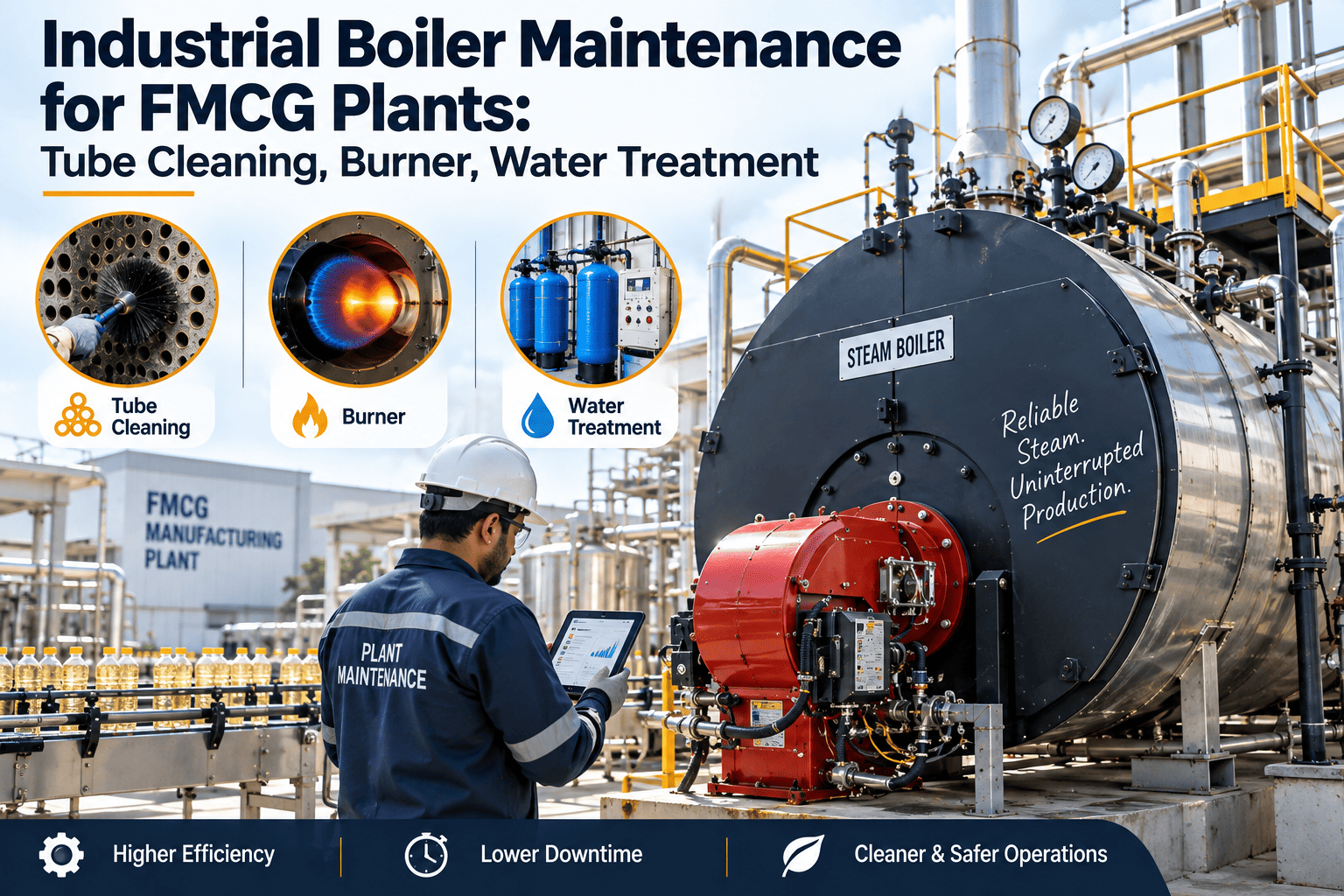
Industrial Boiler Maintenance for FMCG Plants: Tube Cleaning, Burner, Water Treatment
The maintenance programme that keeps steam flowing, keeps PSSR inspectors satisfied, and keeps a scaled tube or a failed trap from turning into a six-figure unplanned outage across a UK FMCG production line.
The Four Systems That Decide Whether Your Boiler Runs or Shuts You Down
A boiler is not one machine to maintain — it is four interdependent systems, each capable of causing an unplanned shutdown on its own, and each with its own failure signature technicians can learn to read. Plants that treat them as a single "boiler maintenance" task on a monthly checklist tend to miss the early warning signs each system gives long before it fails, often for months at a time.
Scale forms invisibly inside boiler tubes, and each millimetre steals measurable fuel efficiency long before it shows up as a visible problem on the shift log. An annual shutdown inspection with tube thickness testing catches wastage before a tube fails under operating pressure, and before an emergency repair takes the whole line offline.
An out-of-tune burner burns fuel it does not need to, and can push a plant outside its emissions consent without anyone noticing week to week until a regulator does. Flame appearance checks, O2 and CO readings, and quarterly tuning keep combustion inside its designed range all year round.
Feedwater hardness, condensate conductivity, and dissolved oxygen are the variables that decide whether scale and corrosion happen at all, regardless of how carefully the rest of the boiler is maintained. Skipping the daily water test does not skip the consequence — it only delays it until the annual inspection finds it.
A failed-open trap can leak steam continuously for months before it shows up anywhere except the fuel bill, quietly draining thermal energy the plant already paid to generate. A systematic survey finds the failure in the maintenance log, on a technician's route, instead of buried inside a quarterly energy invoice.
Treated separately, each of these four systems generates its own paperwork, its own schedule, and its own blind spots. Treated as one connected maintenance programme, a single missed water treatment reading, a burner that has drifted out of tune, and a steam trap that has gone quiet all become visible on the same dashboard before any of them turns into a shutdown.
Boiler Maintenance Isn't Optional Under UK Law
Under the Pressure Systems Safety Regulations 2000, every boiler and steam system in a UK FMCG plant must operate under a Written Scheme of Examination, be inspected at the intervals it specifies by a competent person, and have those examination records retained for the life of the vessel. Most systems require examination every twelve months, though the interval depends on the vessel's design, age, and documented operating history — and the duty holder carries personal responsibility if that schedule slips. The breakdown below shows how that statutory obligation translates into the daily, weekly, monthly, and annual tasks a plant actually has to complete on the floor.
- Gauge, water level, and steam pressure readings logged at shift start and mid-shift
- Blowdown carried out on a fixed schedule to control dissolved solids concentration
- Burner flame appearance checked through the sight glass for colour and stability
- Low-water cutoff function tested to confirm the boiler shuts down safely
- Safety valve visual condition checked for corrosion, leaks, or tampering
- Steam traps spot-checked along the main distribution run for obvious failures
- Full water treatment chemistry analysis recorded against target ranges
- Combustion analysis completed — O2, CO, CO2, and flue temperature at each firing rate
- Log review and week-over-week trend comparison to catch slow drift early
- PSSR thorough examination completed by a competent person, certificate retained
- Safety valve bench test carried out at the stamped set pressure
- Tube thickness testing and a full steam trap survey during the shutdown window
Where FMCG Boiler Downtime Typically Starts
Across FMCG boiler rooms, unplanned downtime rarely comes from a single dramatic failure. It usually traces back to one of four recurring gaps, and the split between them tends to follow a consistent pattern plant after plant, which is exactly why a maintenance programme built around all four catches most problems long before they reach the production line.
Every one of these four causes is visible in routine readings well before it becomes a shutdown — the gap is almost always in whether those readings get taken, logged, and reviewed consistently, shift after shift, rather than in a lack of the right instrumentation on site.
OxMaint turns your steam trap survey into a mobile checklist your technicians actually complete — flagging failed-open and failed-closed traps before they show up as a fuel bill spike or a waterlogged production line no one can explain.
What HSE Inspectors and Insurers Actually Ask to See
A PSSR inspection or an insurance survey rarely starts with a walk around the boiler house. It starts with a request for records — and the speed and completeness of that response often shapes how the rest of the visit goes, sometimes more than the physical condition of the equipment itself. The six categories below cover almost every document a UK inspector or engineering surveyor is likely to ask for during a routine or unannounced visit.
The current WSE and the most recent thorough examination certificate from a competent person, on file and matched to the correct vessel identification and serial number.
Bench test results at the stamped set pressure for every safety valve, with reseating confirmed and any weeping or leaking documented, resolved, and re-tested before sign-off.
Feedwater hardness, condensate conductivity and pH, and deaerator dissolved oxygen readings, tracked over time rather than as a single pass or fail snapshot taken once a month.
O2, CO, and flue temperature readings across firing rates, trended against baseline to show whether burner performance is holding steady or slowly drifting off tune.
Each trap classified as good, leaking, plugged, or blown open, with the date tested and the corrective work order linked wherever a trap has failed.
Wall thickness readings at corrosion-prone locations from the annual shutdown, with any tube below minimum thickness flagged for repair before the boiler returns to service.
How OxMaint Builds Boiler Compliance Automatically
None of the records above need to be assembled manually the week before an inspection. Built correctly, they are a byproduct of the maintenance work a technician was going to do anyway.
Inspection deadlines and re-test intervals pulled straight from your Written Scheme of Examination auto-populate the compliance calendar, so a statutory inspection date never quietly passes unnoticed on someone's personal calendar instead of the plant's own.
Technicians enter hardness, conductivity, and combustion readings on a phone at the boiler itself, timestamped automatically and trended against baseline without a separate spreadsheet or a second round of manual data entry back at a desk.
Each trap gets its own tag and history. A failed trap logged during a survey generates a corrective work order automatically instead of sitting on a paper list until next quarter's rounds, by which point the steam loss has already added up.
Every certificate, water treatment log, combustion trend, and steam trap survey result exports as one complete package the moment an HSE inspector or insurer asks for it, rather than being pieced together from three different systems under time pressure.
The plants that struggle most at inspection time are rarely the ones with the worst-maintained boilers — they are the ones whose good maintenance work never made it into a record anyone could find quickly. Fixing that gap is usually a bigger win than any single mechanical repair.
Industrial Boiler Maintenance — What UK FMCG Plants Ask Most
What is a Written Scheme of Examination and does our plant need one? +
How often does PSSR require a boiler to be inspected? +
What's the fastest way to know if a steam trap has failed? +
Can water treatment testing really be logged on a phone instead of a lab sheet? +
What happens if an inspector asks for records the plant can't produce quickly? +
OxMaint keeps every water treatment log, combustion trend, steam trap survey, and statutory certificate ready in one place — so the next time an inspector or insurer asks for records, the answer is a two-minute export instead of a week of searching through binders, spreadsheets, and someone's memory of last year's shutdown.