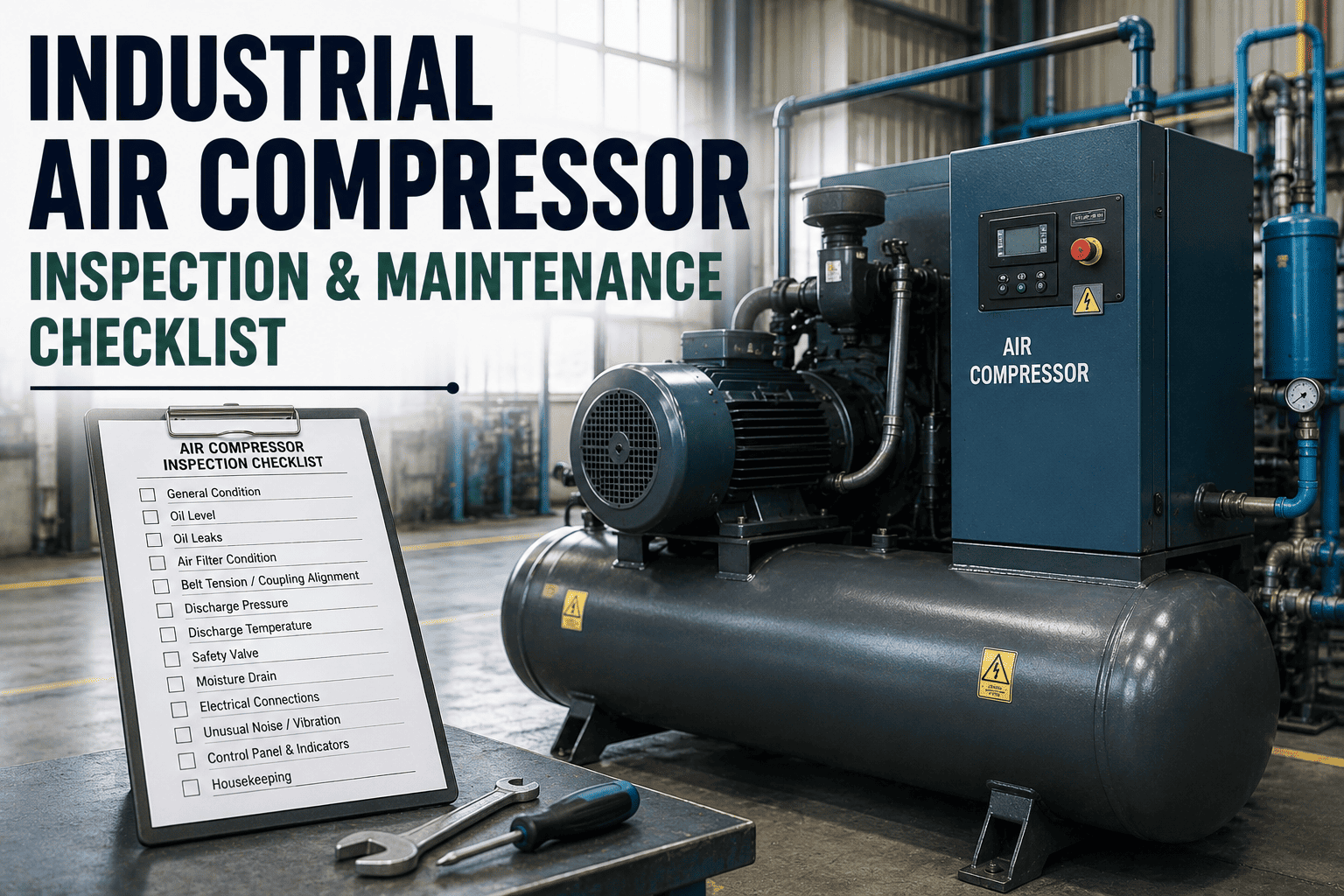
Compressed air is often called the fourth utility in a steel plant, powering pneumatic tools, actuators, and control systems across the floor, and it's also one of the easiest systems to neglect. A slowly rising dew point, a clogged filter, or a hissing fitting rarely trips an alarm, it just quietly drives up energy cost and lets moisture into equipment that was never designed to handle it. A consistent inspection checklist is what catches that before it shows up on the utility bill or the production line. Sign up to log every compressor reading against its asset and get flagged the moment dew point or differential pressure drifts out of range.
Why It Matters
Studies cited by the U.S. Department of Energy estimate up to 30% of compressed air produced in an industrial plant is lost to leaks and inefficiency. For a mid-sized facility, that can mean tens of thousands of dollars a year quite literally leaking out through fittings nobody's checked lately.
Six Readings Every Inspection Depends On
Discharge Pressure
Checked against specification, a drop signals leaks or a struggling compressor
Discharge Temperature
Monitored to confirm the cooling system is keeping up with load
Dew Point
Roughly 3-7°C for refrigerated dryers, rising values mean drying capacity is failing
Filter Differential
Pressure drop across each filter, rising drop means it's time to change the element
Condensate Drains
Tested to open, discharge, and close cleanly, a failed drain wastes air or floods the system
Lubrication
Oil level and condition checked, low or degraded oil accelerates wear fast
The Routine Inspection Checklist
Pressure and temperature logged: discharge pressure and temperature recorded and compared against normal operating range
Dew point measured: checked at the dryer outlet with a hygrometer, not assumed from the dryer's control panel alone
Filter pressure drop checked: differential pressure gauge read on each filter housing, element changed once it exceeds the permissible limit
Condensate drains tested: each automatic drain manually triggered to confirm it opens, discharges, and closes without leaking
Oil level and condition verified: topped off as needed and checked for discoloration that signals contamination or breakdown
Leak survey conducted: fittings, hoses, and quick-connects checked with an ultrasonic detector or soap test, findings logged by location
Stop Losing Compressed Air To Untracked Leaks
OxMaint logs pressure, dew point, and filter differential readings against every compressor and dryer, tracks recurring leak zones, and fires a work order the moment a reading drifts out of range. Sign up for a free trial to run it on your own compressed air system, or book a demo to see it configured for your plant.
Component, What To Check & Inspection Frequency
| Component |
What To Check |
Frequency |
| Compressor Unit |
Discharge pressure, temperature, oil level, unusual noise |
Daily |
| Air Dryer |
Dew point, differential pressure, condensate drain cycling |
Daily to weekly |
| Filters |
Pressure drop across each element, contamination |
Weekly, replace per differential threshold |
| Distribution System |
Leaks at fittings, hoses, valves, quick-connects |
Quarterly leak survey, sooner on flagged zones |
The Takeaway
A compressed air system rarely fails loudly, it just gets quietly less efficient, one rising dew point, one clogged filter, one unfixed leak at a time. Run the same checklist on the same schedule and that drift shows up as a number you can act on, not a bill you can't explain.
Frequently Asked Questions
Q
Why does dew point matter so much for compressed air?
A rising dew point means the dryer isn't removing enough moisture, and that water travels downstream into pipework, valves, and pneumatic tools. Left unchecked it causes corrosion in the distribution system and can ruin product quality on any process where compressed air contacts the material directly.
Q
What does a rising filter differential pressure actually mean?
It means the filter element is loading up with contaminant and restricting airflow, which forces the compressor to work harder and wastes energy. Once the pressure drop crosses the manufacturer's permissible limit, the element needs replacing, running it further just costs more to produce the same usable air.
Q
How much does a small leak actually cost over time?
More than most people expect. A single condensate drain stuck open on a 100 psi system can waste several cubic feet of air per minute continuously, roughly the same as a small hole running around the clock. Across a whole distribution system, unaddressed leaks are one of the biggest hidden costs in a compressed air program.
Turn Every Compressor Reading Into A Tracked Trend
OxMaint logs pressure, temperature, dew point, and filter differential per asset, tracks leak locations over time, and fires a prioritized work order the moment something drifts out of range. Sign up for a free trial to explore it on your own compressed air system, or book a demo to see it configured for your plant.