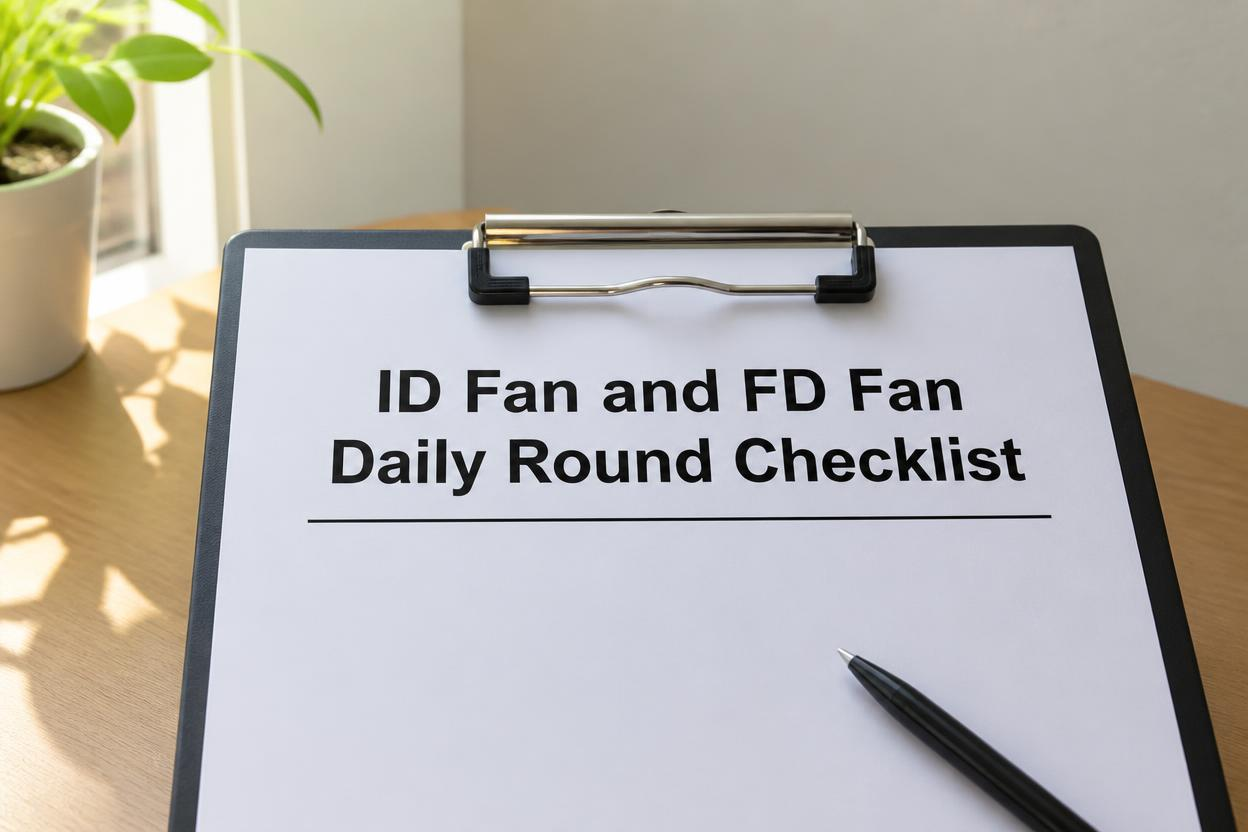
An ID or FD fan trip does not stay a fan problem. Lose draft balance and the boiler follows within seconds — and a single unplanned fan failure typically runs 50,000 to 300,000 dollars in repairs and lost generation. Most of those failures give weeks of warning first: a bearing running warmer, motor current creeping up, a damper feedback that no longer matches the setpoint. Sign up to log every daily round against baseline and catch the drift while it's still a scheduled repair.
Why It Matters
Fatigue cracks in fan blades from thermal cycling, ash and erosion buildup, and bearing wear all produce detectable signatures — rising vibration, shifting motor current, a damper that lags its setpoint — long before a trip. A consistent daily round is what turns those signatures into a scheduled repair instead of a forced outage.
The Round In Three Stops
Motor & Drive
Read motor current against baseline and check drive-end bearing temperature and vibration before moving to the fan housing itself.
Fan & Bearings
Walk both fan bearings for vibration and temperature, listen for abnormal noise, and check for dust or gas leakage at the casing and inspection doors.
Damper & Log
Confirm damper position feedback matches the control room setpoint, then log every reading and flag anything outside normal for the next shift.
The Daily Round Checklist
Record bearing vibration at motor and fan, drive and non-drive end: most plants set an alert at the moderate severity zone and a mandatory work order well before the destructive zone — trend the number, don't just check it against the alarm
Check motor current against established baseline: a deviation of more than about 5% from baseline current often means the fan has moved away from its intended operating point on the system curve
Verify damper position matches feedback and setpoint: a mismatch here on an FD fan risks motor overload if the damper opens too far, and on an ID fan it disturbs the whole draft balance
Inspect casing, inspection doors, and expansion joints for leakage: flue gas leakage on an ID fan and combustion air leakage on an FD fan both quietly erode draft efficiency before anyone notices on the load numbers
Note any abnormal noise or vibration reported during the shift: a rattle or harmonic that wasn't there yesterday is often the earliest human-detectable sign of blade erosion or ash buildup on the impeller
Every Fan Reading Trended, Every Drift Flagged
Oxmaint logs vibration, motor current, and damper position against baseline for every ID and FD fan, and raises a work order automatically once a reading crosses into the zone that needs action. Sign up for a free trial to run it on your own fan fleet, or book a demo to see it configured for your station.
Why ID And FD Fans Fail Differently
An ID fan sits downstream of the furnace, pulling hot, dust-laden flue gas through the system, which makes erosion, corrosion, and thermal cycling its dominant failure drivers. An FD fan pushes clean ambient air into the windbox, so its problems tend to start with the damper and control loop rather than the blades — an inlet filter clogging, or a damper interlock allowing motor overload. The daily round covers both fans with the same five checks, but a technician who knows which failure mode belongs to which fan reads the numbers with better judgment: a rising vibration trend on the ID fan points first toward ash buildup or erosion, while the same trend on an FD fan more often traces back to alignment or foundation looseness.
What A Drifting Reading Usually Means
| Check Point |
Early Warning Sign |
Likely Cause |
| Bearing vibration |
Steady climb into the moderate severity zone |
Imbalance from ash buildup or blade erosion |
| Motor current |
Deviation beyond roughly 5% from baseline |
System resistance change or fan operating off-curve |
| Damper feedback |
Position lagging or not matching the control setpoint |
Actuator wear or linkage issue |
| Casing leakage |
Visible air or gas escaping at doors or joints |
Worn flexible connector or gasket |
Frequently Asked Questions
Q
Should every abnormal vibration reading trigger a bearing replacement?
No. Rising vibration is just as often caused by misalignment, impeller buildup, foundation looseness, or a system-side pressure change as it is by bearing wear. Check the full picture — recent load changes, duct work, and cleaning history — before assuming the bearing is the problem.
Q
How is a daily walk different from continuous vibration monitoring?
Continuous monitoring catches gradual trends between rounds and can flag envelope-level bearing defects weeks earlier. The daily walk still matters because it catches what sensors don't — visible leakage, abnormal noise, and casing condition that only a technician on the floor notices.
Q
Does a UK power station need a digital record of these rounds?
A digital, timestamped record isn't legally mandatory for every reading, but it gives a much stronger audit trail than paper and — more importantly — it's what actually connects a drifting reading to a work order instead of letting it sit in a logbook until the next scheduled inspection.
Stop Reacting To Fan Trips, Start Getting Weeks Of Warning
Oxmaint trends bearing vibration, motor current, and damper position for every ID and FD fan against baseline, and turns a drifting reading into a scheduled work order instead of a forced outage. Sign up for a free trial to build your own fan round checklist, or book a demo to see it set up for your fleet.