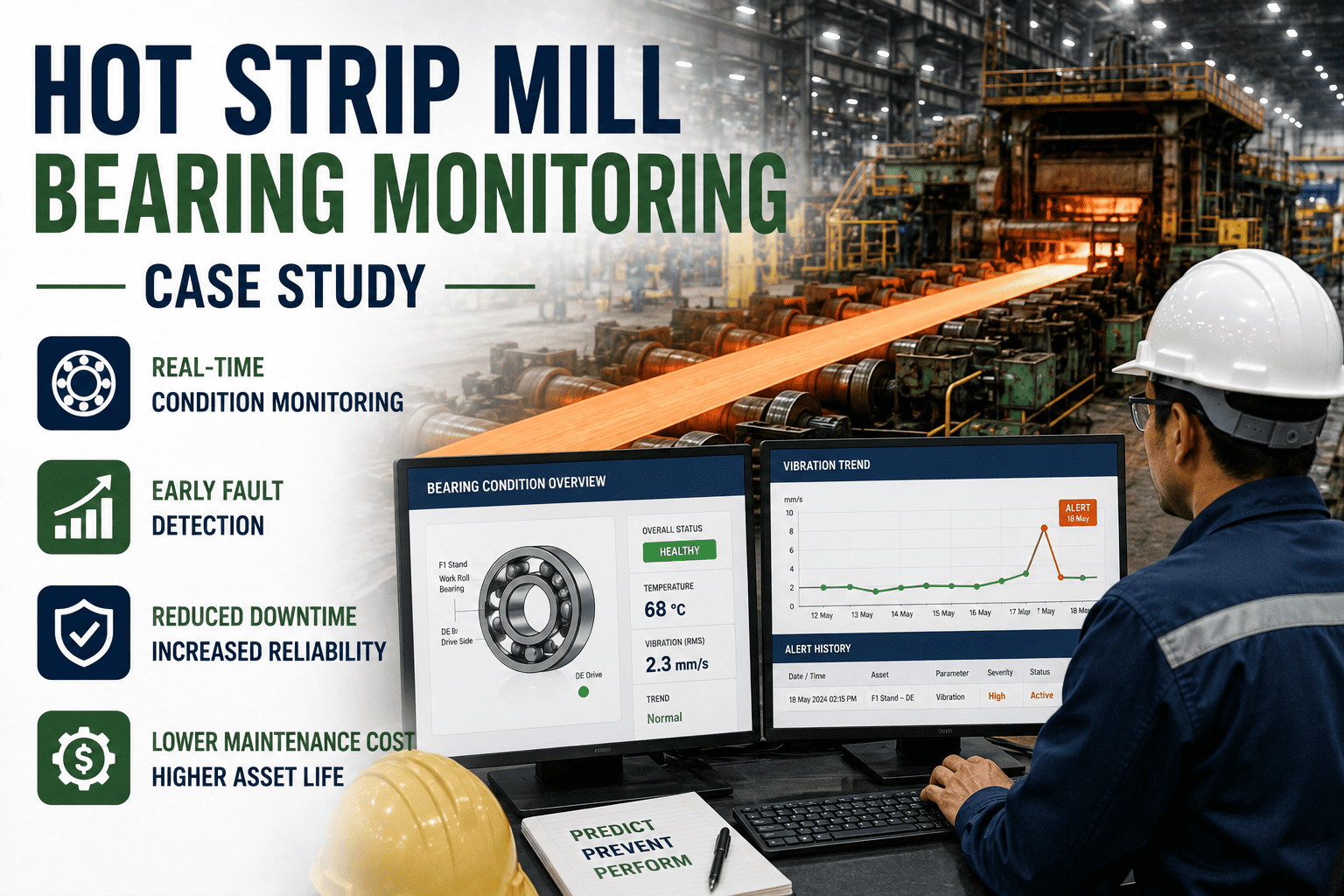
A bearing failure on a hot strip mill rarely gives much warning on paper records, by the time vibration or heat becomes obvious to a technician's hand, the roll stand is usually hours from an unplanned stop. Mills that put bearing monitoring on a CMMS catch the same failure days earlier, because the trend line flags it long before anyone would notice by touch or sound. Sign up to see how early your own mill's bearing alerts could be firing.
-47% Failures
Drop in unplanned bearing failures on monitored roll stands within the first year
9-14 Days Warning
Typical lead time between the first trend alert and the point of actual failure
-38% Downtime
Reduction in unplanned mill downtime once replacements moved to scheduled windows
The Problem
Hot strip mill bearings run under constant heat, load, and scale contamination, so failures tend to arrive suddenly rather than gradually. On a run-to-failure or fixed-interval schedule, technicians either replace bearings too early and waste good service life, or too late and lose an entire shift to an unplanned roll stand stop. Neither approach uses the vibration and temperature data the equipment is already generating.
From Vibration Signal To Scheduled Replacement
Sensor Reading
Trend Analysis
Alert
Work Order
Scheduled Swap
On paper-based programs this chain breaks between trend analysis and alert, since nobody is watching the readings continuously. A CMMS closes that gap by generating the work order automatically the moment a bearing crosses its threshold.
Catch The Bearing Failure Before It Stops The Line
Oxmaint tracks vibration and temperature trends on every monitored bearing and turns a threshold breach straight into a work order. Sign up for a free trial to see it against your own mill data, or book a demo to walk through a real rollout.
Bearing Maintenance Before And After
| Metric |
Before |
After |
| Failure detection |
Noticed by sound, heat, or sudden stoppage |
Flagged 9-14 days early from vibration trends |
| Replacement timing |
Fixed interval, regardless of actual wear |
Condition-based, scheduled around real readings |
| Work order creation |
Manually raised after a technician notices an issue |
Auto-generated the moment a threshold is crossed |
| Unplanned downtime |
Full-shift stops when a bearing seizes mid-run |
Down 38%, replacements moved into planned windows |
The Results
The mills that get the most out of bearing monitoring aren't just collecting vibration data, they're connecting that data straight to a work order the moment it crosses a threshold. That link is what turns a sensor reading into an actual planned repair instead of another chart nobody checks until something breaks.
Frequently Asked Questions
Q
Why are hot strip mill bearings so hard to monitor on a fixed schedule?
Heat, load, and scale contamination cause bearing wear to vary widely between stands, so a fixed replacement interval either wastes good service life or misses a bearing that is degrading faster than average.
Q
How much warning does vibration monitoring actually give before a bearing fails?
Most monitored bearings show a rising vibration trend 9 to 14 days before failure, which is enough time to schedule the replacement into a planned maintenance window instead of an unplanned stop.
Q
Does condition-based bearing replacement require new sensors on every stand?
Most mills start with sensors on the highest-risk stands and expand coverage gradually, since the CMMS can route alerts and generate work orders as each new sensor comes online.
Turn Bearing Data Into Planned Repairs, Not Surprise Stops
Oxmaint connects vibration and temperature trends directly to work orders, so every bearing gets replaced on its own schedule, not the calendar's. Sign up for a free trial to see it against your own mill, or book a demo to walk through a hot strip mill rollout.