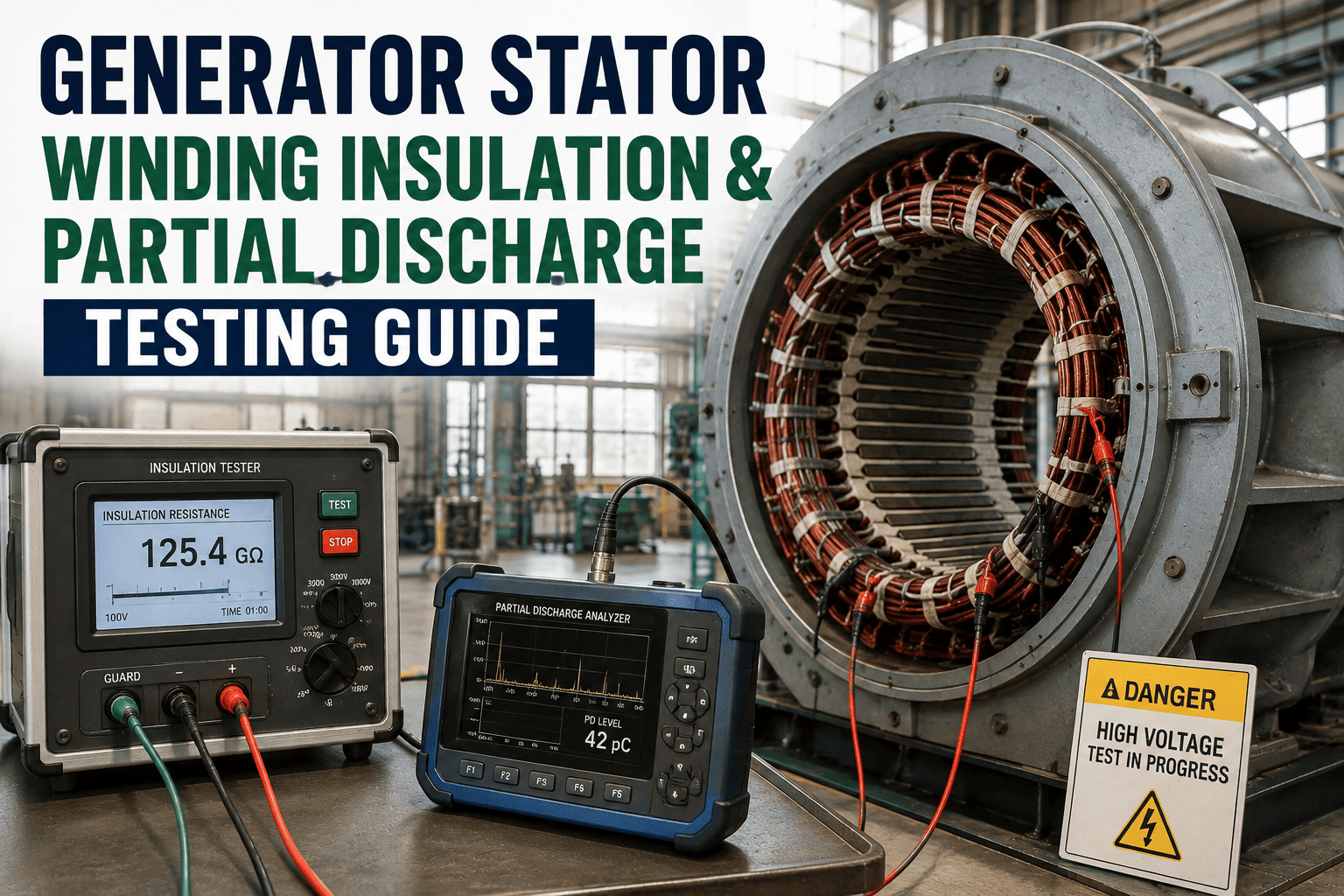
A generator stator winding looks static from the outside, copper bars sitting quietly in slots, but the insulation wrapped around those bars is aging every hour the unit runs, from heat cycling, vibration, and electrical stress. That aging is invisible until it isn't, a winding can test fine at one outage and show a ground fault two years later if nobody is tracking the trend between insulation resistance, polarization index, and partial discharge readings. Sign up to log every stator test against the asset and get flagged automatically when a reading drifts toward a limit, or book a demo to see it mapped to your fleet.
Why It Matters
A single insulation reading tells you almost nothing on its own, it is the trend across outages that reveals whether a winding is drying out, absorbing moisture, or developing partial discharge activity. IEEE 43 sets the acceptance limits, but the failures that catch plants off guard are usually the ones where nobody compared this year's number to last year's.
Four Tests That Make Up A Stator Winding Assessment
Insulation Resistance
DC megger test that flags contamination or moisture soak before either becomes a bigger problem
Polarization Index
Ratio of the 10 minute to 1 minute IR reading, the standard screen for winding dryness
Offline Partial Discharge
AC voltage applied at outage to locate discharge activity inside the groundwall insulation
Online PD Monitoring
Continuous sensors that catch discharge trends developing between planned outages
Field Checklist For Test Day
Winding discharged and grounded: at least 40 minutes of grounding before IR or PI testing so residual charge from a prior test doesn't skew the reading
Winding temperature recorded: IR readings are temperature dependent, a cold winding and a hot winding will never compare fairly without correction
PTs, arrestors and cables disconnected: these devices create parallel paths that quietly pull the IR reading down and can be damaged by the test voltage
PI compared against IEEE 43 limits: a value below 2.0 on a machine above 6 kV means testing stops and drying is scheduled before the unit runs again
This year's reading logged against last year's: a single number rarely fails a winding, a downward trend across outages is what should trigger a closer look
Stop Comparing Test Reports By Hand
OxMaint keeps every IR, PI, and PD reading against the generator's history and flags a winding the moment its trend crosses a limit, not just when a single reading fails. Sign up for a free trial to load your last test report, or book a demo to see the trend view built for your fleet.
Test, What It Reveals & Acceptance Guideline
| Test |
What It Reveals |
Acceptance Guideline |
| Insulation Resistance |
Moisture soak, surface contamination |
Roughly 1 MΩ per kV of rated voltage, minimum |
| Polarization Index |
Overall winding dryness and cleanliness |
PI at or above 2.0, ideally above 4.0 per IEEE 43 |
| Offline Partial Discharge |
Voids, delamination, slot discharge inside insulation |
Compared against sister units and prior outage baseline |
| Online PD Monitoring |
Discharge activity building up between outages |
Alarm set on rate of rise, not a single fixed value |
The Takeaway
IR, PI and PD tests are only as useful as the history behind them, a winding that looks fine today can still be trending toward failure if nobody is watching the curve. Trend the numbers across outages and a stator winding will usually tell you it is in trouble long before it actually fails.
Frequently Asked Questions
Q
Why does a good IR reading not guarantee a healthy winding?
IR and PI are excellent at catching moisture and contamination, but thermal deterioration or vibration abrasion in modern insulation can go unnoticed by these two tests alone. That is why partial discharge testing sits alongside them rather than replacing them, each test is sensitive to a different failure mechanism.
Q
Why is winding temperature recorded during every IR test?
Insulation resistance drops as temperature rises, so a reading taken on a hot winding will always look worse than one taken cold, even if the insulation condition hasn't changed. Recording the exact temperature lets the value be corrected to a standard reference so this year's test can be compared fairly against last year's.
Q
What does online PD monitoring add that outage testing can't?
Offline PD testing only happens once every outage cycle, which can be a year or more between snapshots. Online sensors watch discharge activity continuously while the machine is running, so a winding developing a problem between outages gets flagged in weeks rather than waiting for the next planned shutdown to find out.
Turn Every Stator Test Into A Trend Line
OxMaint logs IR, PI, and PD readings against each generator and raises a work order the moment a winding's trend crosses an acceptance limit. Sign up for a free trial to load your latest test data, or book a demo to see it configured for your fleet.