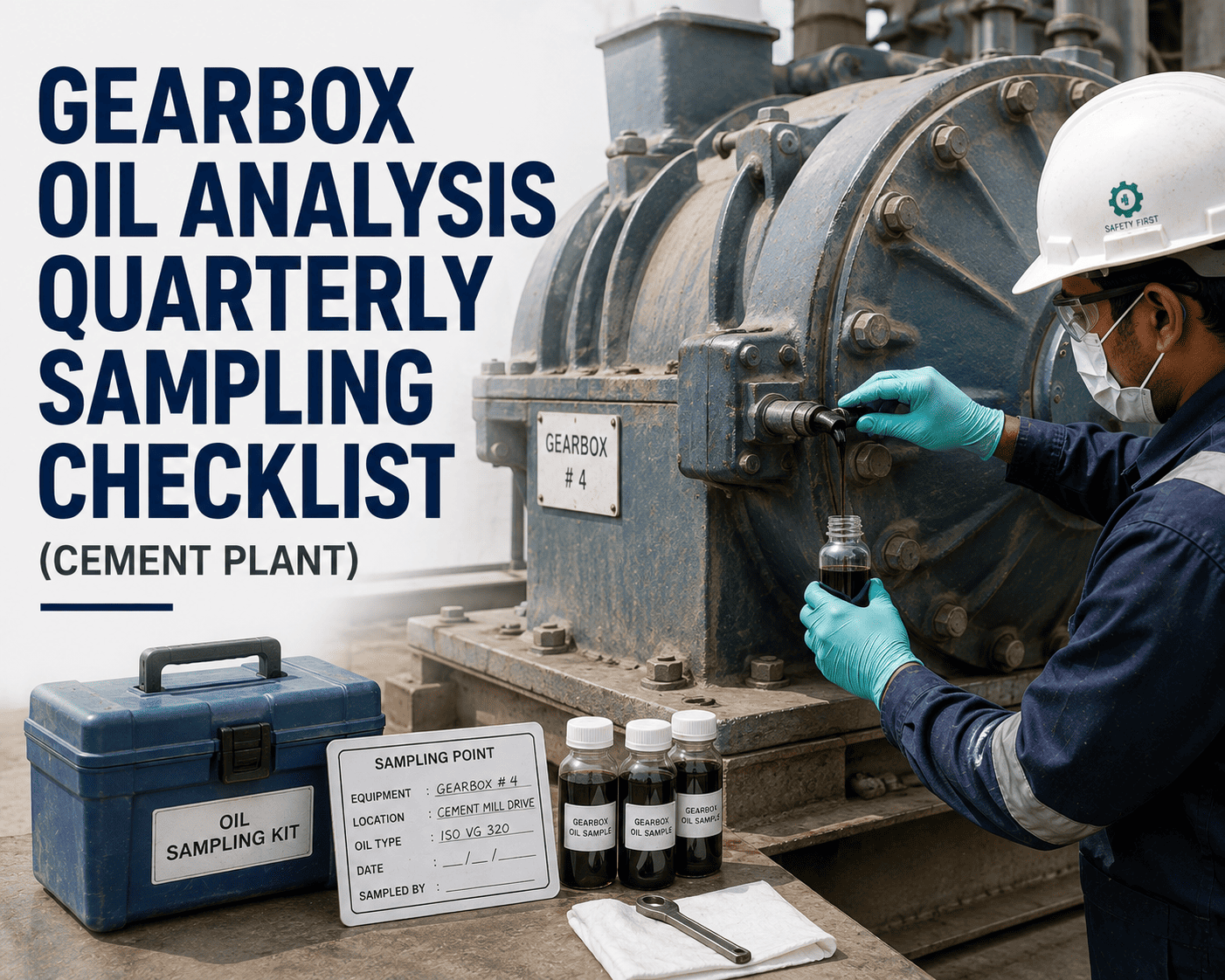
A kiln main gearbox doesn't send a warning before it seizes, the oil does. Wear metal, moisture, and particle counts start climbing weeks before a bearing spalls or a gear tooth pits, but only if the sample was pulled the right way, from the right point, on the right schedule. Sign up to log every quarterly sample, trend the results against your equipment's baseline, and catch a developing failure while it's still a filter change instead of an emergency teardown.
Why It Matters
A single VRM or kiln gearbox seizure can cost anywhere from several hundred thousand to a few million dollars in emergency parts, labour, and lost production. Oil analysis is the earliest warning available, but a badly drawn sample or an inconsistent sampling point can make clean oil look dirty, or hide a real problem entirely.
What Every Quarterly Sample Should Test For
Particle Count
Reported as an ISO 4406 code, tracks abrasive contamination and filter effectiveness
Wear Metals
Iron, copper, and aluminum concentrations flag active gear and bearing surface wear
Viscosity
Measured at 40°C, a drop signals thinning or contamination that thins the oil film
Moisture Content
Water ingress from a failed seal accelerates corrosion and acid-driven wear
TAN
Total acid number rising indicates oxidation and the oil approaching end of service life
Ferrous Density
Quantifies fine ferrous debris separately from concentration, an early fatigue signal
Drawing A Sample That's Actually Trustworthy
Sample while the gearbox is at operating temperature: running oil carries wear particles and contamination from every internal surface, not just what's settled in the sump
Draw from the exact same port every quarter: sumps accumulate metal and contaminant unevenly, so switching sample points breaks the comparability of the trend
Label with unit ID, sample point, and running hours: a sample without operating context can't be trended against the equipment's history
Ship promptly and log the submission date: a delayed sample sitting in a warm truck can skew moisture and viscosity readings before it even reaches the lab
Review results against trend, not a single reading: one elevated metal reading isn't a failure signal, a consistent upward trend across several samples is
Every Sample, Trended Against Its Baseline
Oxmaint schedules quarterly sampling by running hours per gearbox, stores every lab result against its equipment history, and flags a rising trend before it becomes a teardown. Sign up for a free trial to run it on your own gearbox fleet, or book a demo to see it configured for your plant.
Why Quarterly Isn't Always Often Enough
A fixed 90-day interval works fine for a stable, healthy gearbox, but it creates a blind window the moment something starts to change. A seal begins to fail and water works into the sump, and by the time the next scheduled sample is drawn the acid-accelerated wear has already progressed. A filter starts bypassing under load and particle count climbs steadily for weeks before anyone sees the number. This is exactly why the interval should tighten the moment a single parameter starts trending, even if it's still technically within limits, rather than waiting for the next calendar-fixed sample to confirm what's already underway.
ISO 4406 Cleanliness Targets By System
| System |
Target ISO 4406 |
Typical Sampling Interval |
| Kiln trunnion bearing lube |
18/17/14 or better |
Quarterly, tied to running hours |
| Mill gearbox, rolling element bearings |
17/16/13 or better |
Quarterly, accelerate to monthly if trending |
| VRM hydraulic system |
15/13/10 or better |
Every 250 hours during first year, then quarterly |
Frequently Asked Questions
Q
Why does the sampling point matter so much?
Metal and contaminant don't distribute evenly through a gearbox sump, so a sample pulled from a different port each quarter compares apples to oranges. A consistent sample point is what makes the trend across quarters actually mean something.
Q
Does one bad result mean the gearbox is failing?
Not on its own. A single elevated reading can come from a sampling error as easily as a real problem. It's a consistent upward trend across multiple samples that signals a developing issue worth acting on.
Q
Should sampling frequency be tied to hours or to the calendar?
Running hours give a far more accurate picture than calendar months, since a gearbox running near-continuously accumulates wear and contamination on a different timeline than one running intermittently. Quarterly sampling should be scheduled against operating hours per unit, not a fixed date for the whole plant.
Catch A Failing Gearbox Before It Seizes
Oxmaint ties oil analysis results to running hours, trends particle count and wear metals against each gearbox's own baseline, and turns an out-of-limit result into a work order automatically. Sign up for a free trial to run it on your own plant data, or book a demo to see it configured for your gearbox fleet.