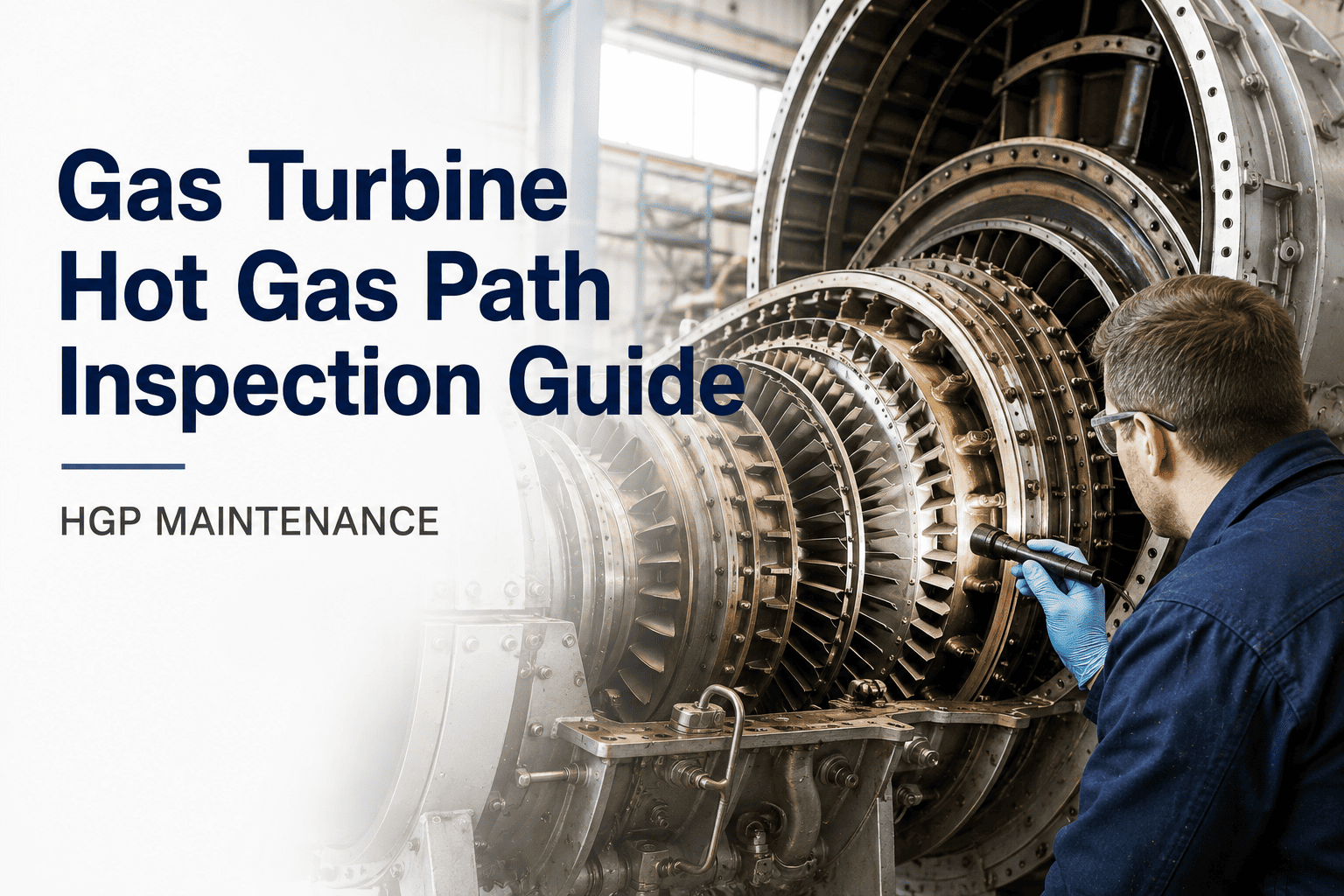
A hot gas path inspection exists because the parts closest to combustion age faster than anything else in a gas turbine, and by the time a blade crack or a burnt-through liner shows up on an alarm, the part has usually been degrading for thousands of hours. An HGPI opens the machine up far enough to catch that degradation on OEM's schedule instead of the turbine's. Sign up to track fired hours, borescope findings, and inspection intervals against every unit in your fleet.
Why It Exists
Combustion liners, transition pieces, and turbine blades sit directly in the hottest gas stream in the machine, exposed to thermal cycling that induces microscopic cracking long before it's visible from outside the casing. An HGPI is the scheduled point where those components get opened up, measured against OEM limits, and repaired or replaced before a crack propagates into a liberated blade and secondary damage across the whole turbine section.
What An HGPI Actually Covers
Combustion Liners
Checked for hot spots, burnthrough, and cooling hole blockage that lets local temperatures spike
Transition Pieces
Wall thickness measured by ultrasonic testing, cracking assessed at welds and cooling features
Fuel Nozzles
Flow tested against a reference nozzle, checked for tip erosion, carbon buildup, and swirler cracking
Turbine Blades & Buckets
Inspected for cracks, bowing, and coating loss on surfaces a borescope alone can't fully assess
The HGPI Process, Step By Step
Review Fired Hours Against Interval
Most units target an HGPI around 24,000 fired hours or four years, adjusted for fuel type and duty cycle
Run A Borescope Screening First
A pre-outage borescope pass flags where attention is needed, though it can't replace the dimensional checks that follow
Disassemble And Visually Inspect The Hot Section
Liners, transition pieces, nozzles, and blades come out for close inspection, UT wall checks, and flow testing that borescope can't do in place
Measure Findings Against OEM Limits
Crack depth, wall thickness, and coating condition are compared to OEM or DER limits, not judged by eye
5
Repair, Refurbish, Or Scrap Each Component
Parts within limits go for weld repair or recoating, parts beyond them are run-to-scrap, and the decision gets documented against the serial number
Plan The Outage Before The Interval Arrives
Oxmaint tracks fired hours against every unit's inspection interval and generates the outage work package, parts kit, and procurement requests weeks ahead of the deadline. Sign up for a free trial to bring interval tracking to your fleet, or book a demo to see it configured for your turbines.
CI vs HGPI vs Major Inspection
| Factor |
CI |
HGPI |
Major Inspection |
| Typical interval |
8,000-12,000 hours |
24,000 hours or 4 years |
40,000-48,000 hours |
| Scope |
Fuel nozzles, liners, transition pieces |
Full CI scope plus turbine blades, nozzles, shrouds |
Full HGPI scope plus rotor and compressor teardown |
| Casing access |
Combustion casing only |
Turbine casing cover removed |
Complete disassembly |
| Key decision |
Wash, plug, or replace nozzles |
Repair, recoat, or run-to-scrap blades |
Rotor replacement or life extension |
The Payoff
Borescope inspections earn their keep between outages, but they can't measure wall thickness, flow test a nozzle, or check coating on a blade's undersurface. Treating borescope findings as an early warning system rather than a substitute for the HGPI itself is what keeps a small crack from turning into an unplanned outage and secondary hot-section damage.
Frequently Asked Questions
Q
Can a borescope inspection replace a scheduled HGPI?
No. A borescope is excellent for spotting cracks, erosion, and coating loss visually between outages, but it can't measure fuel nozzle flow characteristics, perform ultrasonic wall thickness checks on transition pieces, or assess coating condition on the underside of a bucket. Those require the component to actually come out of the machine.
Q
What decides whether a hot-section part is repaired or scrapped?
Crack depth and dimensional wear are measured against OEM or Designated Engineering Representative limits once the part is out of the turbine. A part within those limits is typically a repair or recoat candidate, while one beyond them moves to run-to-scrap, with borderline cases usually needing engineering judgment rather than a simple pass or fail.
Q
Why does documentation matter as much as the inspection itself?
Every removed component needs as-found and as-left condition, serial numbers, defect photos, and torque records to support OEM warranty claims and audit requests. Without that trail, a part's inspection history can't be reconstructed, which weakens both warranty standing and the case for extending an interval based on condition.
Turn Every HGPI Into A Documented, Repeatable Record
Oxmaint logs fired hours, borescope findings, and component-level inspection data for every unit in your fleet, and builds the outage work package before the interval matures. Sign up for a free trial to bring interval tracking to your turbines, or book a demo to see it configured for your fleet.