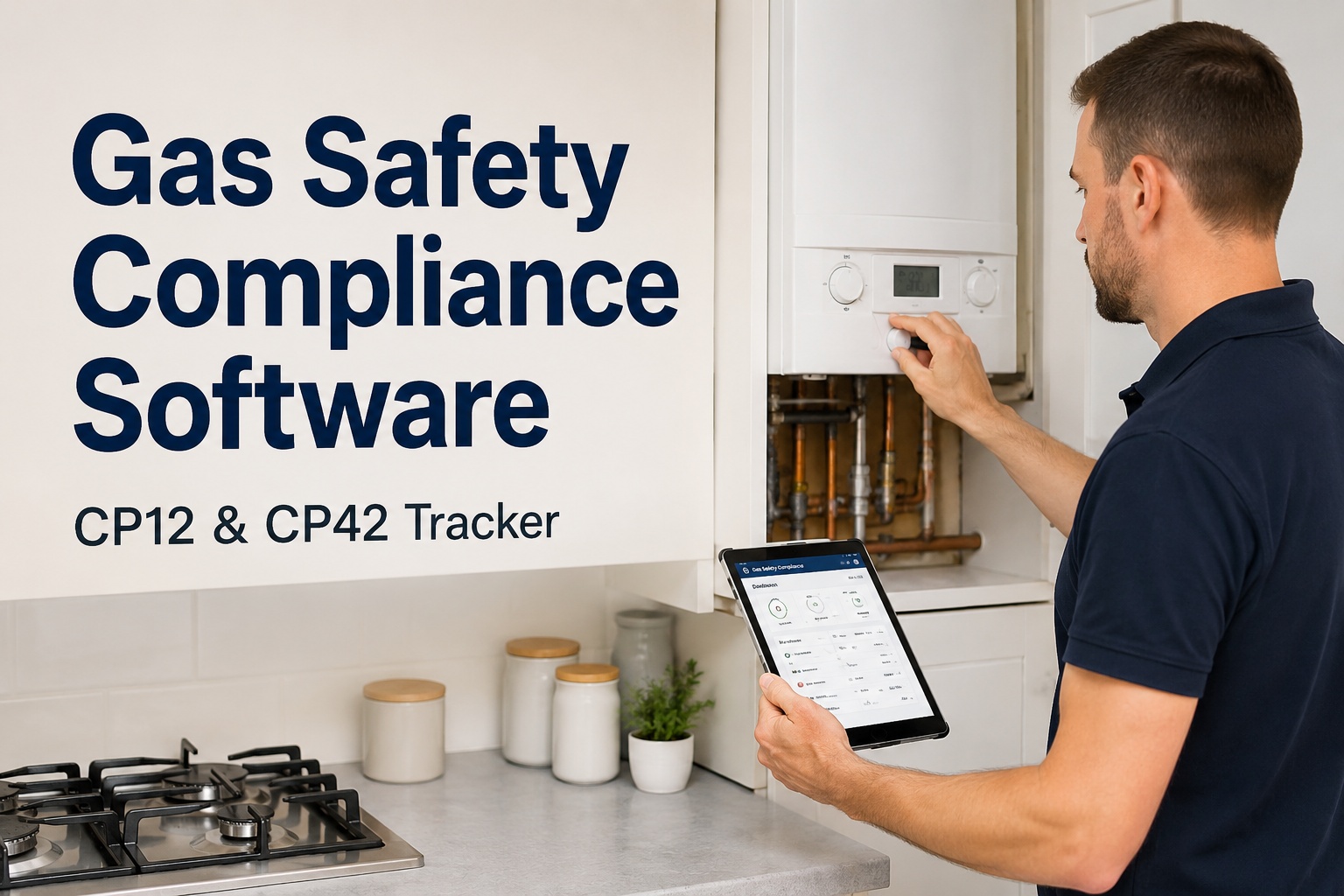
The alphabet soup of UK gas safety certificates — CP12, CP42, CP15, CP16, CP17, LGSR — is where most property portfolios quietly fall out of compliance. The wrong certificate gets filed against the wrong property, renewal dates slip past spreadsheets, and the 28-day tenant deadline gets missed on properties that changed managing agent mid-year. Under GSIUR 1998, that oversight carries £6,000 fines per appliance and voided insurance. Oxmaint gives property teams one platform for CP12, CP42 and LGSR tracking, renewal alerts, tenant distribution and remedial actions. Book a demo to see gas safety workflows in action.
12mo
annual CP12 renewal cycle on every let property with gas appliances
28days
deadline to distribute CP12 to existing tenants after the annual check
£6k/appliance
maximum fine per non-compliant appliance under GSIUR 1998
The CP Code Family — Which Certificate Covers What
"CP" numbers are legacy CORGI Proforma codes that survived Gas Safe Register's replacement of CORGI in 2009. They're still universally used across the UK gas industry to identify the specific certificate type. Filing a CP42 against a residential let — or a CP12 against a commercial kitchen — is a documented compliance failure, even where the engineer was Gas Safe registered. Getting the code right per asset type is where portfolio compliance either works or doesn't.
CP12
Landlord Gas Safety Record (LGSR)
Every let property with landlord-provided gas appliances
Annual · every 12 months
CP42
Commercial Catering Gas Safety Record
Commercial kitchens, restaurants, pubs, catering units
Annual · every 12 months
CP15
Commercial Boiler Safety Certificate
Commercial boiler installations in non-domestic premises
Annual · every 12 months
CP16
Gas Installation Testing & Purging
New installs, alterations, testing after significant works
Per event · installation-triggered
CP17
Non-Domestic Gas Installation Safety
Commercial gas installations broader than catering or boilers
Annual · every 12 months
All certificates must be issued by a Gas Safe registered engineer holding the specific competence category (LPG, Commercial Catering, Domestic, etc.) applicable to the appliance under inspection.
The 28-Day Rule — The Deadline That Catches Landlords Out
Under Regulation 36 of the Gas Safety (Installation and Use) Regulations 1998, a landlord must provide the CP12 to existing tenants within 28 days of the annual gas safety check, and to new tenants before they move in. Portfolios of 20+ properties routinely break down at this exact step: the certificate arrives from the engineer, gets filed, and nobody sends it to the tenant. Missing this deadline is a separate documented breach — independent of the check itself being done.
Day 0
Gas safety check completed
Gas Safe registered engineer inspects all landlord-provided gas appliances, flues and pipework. CP12/LGSR issued on completion.
Days 0-28
Distribute to existing tenants
Copy of CP12 must reach every existing tenant within 28 days of the inspection date. Digital delivery accepted where the tenant has agreed.
Pre-move-in
Provide to new tenants
Any incoming tenant must be given the current CP12 before they take occupation — the 28-day window doesn't apply to new tenancies.
2 yrs+
Retain records
Landlord must retain every CP12 for at least 2 years. Best practice: indefinite retention through the property's full tenancy history.
Oxmaint automates the tenant distribution step — CP12 upload against the property triggers automatic notification with the certificate attached, timestamped as proof of 28-day compliance. Sign up free to configure automatic tenant distribution across your properties.
The Penalty Ladder — What Non-Compliance Actually Costs
Enforcement under GSIUR 1998 sits with the HSE, and the penalty structure escalates sharply with each layer of non-compliance. This isn't theoretical — landlords have received custodial sentences where tenant injury or death was linked to missing or fraudulent CP12 certificates. The Renters' Rights Act 2025, in force from 1 May 2026, has tightened this further by making current CP12 evidence a prerequisite for possession proceedings.
Level 1
£6,000
Per non-compliant appliance
Statutory maximum fine per gas appliance without a valid current CP12. A single property with three unchecked appliances = up to £18,000 exposure.
Level 2
Unlimited
Unlimited fines on conviction
On indictment, courts can impose unlimited fines. Insurance policies routinely void without evidence of current CP12 — repair, rebuild and liability exposure fully carried by the landlord.
Level 3
Criminal
Prosecution & custodial sentences
Where tenant injury or death results from missing or falsified certification, landlords have received custodial sentences. Corporate directors carry personal liability under GSIUR.
Level 4
Blocked
Loss of possession rights
Under the Renters' Rights Act 2025, absence of a current CP12 blocks landlords from regaining possession — even from tenants in significant arrears.
See Live Gas Safety Compliance Workflows
Walk through the property portfolio register, engineer scoped access, CP12/CP42 upload against the specific asset, automatic 28-day tenant distribution and remedial action tracking — configured against your specific portfolio. Thirty minutes with the Oxmaint team.
The Renewal Cadence Problem at Portfolio Scale
A single CP12 renewal is trivial to manage. A portfolio of 200 properties, each with its own annual renewal date, three or four gas appliances, an assigned engineer and tenants that need the certificate within 28 days — that's where spreadsheet-based tracking collapses. Oxmaint sits above the portfolio as the renewal calendar: 90-day advance notice for booking, 30-day escalation, day-of-expiry hard alert, plus automatic engineer assignment and tenant distribution. The renewal never gets forgotten because the platform watches the entire portfolio at once. Sign up free to set up your portfolio renewal calendar.
Expert Perspective — Where Gas Safety Compliance Actually Fails
Ninety percent of gas safety enforcement cases don't involve landlords who deliberately ignored the law. They involve landlords who thought they were on top of it — until an audit exposed a portfolio-level gap. A missed renewal on a property that changed managing agent mid-year. A CP12 that arrived from the engineer but never got sent to the tenant. A CP42 on a takeaway that expired the day the freezer failed and someone got hurt. The failure mode is administrative, not intentional. Which is exactly why moving from spreadsheet-based tracking to a portfolio-level renewal calendar with automatic tenant distribution is such a step-change in real-world compliance.
Renewal alerts at 90/30/0 days
Advance booking window, escalation and hard-stop alert — three touchpoints per property prevent the "we forgot" scenario at portfolio scale.
28-day distribution automated
CP12 upload triggers tenant notification with certificate attached. Timestamp proof for the 28-day compliance requirement — no manual step.
Engineer credentials verified
Gas Safe registration number checked at upload. Wrong category = wrong certificate = compliance failure. Verification at the point of entry.
Historical audit trail retained
Full CP12 history per property retained indefinitely. 2-year minimum met automatically; longer retention protects against future dispute.
Who Uses Oxmaint for Gas Safety Compliance
The platform is used by the specific UK operational roles that carry gas safety accountability: property managers running CP12 renewals across residential portfolios of any size, letting agents managing gas safety compliance on behalf of landlord clients, housing association and social landlord teams operating multi-thousand-property portfolios, facilities managers coordinating CP42 across hospitality and commercial catering estates, FM contractors delivering gas compliance services to multi-site clients, HMO managers under enhanced gas safety obligations for shared occupancy, and commercial property operators managing CP15/CP17 across office and retail portfolios. Each role sees the same underlying data filtered to their view — renewal calendar, tenant distribution status, remedial action queue or audit evidence pack. Sign up free to configure roles for your property team.
Getting Gas Safety Compliance Live
Deployment starts with importing your existing property portfolio — addresses, gas appliance inventory, current CP12 status, assigned engineers — into the Oxmaint gas safety module. Each property is tagged by tenure (let / owner-occupied / HMO / commercial) so the correct certificate type is applied automatically. Gas Safe registered engineers get scoped access to upload certificates directly against the correct property with credential verification. Tenant contact details enable automatic 28-day distribution. Most portfolio deployments move from initial scoping to live renewal calendar operation inside 30 days. Book a walkthrough to see live UK portfolio deployments.
Turn Gas Safety From Portfolio Risk to Managed Process
Oxmaint gives property and facilities teams one platform for CP12, CP42, LGSR and all Gas Safe certificate tracking — renewal alerts, automatic 28-day tenant distribution, remedial actions and audit-ready evidence, at any portfolio scale.
Frequently Asked Questions
What is a CP12 gas safety certificate and how does it differ from an LGSR?
They are the same document. "CP12" is the legacy CORGI Proforma 12 code from before Gas Safe Register replaced CORGI in 2009 — the industry never dropped the term. The official current name is Landlord Gas Safety Record (LGSR). Either name refers to the same certificate issued by a Gas Safe registered engineer after the annual gas safety check on a let property. Both terms are legally interchangeable in UK usage. Oxmaint accepts both terminologies against the property record so certificates from any engineer or contractor land in the correct place.
What's the difference between CP12 and CP42?
CP12 is the residential Landlord Gas Safety Record — the annual check every UK let property with landlord-provided gas appliances requires. CP42 is the Commercial Catering Gas Safety Record for commercial kitchens, restaurants, pubs, cafes, canteens and catering units. They cover different premises types, different appliance categories and require different Gas Safe engineer competence endorsements. Filing a CP12 against a commercial kitchen (or a CP42 against a residential let) is a documented compliance failure. Both need to be tracked separately in a portfolio containing mixed property types.
How often are gas safety checks required in the UK?
CP12 (residential landlord) is annual — every 12 months from the last check, on every let property with landlord-provided gas appliances or flues. CP42, CP15 and CP17 (commercial) are also typically annual, though commercial premises are treated on a risk basis rather than by a single fixed statutory interval — the 12-month cycle is the accepted industry standard and insurers routinely require it. CP16 (installation testing and purging) is event-triggered rather than periodic — carried out at new installation, alteration or significant modification.
Can CP12 and CP42 certificates be tracked across multiple properties?
Yes — that's the specific value of the Oxmaint gas safety module at portfolio scale. Every property carries its own gas appliance register, renewal calendar and complete certificate history. Renewal alerts trigger at 90 days, 30 days and on the day of expiry. Certificates from Gas Safe engineers upload directly against the correct property with credential verification. Mixed portfolios containing residential lets (CP12), commercial catering (CP42), and commercial installations (CP15/CP17) all live in the same platform, filtered by property type and certificate code.
Does Oxmaint replace a Gas Safe registered engineer?
No — and it isn't intended to. Only Gas Safe registered engineers holding the applicable competence category are legally permitted to carry out gas safety inspections and issue CP12, CP42 or any other Gas Safe certificate in the UK. Oxmaint is the property-side platform that manages the workflow around those inspections: portfolio-level renewal calendar, engineer scoping and assignment, certificate upload and retention, 28-day tenant distribution, remedial action tracking, and audit evidence. The engineer performs the statutory check; Oxmaint ensures the compliance workflow around it never fails.