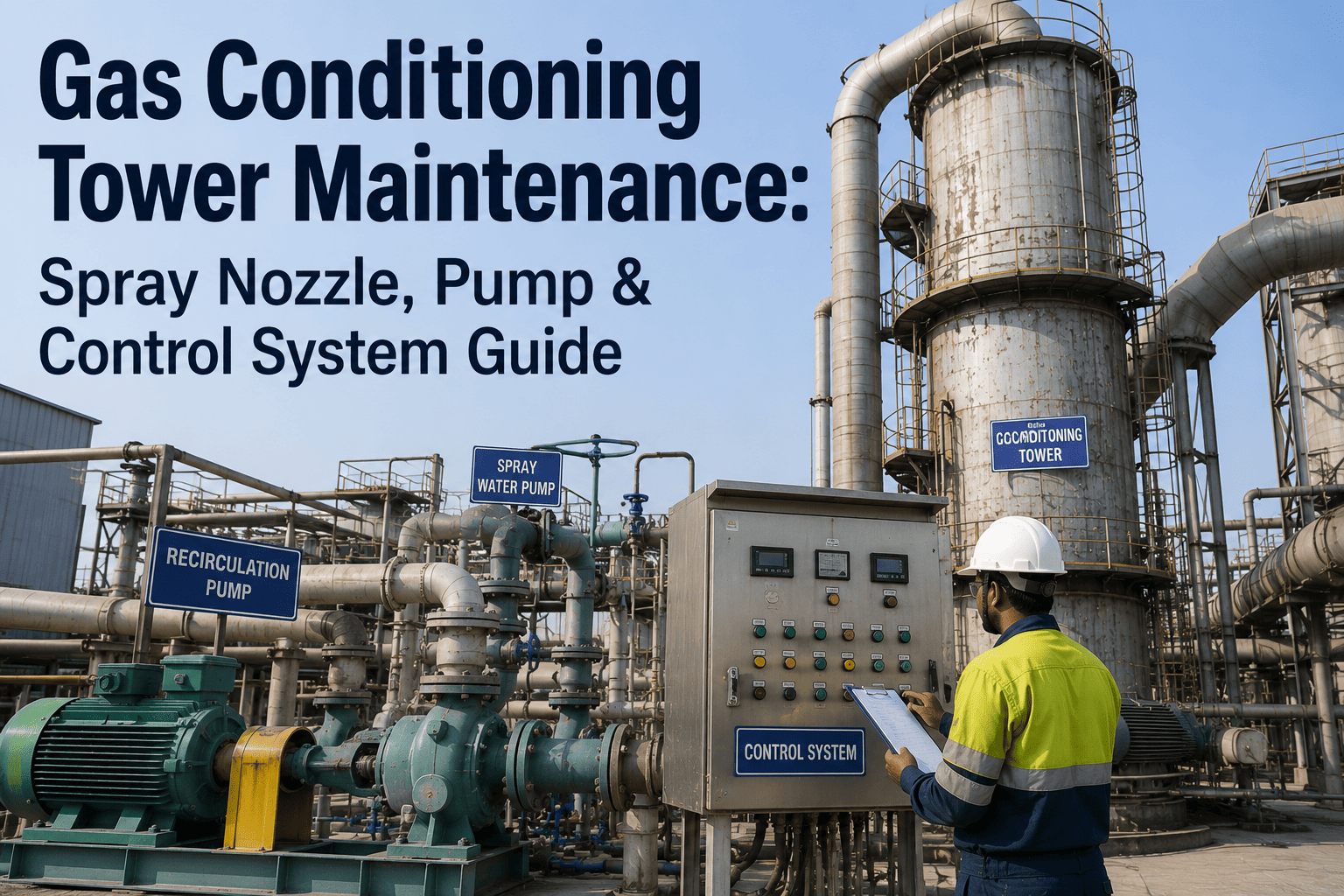
A gas conditioning tower has one non-negotiable job: cool exit gases from the preheater or kiln bypass to the exact temperature the downstream mills and filters need, without a single drop of water surviving past the last spray zone. When a nozzle drifts out of pattern or a control valve lags behind an inlet swing, that unevaporated moisture doesn't disappear, it wets ductwork, cakes onto the ESP or baghouse, and turns a routine shift into an unplanned shutdown. Sign up for a free trial to see how Oxmaint schedules condition-based PM for GCT nozzles, pumps and control loops before they drift that far.
100%
Of injected water must fully evaporate before reaching downstream ductwork or filters
400°C
Typical inlet gas temperature a GCT must bring down before it reaches the ESP
2 Weeks
Typical downtime for a full nozzle and system upgrade when PM is neglected too long
Real-Time
Control response needed to match spray rate against inlet gas fluctuations
Why Nozzle Health Decides Everything Downstream
Spray nozzles atomize cooling water into fine droplets that evaporate completely before the gas leaves the tower. A partially clogged or worn nozzle throws a coarser spray pattern, and coarser droplets don't finish evaporating in the available residence time, which means wet gas, caked deposits and corrosion risk further along the duct. This is why nozzle inspection sits at the center of any GCT maintenance program, not as an afterthought to the pump and valves around it.
Where Gas Conditioning Tower Failures Actually Start
| Component |
Common Failure Mode |
Maintenance Focus |
| Spray nozzles |
Erosion widens the orifice, deposits narrow the spray angle and pattern drifts |
Regular pattern checks and orifice wear measurement against baseline |
| Water pump & piping |
Impurities in water impair flow and pressure delivered to nozzle headers |
Filter checks, seal inspection and pressure trend logging |
| Control valves |
Slow actuator response lags behind sudden inlet gas fluctuations |
Actuator response testing and calibration on a fixed interval |
| Temperature sensors |
Drift causes the control loop to over-spray or under-spray silently |
Cross-checking against a reference probe on a set schedule |
One Dashboard for Nozzles, Pumps and Control Loops
Oxmaint keeps GCT nozzle wear checks, pump seal inspections and valve calibration on separate, condition-based schedules instead of one generic tower checklist. Sign up for a free trial to test it against your own conditioning tower, or book a demo and we'll map it to your system.
One-Phase or Two-Phase: Maintenance Runs Differently
| System Type |
How It Cools |
Upkeep Priority |
| High-water-pressure (one-phase) |
Hydraulic nozzles use pressurized water alone for lower power draw |
Pressure consistency checks and nozzle orifice wear tracking |
| Air-atomised (two-phase) |
Compressed air atomizes water into finer droplets for faster evaporation |
Air supply and header pressure checks alongside nozzle inspection |
Temperature Control Is the Part Teams Forget to Maintain
A gas conditioning tower's control system is meant to react automatically the moment inlet gas conditions shift, adjusting spray rate to hold the target exit temperature. But a control loop is only as reliable as the sensors and valves feeding it, so PM on the automation side deserves the same attention as the nozzles themselves, not a once-a-year afterthought during the annual shutdown.
Frequently Asked Questions
Q
Why does incomplete evaporation matter so much in a GCT?
If any injected water survives past the spray zone, it reaches the ductwork and downstream ESP or baghouse as moisture, where it cakes dust into deposits and accelerates corrosion. Complete evaporation before the gas leaves the tower is treated as an absolute design requirement, not a target to approach.
Q
How often should spray nozzles actually be inspected?
Nozzle wear rate depends on water quality and gas temperature, so a fixed calendar interval often misses drift. Tracking orifice size and spray pattern against a recorded baseline, and scheduling inspection when readings start moving, catches wear before it shows up as coarse droplets downstream.
Q
Does the type of nozzle system change the maintenance plan?
Yes. Air-atomised two-phase systems add a compressed air supply that needs its own pressure checks alongside the nozzles, while high-water-pressure one-phase systems rely more heavily on consistent pump pressure and orifice condition. Treating both as the same checklist misses what each one actually depends on.
Q
Why include the control system in GCT maintenance at all?
The control system is what keeps spray rate matched to a constantly shifting inlet gas condition. If a temperature sensor drifts or a valve responds too slowly, the tower can quietly over-spray or under-spray for a long stretch before anyone notices the trend, which is why sensor and valve checks belong on the same PM schedule as the nozzles.
Keep Your Gas Conditioning Tower Running on Schedule, Not on Guesswork
Oxmaint gives cement plant teams condition-based PM for spray nozzles, pumps, control valves and temperature sensors, plus wear trend tracking in one platform. Sign up for a free trial to explore it yourself, or book a demo and we'll walk through it against your own GCT setup.