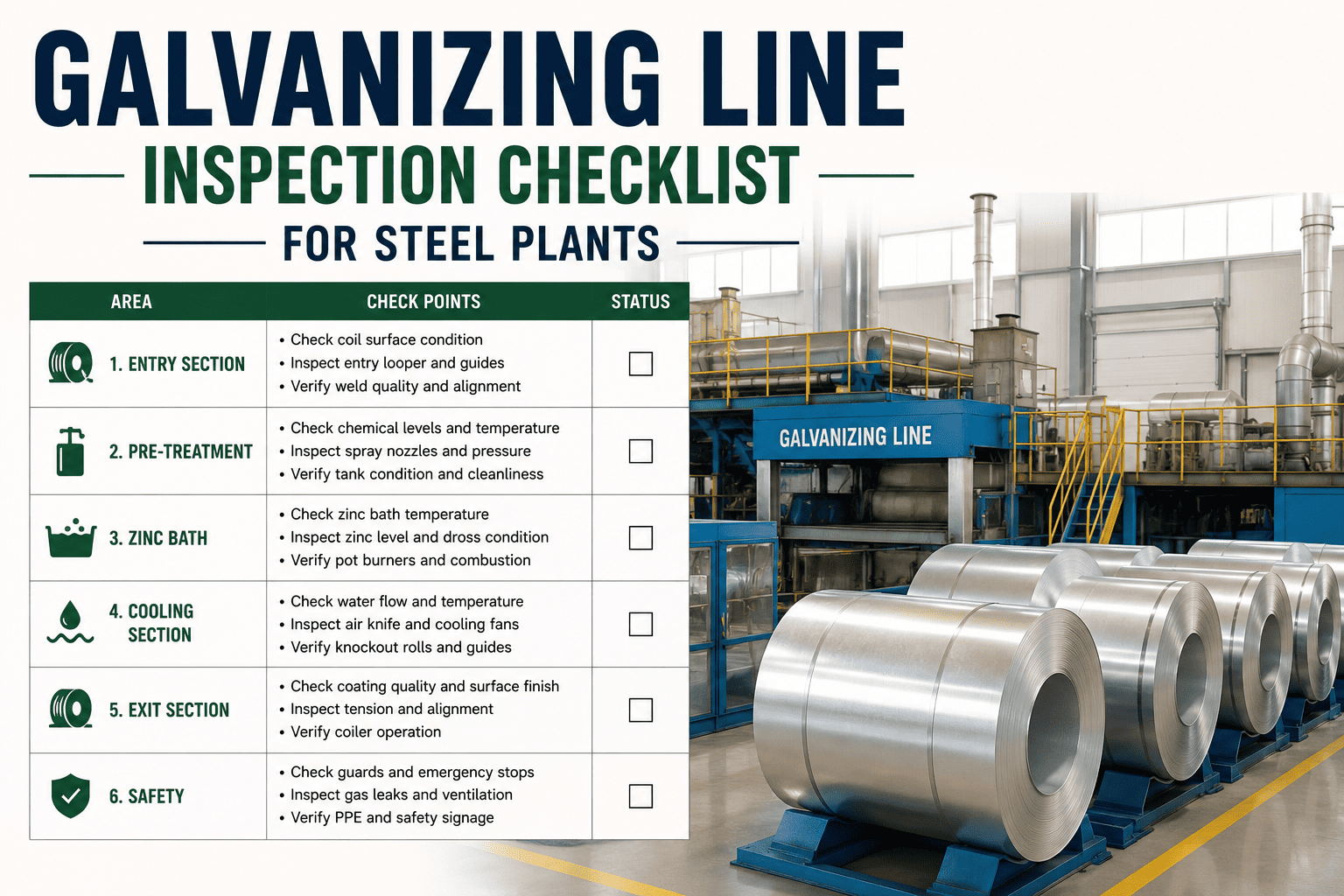
A continuous galvanizing line turns raw steel into corrosion-resistant sheet by running it through a submerged zinc pot at temperatures above 840°F, and a bearing failure or dross buildup down there doesn't just hurt quality, it can force a line stop costing upwards of $25,000 an hour. The first warning is usually small: an air knife gap drifting a fraction, a snout seal wearing thin, a sink roll bearing running warmer than usual. This checklist covers the eight points a galvanizing line inspection route should never skip. Sign up to turn this checklist into a recurring digital inspection your team can't miss a step on.
8 Points
Core checks that belong on every galvanizing line inspection route
840°F+
Approximate zinc pot temperature the sink rolls operate inside of
0.05mm
Typical roll grinding tolerance required for automotive-grade strip
Zero Skips
Tolerance for missed checks, since early drift rarely repeats itself
Why Air Knife Consistency Decides Coating Quality
After the strip exits the zinc bath, the air knife is what sets the final coating weight, and consistent air knife performance is the single biggest factor in coating weight uniformity. A gap that drifts even slightly, or a nozzle that's starting to clog, shows up downstream as an out-of-spec coating long before anyone traces it back to the knife itself.
The Galvanizing Line Inspection Checklist
Zinc Pot Temperature & Bath Level
Confirm bath temperature and level are holding steady, since drift here is often the first sign of a bigger process issue
Sink Roll & Stabilizer Roll Bearings
Track bearing condition against tonnage run, since these submerged rolls are working at high temperature nonstop
Air Knife Gap & Pressure
Measure nozzle gap and air-lip cleanliness per wipe, since this setting directly determines coating weight uniformity
Snout Seal Condition
Check the seal between the annealing furnace and the zinc pot, since a worn seal lets in atmosphere that causes bare spot defects
Pot Roll Coating Wear
Inspect the thermal spray coating on pot rolls for wear, since a degraded coating lets dross adhere and cuts service life
Coating Weight Gauge
Verify the X-ray fluorescence gauge is reading accurately across the full strip width against the target coating weight
Dross Buildup & Removal
Check the bath for dross accumulation, since buildup left unaddressed raises both bearing risk and zinc consumption
Zinc Consumption Per Tonne
Compare actual zinc use against the theoretical baseline, since a rising trend is often the earliest sign of process drift
Never Miss A Galvanizing Line Inspection Point
Oxmaint turns this eight-point checklist into a recurring digital route, logging air knife gaps, pot temperatures, and roll condition so quality drift is caught before a coil is shipped out of spec. Sign up for a free trial to build your galvanizing line inspection route, or book a demo to see it in action.
What An Abnormal Reading Might Be Telling You
| What You Notice |
Possible Cause |
| Coating weight drifting off target |
Air knife gap or pressure has shifted out of its set position |
| Bare spot defects on the strip |
Snout seal wear allowing furnace atmosphere to oxidise at the pot interface |
| Zinc consumption rising above baseline |
Increasing dross formation or early air knife inefficiency |
| Sink roll running rough or vibrating |
Bearing wear approaching its tonnage limit, or dross adhesion on the roll surface |
Paper Checklist vs A Digital Inspection Route
Paper Checklist
Air knife and pot readings filed away, hard to compare against production orders
Easy for a busy shift to skip a check without anyone noticing
No trend line until someone manually pulls old sheets together
Digital Inspection Route
Every reading logged against the exact asset and production order automatically
A skipped point flags itself instead of quietly disappearing
Trend lines build on their own, making slow drift easy to catch early
Where A CMMS Fits Into Galvanizing Line Inspections
Oxmaint turns this eight-point checklist into a recurring digital route, capturing each reading against the zinc pot, air knife, or roll asset so trends are visible instantly and a missed check never slips through unnoticed.
Frequently Asked Questions
Q
How often should a galvanizing line be inspected?
Air knife gaps and pot temperatures are best logged every shift, while sink roll bearings, snout seals, and pot roll coatings are typically checked against production tonnage rather than a fixed calendar interval.
Q
Which check on this list matters most?
Air knife gap and pressure tend to matter most, since consistent air knife performance is the single biggest factor in coating weight uniformity.
Q
Can a CMMS turn this checklist into a recurring digital inspection?
Yes, a CMMS can schedule the checklist as a recurring route, prompt the technician for each reading by asset, and build a trend history automatically across the zinc pot, air knife, and roll systems.
Turn This Checklist Into A Route Your Team Follows Every Day
Oxmaint schedules this eight-point galvanizing line inspection as a recurring digital route, capturing readings and trends automatically across the zinc pot, air knife, and roll systems. Sign up for a free trial to build your galvanizing line inspection route, or book a demo to see it in action.