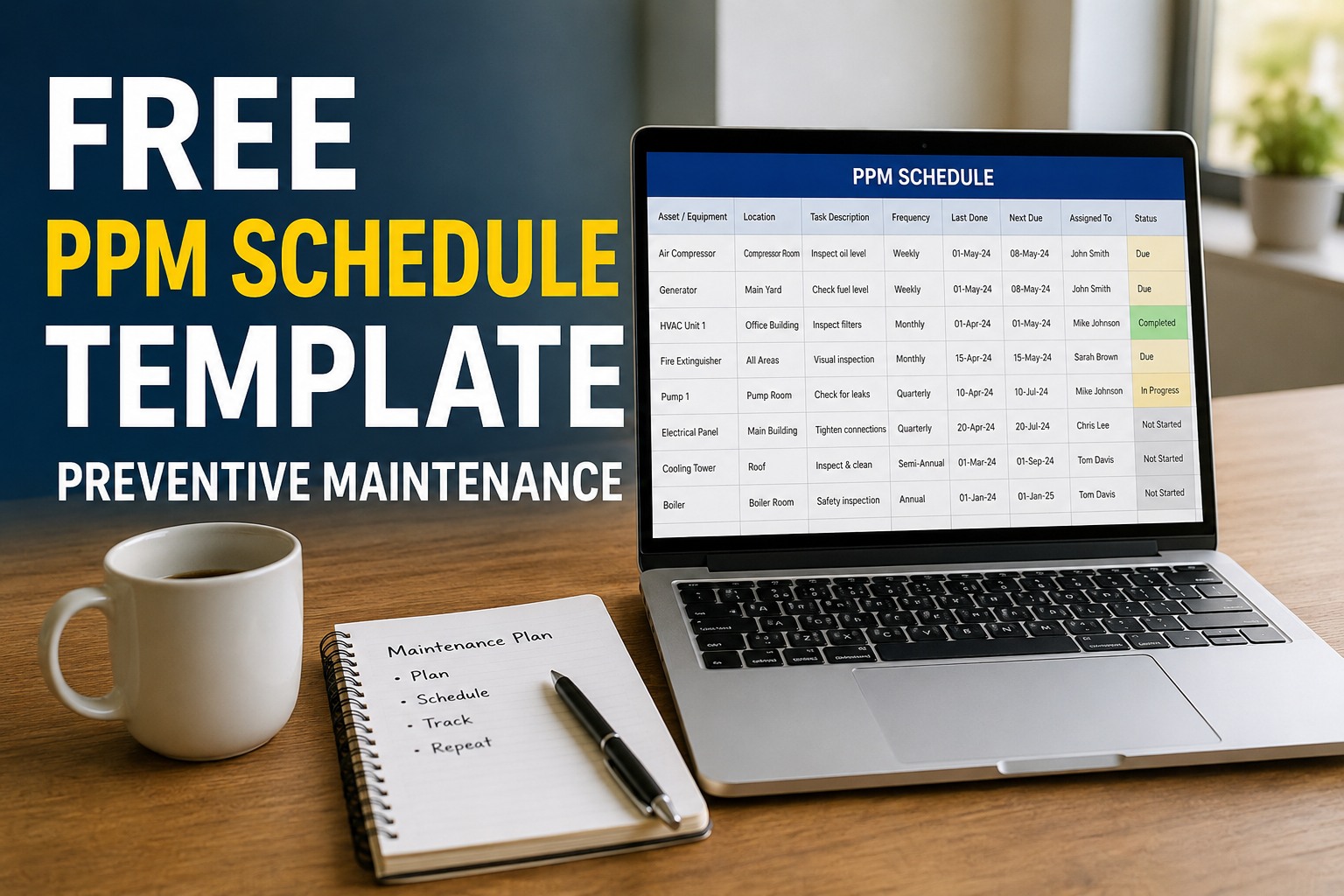
Most PPM schedules don't fail because nobody planned them — they fail quietly, one missed reset at a time. An "annual" task gets logged 14 months apart instead of 12, a filter change slips from monthly to "whenever someone remembers," and nobody notices until an inspection or a breakdown makes the gap obvious. A structured PPM schedule fixes this before it starts, giving your team a fixed timetable for recurring tasks, frequencies and due dates. Sign up free to build a live version of this schedule whenever a spreadsheet stops being enough.
Free PPM Schedule Template
Excel-ready. Pre-built columns for asset, task, frequency, due date and completion sign-off — structured around how UK compliance frequencies actually work.
A PPM schedule is a fixed timetable defining when, how, and by whom equipment gets inspected, serviced or replaced — carried out on a calendar, not in response to a complaint. Rather than waiting for something to break, planned preventive maintenance catches wear before it becomes failure. Around 30% of work-related deaths in manufacturing have been linked to poor maintenance practices, which is exactly why a documented, evidenced schedule matters well beyond simply keeping equipment running.
Common PPM Frequency Bands
Not every task needs the same rhythm. Matching frequency to actual risk — rather than defaulting everything to monthly — keeps a schedule realistic enough that your team can actually keep up with it.
Filter changes, lubrication, Legionella temperature checks
Quarterly
Belt tension, calibration checks, minor servicing
Annual
Gas safety, fire alarm test, full statutory inspection
The Schedule Drift Problem Nobody Notices Until It's Too Late
Modern scheduling logic triggers "annual" tasks 12 months from completion, not 12 months from the original due date. Get that wrong in a spreadsheet — where dates are typed manually — and small delays compound. A task due every 12 months but logged a month late each time drifts to 14, then 16 months between actual services, quietly falling out of compliance without a single missed entry in the sheet. Book a free demo to see drift-proof scheduling in action.
How Schedule Drift Builds
Cycle 1
On time — 12 months
Cycle 2
14 months — 2 late
Cycle 3
16 months — non-compliant
A spreadsheet doesn't flag this. A rule-based schedule resets from actual completion, every time.
What's Inside the Template
The template is built around the fields a PPM schedule needs to stay both practical and audit-ready — the same structure OxMaint uses when a schedule moves from spreadsheet to platform.
Core Schedule Columns
Asset
Equipment ID, name, location
Task
Exact action to be carried out
Frequency
Daily, monthly, quarterly, annual
Priority
Statutory, safety-critical, routine
Assigned To
Technician or contractor responsible
Due & Completion Date
Next due, last completed, sign-off
See a Drift-Proof PPM Schedule, Live
Watch how OxMaint resets frequencies from actual completion dates and auto-generates work orders before anything falls overdue.
Expert Perspective: Building a Schedule That Holds Up to Audit
A PPM schedule is only as good as its evidence trail. Frequencies chosen without a documented reason — asset criticality, manufacturer guidance, or a statutory requirement — rarely survive scrutiny. The schedules that hold up under audit are the ones where every interval traces back to a stated reason, and every completion is logged with proof, not just a tick in a box.
Frequency Should Follow Risk
Statutory tasks follow the regulation's stated interval; everything else should follow asset criticality and manufacturer guidance, not habit.
Reset From Completion, Not Due Date
Rule-based scheduling prevents the slow drift that turns a 12-month cycle into a 16-month one over a few missed resets.
Evidence Beats a Tick Box
Photos, sign-off and timestamps give a defensible audit trail — a checked box alone proves very little after the fact.
The common thread across all three: a schedule built once and left alone will drift. One built with a system for keeping itself honest doesn't.
UK Statutory Frequencies Worth Knowing
Several PPM tasks aren't a matter of judgement — the interval is set by regulation. Getting these into your schedule correctly from the start avoids the most common compliance gaps.
Common Statutory Intervals (Check Current Guidance)
Gas safety check
Annual
Fire alarm test
Weekly (test), Annual (full)
Legionella temperature checks
Monthly
Emergency lighting test
Monthly (function), Annual (full)
Electrical installation (EICR)
Up to 5 years
Intervals vary by regulation, building type and risk assessment — always confirm against the current standard for your site.
Turning a Spreadsheet Into a Schedule That Runs Itself
A spreadsheet-based PPM schedule works fine at a small scale, but it depends entirely on someone remembering to update it. Every reset, every reminder and every audit trail has to be built and maintained by hand. Once your schedule covers more than a handful of statutory tasks, that manual effort becomes the biggest risk in the whole system. Sign up free and import this schedule to see it run automatically instead.
Instead of a planner scanning a spreadsheet each Monday for what's coming due, a connected PPM schedule pushes the work forward on its own: a task hits its trigger date, a work order is created automatically, and it's assigned straight to the right technician's mobile device. Completion is logged with a timestamp and, where needed, a photo — building the audit trail as a natural side effect of doing the job, not a separate paperwork exercise afterwards.
Getting Started This Week
Begin with your statutory and safety-critical tasks — the ones with a legal frequency attached — since these carry the least room for drift. List the asset, the exact task, the required frequency and who's responsible, then build outward to routine servicing once the essentials are locked in. A rough schedule covering your top priorities beats a perfect one that never gets finished.
Once the core list exists, set a weekly review habit — even ten minutes checking what's due in the next seven days catches problems long before they become overdue statutory work. That single habit, more than any tool, is what keeps a PPM schedule honest over time.
Before You Start: Quick Prep Checklist
List every asset that has a legal or statutory requirement first
Confirm the current required interval for each — don't assume last year's still applies
Name one responsible owner per task, not a team or department
Decide how completion will be evidenced before the first task comes due
Frequently Asked Questions
What's the difference between PPM and preventive maintenance?
They're closely related — PPM (Planned Preventive Maintenance) is the structured, scheduled version of preventive maintenance, carried out on fixed calendar intervals regardless of asset condition. Preventive maintenance more broadly can also include condition-based or usage-based triggers. In UK facilities and compliance contexts, "PPM" specifically refers to the documented, auditable schedule of inspections and servicing tied to fixed frequencies.
How do I decide the right frequency for each PPM task?
Start with any statutory requirement — gas safety, fire alarm testing, Legionella checks and similar duties come with a legally defined interval that isn't negotiable. For everything else, base frequency on manufacturer guidance, asset criticality, and operating environment: equipment running continuously in a harsh environment needs shorter intervals than lightly used equipment in a clean one. Document the reason behind each frequency, since that reasoning is what an audit will actually ask for.
What is schedule drift and why does it matter?
Schedule drift happens when a task's next due date is calculated from its original due date rather than its actual completion date, or when small delays are never corrected. A task nominally due every 12 months can slowly stretch to 14, then 16 months if each cycle starts a little later than the last — eventually falling out of compliance without a single obviously missed entry in the schedule. Rule-based systems that reset from actual completion date prevent this.
Is this PPM template suitable for statutory compliance tasks?
Yes, the template includes the fields UK compliance frequencies typically require — asset, task, frequency, priority, responsible person, and due and completion dates. It's a starting structure rather than a substitute for checking the specific regulatory requirement for each system, since statutory intervals for things like gas safety or fire alarm testing are set by law and should be confirmed against the relevant standard.
Can I move this template into OxMaint later without starting over?
Yes. The template's column structure maps directly onto OxMaint's PPM scheduling fields, so importing it is a straightforward upload rather than manual re-entry. Once imported, frequencies, due dates and assignments continue exactly as planned, but the platform takes over generating work orders and resetting due dates automatically from completion.
Stop Managing PPM by Spreadsheet
Import your schedule into OxMaint and let it generate work orders, track compliance and reset dates automatically. See it with your own assets in a free 30-minute walkthrough.