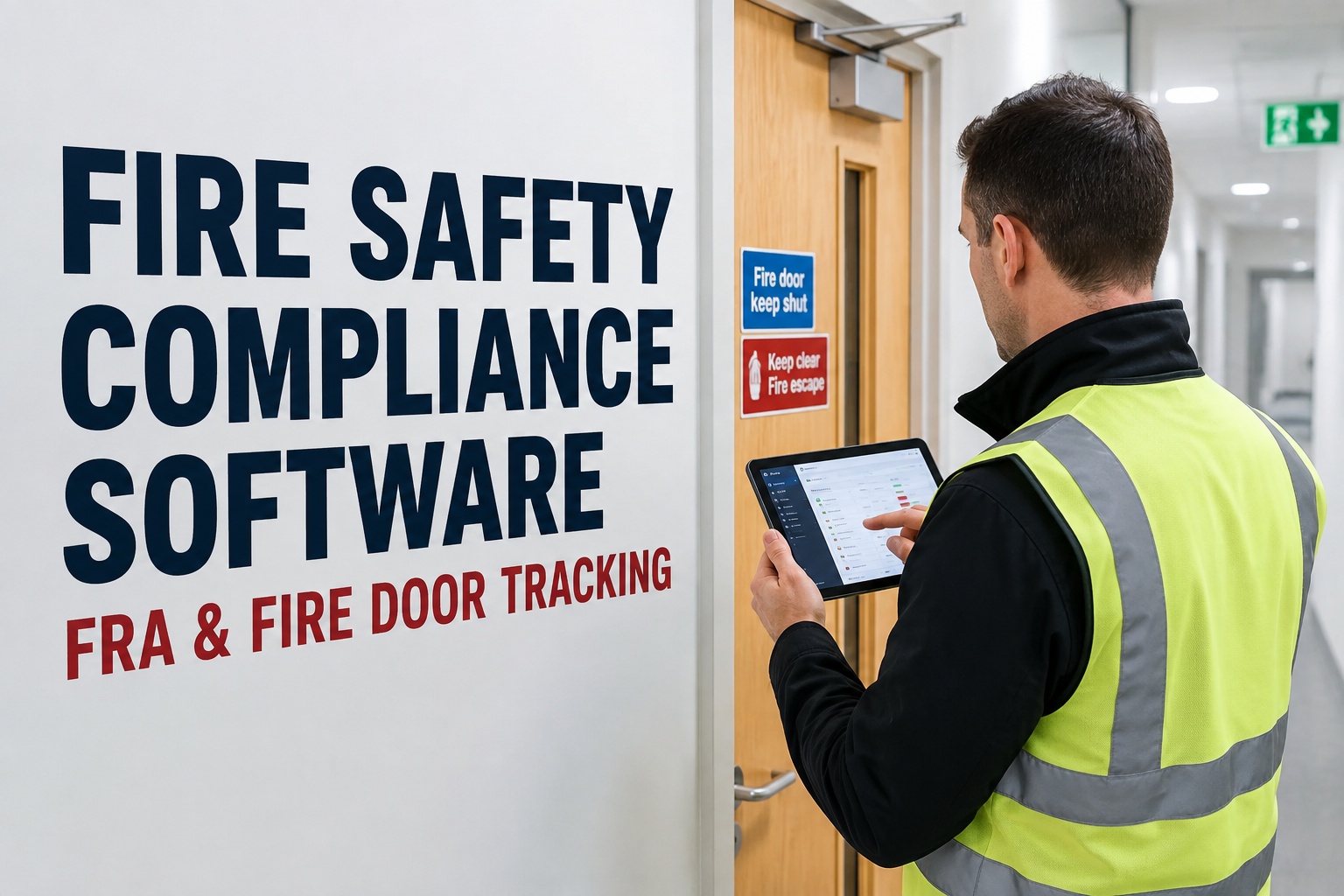
The UK fire safety regime rebuilt itself after Grenfell. The Regulatory Reform (Fire Safety) Order 2005 sits underneath, amended by the Fire Safety Act 2021 to explicitly cover structure, external walls and flat entrance doors. The Fire Safety (England) Regulations 2022 came into force on 23 January 2023 with specific duties on high-rise residential — quarterly fire door checks in common parts, annual flat entrance checks, Premises Information Boxes. The Building Safety Act 2022 sits above for higher-risk buildings. Every responsible person carries criminal liability. Book a demo to see fire safety workflows in action.
UK FIRE SAFETY · WHY EVIDENCE IS THE WHOLE JOB
Four pieces of legislation. Criminal liability for the responsible person. Unlimited fines. Every FRA action needs a documented trail.
2005
Fire Safety Order — foundational duty on the responsible person
Jan 2023
Fire Safety (England) Regulations 2022 in force — specific HRB duties
£∞
Unlimited fines for breach + potential custodial sentences
The Legislation Stack — What Actually Applies to Your Building
UK fire safety isn't one regulation — it's a layered stack built up over two decades and rebuilt after Grenfell. Every duty holder needs to know which layers apply to which building. The stack below is how Oxmaint organises compliance evidence per building, per applicable regulation. Sign up free to organise fire safety compliance by building.
LAYER 4 · 2022
Building Safety Act 2022
Higher-risk buildings (18m+ or 7 storeys, residential). Building Safety Regulator oversight, Golden Thread of information, Accountable Person duties.
LAYER 3 · 2023
Fire Safety (England) Regulations 2022
In force 23 January 2023. Quarterly fire door checks in common parts, annual flat entrance door checks (11m+), Premises Information Boxes, wayfinding signage, monthly lift checks.
LAYER 2 · 2022
Fire Safety Act 2021
Commenced 16 May 2022. Clarifies that FSO 2005 covers structure, external walls (including cladding), balconies, windows and flat entrance doors in multi-occupied residential buildings.
LAYER 1 · 2005
Regulatory Reform (Fire Safety) Order 2005
The foundational regime. Applies to all non-domestic premises and common parts of residential buildings. Places duty on the "responsible person" to carry out fire risk assessment and maintain fire safety measures.
The Inspection Frequency Matrix — What FSER 2022 Actually Requires
The Fire Safety (England) Regulations 2022 introduced specific inspection frequencies that depend on building height and door type. Above 11 metres, the regime tightens significantly. Above 18 metres or 7 storeys, additional Building Safety Act duties apply. Every check needs a documented record — not just a tick in a book but the specific door reference, the inspector's competence evidence, the finding, any remedial action raised.
The 11m threshold is measured to the finished floor level of the top storey. Inspections must be by a competent person under Article 18 of the Fire Safety Order. Certified Fire Door Inspectors carry evidenced qualification, but the RP retains the duty.
The Responsible Person Duty Chain — Where Personal Liability Actually Sits
The "responsible person" under Article 3 of the Fire Safety Order is a specific legal role, not a job title. In non-domestic premises it's typically the employer or building occupier. In multi-occupied residential buildings it's typically the freeholder, managing agent or building owner. Under the Building Safety Act, an additional "Accountable Person" role applies for higher-risk buildings. All of these carry criminal liability under the Fire Safety Order — unlimited fines and, in serious cases, custodial sentences up to two years.
01
Fire Risk Assessment (FRA)
Suitable and sufficient FRA in place, reviewed after any material change or incident. Post-2022 must cover structure, external walls, cladding, balconies, flat entrance doors.
02
FRA Action Tracking
Every FRA finding becomes an action with owner, deadline, priority and evidence trail. Overdue actions are the single most common enforcement finding.
Fire Door Inspection
03
Quarterly common parts, annual flat entrance (11m+). Every door referenced, competent-person inspection, findings and remedials logged.
04
Statutory Testing
Fire alarm weekly test (BS 5839), emergency lighting monthly test (BS 5266), extinguisher annual service (BS 5306), sprinkler system per BS 9251/9990.
Resident Information
05
Multi-occupied residential: fire safety information to residents, evacuation strategy, importance of fire doors, how to report a fire.
06
PEEP Management
Personal Emergency Evacuation Plans for residents / employees who cannot self-evacuate. Reviewed periodically and after any material change.
See Fire Safety Compliance Live
Walk through FRA action tracking, quarterly fire door inspection workflows, competent-person sign-off gating, PEEP records, statutory testing schedules and audit-ready evidence packs for FSO 2005, FSER 2022 and Building Safety Act duties. Thirty minutes with the Oxmaint team.
Why Spreadsheets Fail Fire Safety Duty Holders
The single most common enforcement pattern in UK fire safety inspection isn't discovery of a new hazard — it's discovery that a known FRA finding hasn't been actioned. A door listed as needing remedial work six months ago, still not done. A cladding survey action from the 2022 review, still open. A resident PEEP that hasn't been reviewed since the resident moved out. These aren't accidental oversights; they're what happens when action tracking lives in spreadsheets across multiple people's inboxes. A properly structured platform makes overdue FRA actions structurally visible — and blocks them from being quietly forgotten. Sign up free to eliminate overdue FRA actions.
Expert Perspective — Why the Responsible Person Needs Structural Support
"
The responsible person under the Fire Safety Order is a specific legal role that carries personal criminal liability in a way most duty holders don't fully internalise until an enforcement notice arrives. When something goes wrong on a building — and post-Grenfell, enforcement activity has intensified across every fire and rescue service — the first evidence request isn't "what happened" but "what did you know, when did you know it, and what did you do about it." The responsible person who can produce the FRA, the action tracker showing every finding with its status, the fire door inspection records, the competent person sign-offs and the resident information distribution log comes out of the enforcement conversation in a defensible position. The responsible person whose evidence sits across spreadsheets, email chains and paper contractor reports does not. This isn't about the software; it's about whether the duty holder can meet the evidential burden the statute now imposes.
01
FRA action tracker native
Every FRA finding becomes an action with owner, deadline, evidence. Overdue items structurally visible, not buried.
02
Door-by-door inspection log
Every fire door individually referenced. Quarterly and annual cycle tracked per door with competent-person sign-off.
03
PEEP records per person
Personal Emergency Evacuation Plans tied to residents/staff with review cycle. Change triggers re-review automatically.
04
Statutory test scheduling
BS 5839, BS 5266, BS 5306, BS 9251/9990 test frequencies enforced. Missed tests trigger overdue alerts.
Who Uses Oxmaint for UK Fire Safety Compliance
The platform is used by the specific UK roles carrying fire safety duty: managing agents responsible for multi-occupied residential portfolios under FSO 2005 and FSER 2022, housing associations managing social housing stock with mixed low-rise and high-rise buildings, freeholders and building owners acting as responsible person for their properties, hard-FM contractors delivering fire safety compliance under client SLA contracts, facilities managers running fire safety programmes across corporate and public sector estates, hospital and care home operators managing fire safety alongside patient/resident evacuation planning, and Accountable Persons for higher-risk buildings under the Building Safety Act. Each role sees the same asset data filtered to their view — FRA action queue, door inspection dashboard, PEEP register or statutory test schedule. Sign up free to configure fire safety workflows for your team.
Getting Fire Safety Compliance Live in 30-45 Days
Deployment starts by importing the building portfolio and existing fire safety data — current FRA documents, door registers, PEEP records, statutory test schedules. Every FRA finding converts into a trackable action with owner, deadline, priority and evidence field. Door-by-door registers configure per building with the applicable FSER 2022 inspection frequency (quarterly common parts, annual flat entrance for 11m+). Statutory testing schedules deploy per relevant BS standard (5839 fire alarm, 5266 emergency lighting, 5306 extinguishers, 9251/9990 sprinklers). PEEP records tie to residents or staff with periodic review. Competent-person sign-off gating prevents inspection records closing without evidence. Most managing agents and FM operators see FRA action tracking, door inspection cycles and statutory testing live within 30-45 days on primary buildings; portfolio deployments typically inside two quarters. Book a walkthrough to see live UK fire safety deployments.
Turn Fire Safety Duty Into a Defensible Evidence Trail
Oxmaint gives UK responsible persons and duty holders one platform for fire safety compliance — FRA action tracking, door-by-door inspection cycles under FSER 2022, PEEP management, statutory testing and audit-ready evidence packs for FSO 2005, Fire Safety Act 2021 and Building Safety Act duties.
Frequently Asked Questions
What UK fire safety legislation applies to my building?
Four layers may apply. The Regulatory Reform (Fire Safety) Order 2005 is the foundational regime and applies to all non-domestic premises and common parts of multi-occupied residential buildings — it places the duty on the "responsible person" to carry out a fire risk assessment. The Fire Safety Act 2021 (commenced May 2022) amended the FSO to explicitly cover structure, external walls, cladding, balconies and flat entrance doors in multi-occupied residential buildings. The Fire Safety (England) Regulations 2022 (in force 23 January 2023) added specific duties on residential buildings above 11m. The Building Safety Act 2022 sits above these for higher-risk buildings — 18m+ or 7 storeys+ residential. Which layer applies depends on building type, height and occupation.
Who is the "responsible person" and what liability do they carry?
The responsible person under Article 3 of the Fire Safety Order is a specific legal role. In non-domestic premises it's typically the employer or the person in control of the premises. In multi-occupied residential buildings it's typically the freeholder, managing agent or building owner. The RP has personal statutory duty to carry out and maintain a suitable and sufficient FRA, implement fire safety measures, and appoint competent persons where required (Article 18). Breach carries criminal liability — unlimited fines and, for serious breaches involving risk to life, custodial sentences up to two years. For higher-risk buildings under the Building Safety Act, an additional "Accountable Person" role applies with its own duties.
What are the fire door inspection frequency rules?
The Fire Safety (England) Regulations 2022 introduced specific frequency requirements for residential buildings over 11m in height. All fire doors in common parts (corridors, stairwells, lobbies) must be checked at least every three months. All flat entrance doors that open into common parts must be checked at least once a year. These are minimum legal requirements — the FRA may specify tighter frequencies for specific doors or door types based on risk. Checks must be carried out by a competent person, and every check needs to be documented per door with the inspector's competence evidence, findings and any remedial actions raised. For buildings under 11m, inspection frequency is per the FRA schedule (annual is typical best practice).
How does Oxmaint handle FRA action tracking?
Every FRA finding becomes a discrete tracked action in Oxmaint with owner, deadline, priority, description, and an evidence field for closure documentation. Overdue actions are structurally visible on the duty holder's dashboard — no buried spreadsheet rows. Actions link back to the source FRA document version, so historical evidence chain remains intact through FRA revisions. Post-2022 FRA scope items — structure, external walls, cladding, balconies, flat entrance doors — configure as tagged categories so the RP can demonstrate coverage of the specific Fire Safety Act 2021 clarifications. Every closed action retains its evidence pack indefinitely; the enforcement question "what did you do about it" gets answered by filter.
What statutory testing does fire safety compliance require alongside FRA actions?
Several British Standards define the underlying statutory testing regime. BS 5839 covers fire alarm and detection systems — weekly manual call point tests, six-monthly service by competent person. BS 5266 covers emergency lighting — monthly function tests, annual full duration tests. BS 5306 covers portable fire extinguishers — monthly visual check, annual service by competent person. BS 9251 (residential sprinklers) and BS 9990 (dry/wet risers) apply to specific building types. FSER 2022 added monthly lift checks for HRB residential. Oxmaint tracks all of these against the applicable British Standard with automatic overdue alerting and competent-person sign-off gating to prevent unrecorded closures.