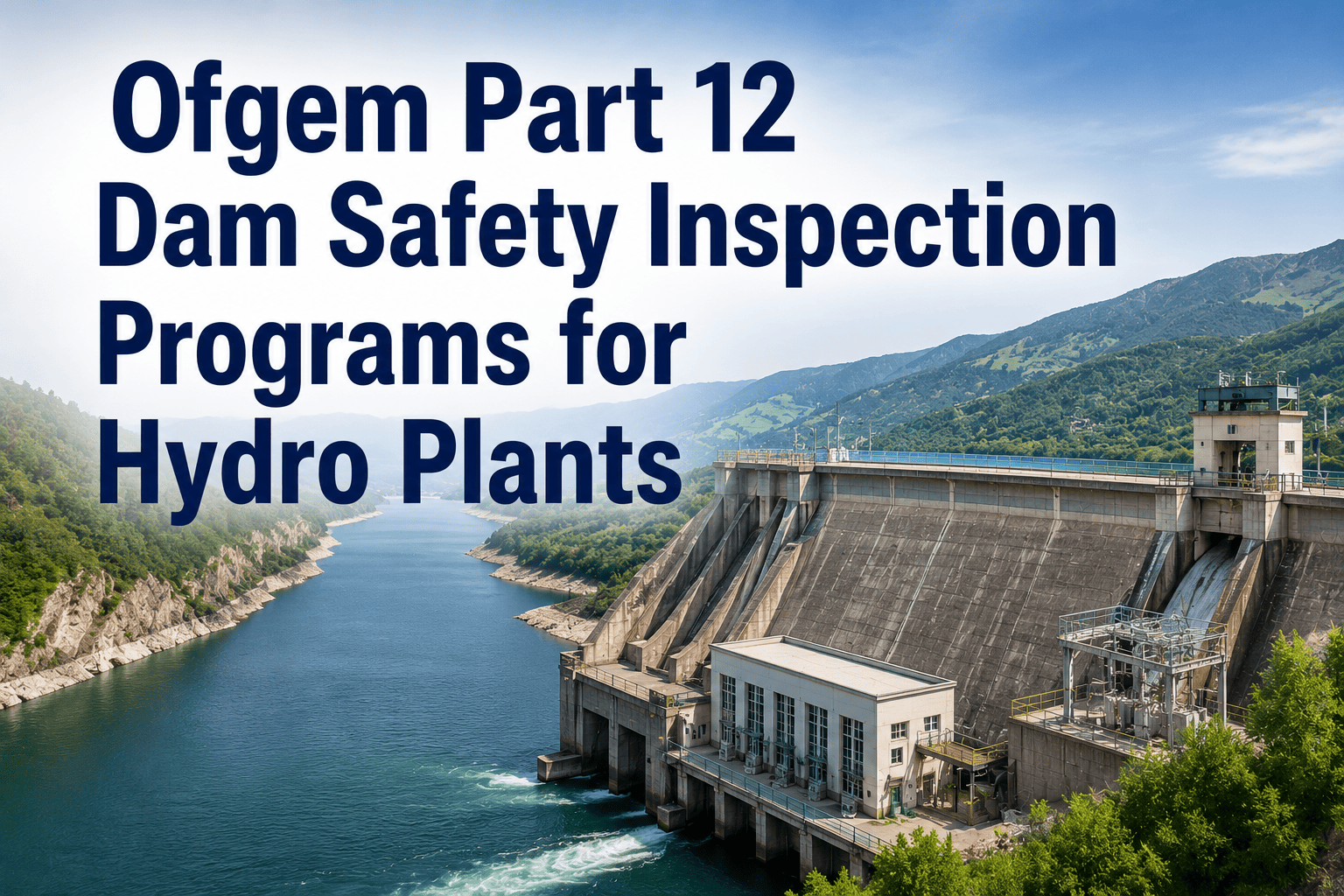
Ofgem Part 12 Dam Safety Inspection Programs for Hydro Plants

By Mark strong on August 12, 2026

ferc-part-12-dam-safety-inspection-programs-hydro-plants

A weir reading that's ten minutes late, a hairline crack left unphotographed for a month, or a spillway gate cycle test that never gets logged — on paper these look like small gaps. On a dam, they're the difference between catching a problem early and explaining to a regulator why nobody caught it at all. Sign up to run your Ofgem Part 12 inspection program — seepage readings, crack monitoring, spillway checks, and closure records — from one auditable system built for UK power station teams.

Why It Matters

Every hydro dam in the UK carries a downstream risk that doesn't announce itself until it's already a problem. Seepage that changes colour, a crack that widens by a millimetre, a spillway gate that sticks halfway — these are the early signals a Part 12 inspection program exists to catch, and a gap in the record is treated the same way a gap in the physical structure would be.

Periodic Inspection vs Comprehensive Assessment

Periodic Inspection
A structured walkdown of the dam, spillway, and appurtenant structures against prior findings. Checks physical condition, reviews instrumentation trends, and confirms every open action item from the last cycle has actually closed.
Comprehensive Assessment
A deeper engineering review layered on top of the routine walkdown — long-run instrumentation trends, seepage chemistry, seismic and flood loading, and a fresh look at whether the dam's risk profile has shifted since the last assessment.

The two feed each other. A periodic inspection that flags a slow seepage trend is what triggers a closer look in the next comprehensive assessment, which is exactly why a broken chain of readings is worse than a single missed one — it's the trend that tells the real story, not any one data point.

What A Structured Inspection Program Tracks

Seepage Monitoring
Piezometers and weirs read on a set schedule, flagged the moment flow or clarity drifts from baseline
Crack And Movement
Crack gauges and settlement monuments tracked over time, not just measured once and forgotten
Spillway And Gates
Cycle tests, corrosion checks, and stilling basin condition confirmed operable before flood season
Concrete And Embankment
Spalling, cracking, and slope condition logged with photos against a fixed reference point
Instrumentation Trends
Readings plotted against action levels so a slow drift shows up long before it becomes a finding
Records And Closure
Every finding tied to a work order with an owner and a closure date, ready for the next audit
Stop Chasing Readings Across Spreadsheets

Oxmaint schedules every seepage reading, crack check, and spillway test against your own Part 12 cycle, and keeps the finding-to-closure trail intact for the next inspector. Sign up for a free trial to run it on your own dam, or book a demo to see it set up for your station.

Why A Trend Beats A Single Reading

A seepage flow of 2 litres a minute means nothing on its own. Whether that's normal or alarming depends entirely on what the same weir read last month, and the month before that. The value of a Part 12 program isn't the individual inspection, it's the unbroken chain of readings that lets a small, gradual shift stand out against its own history. Spreadsheets and paper logs make that chain easy to break — a missed entry, a reading filed under the wrong date, a photo that never got attached to the right finding. A dam that's been read consistently for years tells you far more than one that's been read perfectly once.

Typical Inspection Triggers

Component Inspection Basis Typical Trigger
Seepage weirs Scheduled reading interval Flow rate, clarity, or sediment change from baseline
Crack gauges Periodic reading, condition-triggered Width or movement beyond the last recorded value
Spillway gates Pre-flood season cycle test Failed full-travel operation or actuator delay

Frequently Asked Questions

Q What does a Part 12 style inspection actually cover?
It covers the full structure, not just the dam face — seepage points, crack and settlement instrumentation, spillway and gate operability, and concrete or embankment condition, each checked against its own inspection history rather than a one-off snapshot.
Q How often should seepage and crack instruments be read?
Frequency depends on the instrument and the dam's risk classification, but the interval matters less than consistency — a weir read reliably every week builds a far more useful trend than one read perfectly but sporadically.
Q Why do inspection records matter as much as the inspection?
An inspection that finds a problem but leaves no linked, dated corrective action is functionally the same as no inspection at all — the record is what proves the finding was actually closed, not just noticed.
Give Your Next Inspector A Clean Record To Review

Oxmaint keeps seepage readings, crack monitoring, spillway checks, and every closed finding in one place, ready for the next audit without a scramble through old spreadsheets. Sign up for a free trial to run it on your own dam, or book a demo to see it configured for your station.


Share This Story, Choose Your Platform!