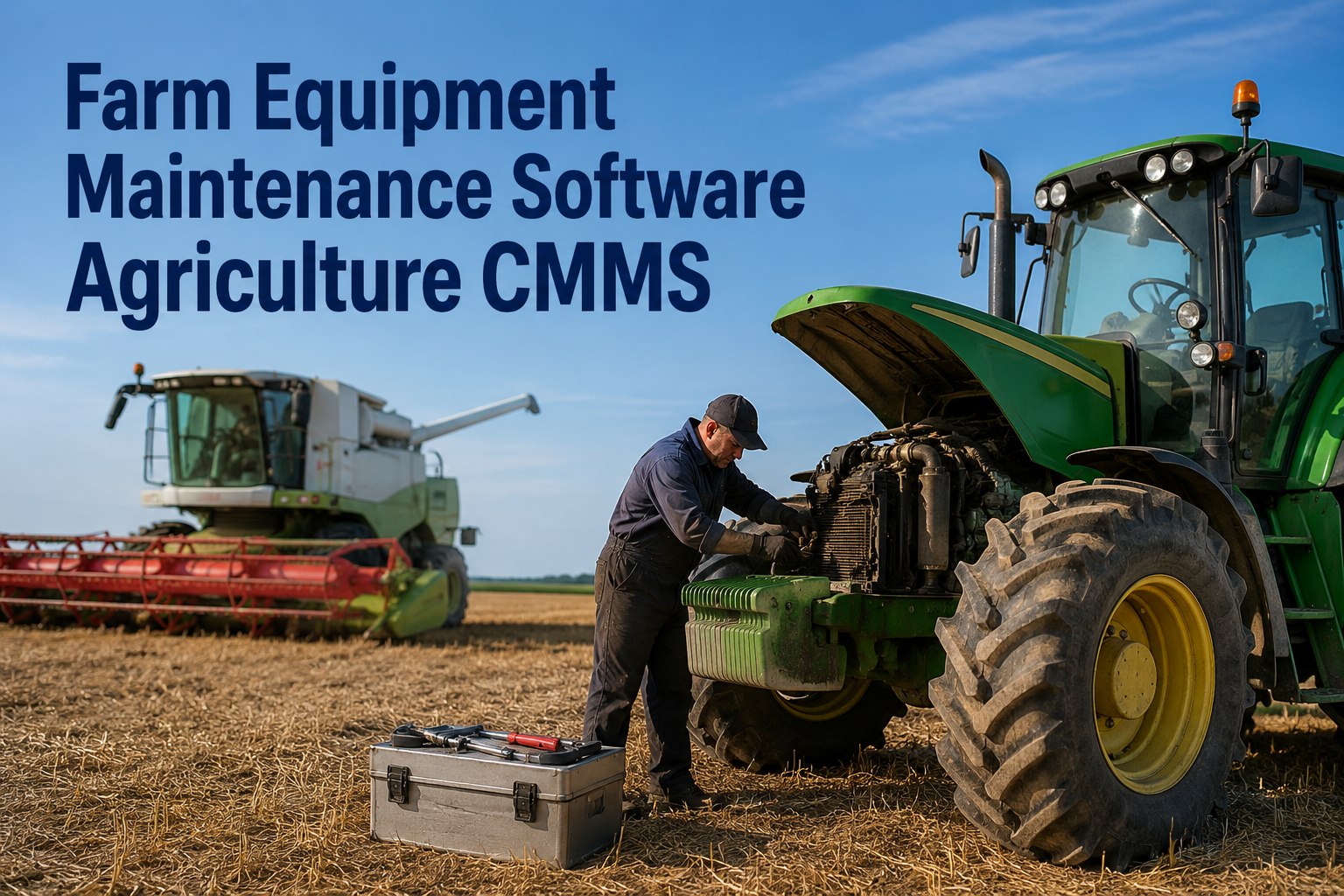
A UK combine harvester earns its keep in about 15 working days a year. Miss a fortnight of weather because the header's down, and next season's yield is a spreadsheet full of red. Agricultural maintenance operates under a constraint no factory ever faces — machines that sit for nine months, run flat-out for weeks, and cannot fail during the window that pays for them. Add milking hygiene, grain dryer uptime, sprayer testing and Red Tractor audits, and farm maintenance stops looking like a workshop task. Book a demo to see farm maintenance workflows in action.
◆ FARM WORKSHOP · SEASONAL OPS · RED TRACTOR AUDIT
Your combine has 15 working days. Your milking parlour has zero. Farm maintenance is a calendar problem before it's a workshop problem.
Every tractor. Every harvester. Every parlour cluster and grain-store fan. Sequenced against the season, not against convenience.
15
HARVEST DAYS PER YEAR
The window that pays for the combine
JANAPRJULOCTDEC
4% of the year · 100% of the yield decision
£800/hr
Typical harvest downtime cost per combine
2×/day
Milking parlour cycles — no maintenance window
£40k
Average farm machinery repair spend per year
The Farm Asset Map — What a Real Register Looks Like
Farm asset registers aren't a workshop parts list — they're a fleet, a plant, a herd of buildings, and a rack of stored kit that has to survive nine dormant months and start on day one. The hub-and-spoke map below is what a mixed arable-and-dairy operation actually holds under a single system.
FIELD FLEET
Tractors & Telehandlers
John Deere · New Holland · Fendt · Massey · JCB Loadall
Highest-hours assets · 250/500hr PPM cycle · MOT + inspection duty
HARVEST
Combines & Foragers
Combine harvester · Cutting header · Trailed forager · Bailer
Seasonal-critical · Pre-season strip-down · Zero-fail window
DAIRY
Milking Parlour & Bulk Tank
Cluster · Vacuum pump · Plate cooler · Bulk tank · Wash system
2x/day duty · Hygiene-critical · Red Tractor evidence trail
GRAIN STORE
Drying & Handling Plant
Grain dryer · Bucket elevator · Auger · Aeration fan · Weighbridge
Post-harvest continuous · ATEX zoning · Fire risk assessment
IMPLEMENTS
Ploughs, Drills & Sprayers
Reversible plough · Power harrow · Combi drill · Boom sprayer · Muck spreader
Seasonally rotated · NSTS sprayer test · PUWER inspection
INFRASTRUCTURE
Buildings & Fixed Plant
Slurry system · Feed mill · Generator · Water supply · Fencing · Yard scraper
Continuous background PPM · Electrical + LEV compliance
The Harvest Downtime Cascade — What a Broken Combine Actually Costs
Ask any UK arable farmer what a combine breakdown costs and the honest number surprises the accountant. It's never just the repair. The real cost cascades — hire replacement, delayed cut, weather exposure, grain moisture penalty, drying-cost hit, contractor overrun, missed haulage slot, following-crop drilling delay. The cascade below is what a single 72-hour combine failure at peak harvest actually looks like on a 400-hectare operation.
HARVEST DOWNTIME
72hr combine failure · 400ha wheat operation
Hire replacement (3 days)
£5,400
Moisture penalty & drying cost
£8,800
Contractor overrun & haulage delay
£12,200
Next-crop drilling delay impact
£16,500
Total cascade impact — one combine · one week · one operation
£46,400
Inside a Working Tractor Service — Where PPM Actually Lives
A modern high-hours farm tractor is a rolling machine — engine, driveline, hydraulics, PTO, cab electronics, telematics, tyres, front-loader, and a growing stack of precision-ag electronics that used to be optional and are now standard. The callout diagram below is what the workshop team actually holds on the PPM card for each unit. Sign up free to structure PPM cards for your whole tractor fleet.
TRACTOR PPM ANATOMY
Service Points · 250 / 500 / 1000 hour cycles
1
Engine & cooling
Oil + filter 500hr · Coolant SCA test 500hr · Air filter · Fuel pre-filter · EGR/DPF cycle
2
Driveline & PTO
Transmission oil 1000hr · Front-axle diff · PTO stub inspection · Clutch adjustment
3
Hydraulics & couplers
Hydraulic oil filter · Return-line filter · Spool valve leak check · Quick-coupler seals
4
Wheels & tyres
Wheel-nut torque · Tyre pressure per implement · Rim inspection · Ballast check
5
Cab, electronics & telematics
ISOBUS interface · GPS receiver · Section-control valves · Cab HVAC filter · Camera
6
Front loader & attachments
Loader pins & bushes · Attachment latch · Hose routing · Boom weld inspection
◆ FARM MAINTENANCE DEMO
See the Full Farm Workflow in 30 Minutes
Tractor and combine PPM cards, milking parlour hygiene cycles, grain-store fire risk inspections, sprayer NSTS scheduling, mobile fault raise from the field, spares chain and Red Tractor audit-ready evidence — configured for your operation.
The Milking Parlour Rhythm — Why Dairy Maintenance Is Different
Dairy is the one part of a mixed farm where "we'll do it tomorrow" doesn't work. Cows arrive at the parlour twice a day, every day, and the machine has to be ready. Rubber liners wear on a strict schedule. Vacuum pumps drift out of specification long before they fail. Plate coolers foul with milkstone. Bulk-tank refrigeration failures spoil an entire day's yield. And Red Tractor and dairy processor assurance schemes ask for evidence — service records, water quality tests, chemical dosing logs, the cluster changeout schedule. The cycle below is what a dairy CMMS actually has to hold.
DAILY
Pre-milkingVacuum level check · Wash cycle verification · Cluster inspection
Post-milkingFull CIP wash · Filter sock change · Bulk-tank temperature log
WEEKLY
RubberwareLiner condition inspection · Long-milk tube check
ChemistryDetergent titration · Water hardness test · Chemical dose verification
MONTHLY
Vacuum & pulsationVacuum pump service · Pulsator function test · Regulator calibration
CoolingPlate cooler descale · Condenser cleaning · Bulk tank calibration
6-MONTHLY
Liner replacementFull cluster liner changeout (per manufacturer hour cycle)
Static testMilking Machine Static Test (BS EN ISO 6690) · Certificate for processor
Miss a Static Test date and the milk processor contract flags it before the next collection. Miss a liner changeout and cell counts drift up. Miss a bulk-tank temperature log for a week and the Red Tractor audit is uncomfortable. Structural discipline is the whole point. Sign up free to structure dairy hygiene cycles.
Expert Perspective — What Farm Maintenance Software Actually Fixes
"
Farm maintenance software gets sold on the tractor fleet, but the value on a mixed operation is almost always in the bits that aren't tractors — the parlour cycle discipline that stops liner changeouts drifting six weeks late, the sprayer NSTS date that gets flagged eight weeks before it expires instead of the day the crop needs spraying, the grain-store fire risk assessment actions that stop being a filing-cabinet exercise and become tracked work, the Red Tractor audit evidence that assembles itself from the workflow rather than the week before the auditor arrives. Farms that have run maintenance out of a wall-planner and a diary for 20 years often assume digitisation is a workshop tool. In practice, the return comes from the compliance and seasonal-critical disciplines that were quietly slipping in the paper system. The workshop teams already know their tractors. What they didn't have was the calendar visibility across the operation, and that's what changes.
— Agricultural Engineering & Farm Business Practice
01
Hours-based PPM cards
Every tractor, combine and telehandler runs on hour-cycle PPM tied to telematics data feed or manual reading.
02
Seasonal pre-work strip-down
Pre-harvest and pre-drilling readiness inspections triggered on calendar with parts-ready ticklists.
03
Compliance dates surfaced
NSTS sprayer test, LOLER lift inspection, PUWER assessment, Static Test all flagged before expiry.
04
Field-side mobile fault raise
Operator photographs and logs a fault in the field. Workshop sees it before the machine reaches the yard.
Who Uses Oxmaint on UK Farms
The platform is used by the roles that keep UK farm operations moving day-to-day: farm managers running mixed arable and livestock operations with fleets of tractors and implements, workshop managers coordinating PPM and repair work across the year's seasonal peaks, dairy managers running twice-daily parlour cycles with Red Tractor and processor assurance evidence duties, arable managers scheduling combine and sprayer readiness around the weather window, grain-store operators managing dryer and handling plant through the post-harvest period, farm secretaries producing audit-ready records for Red Tractor and dairy assurance visits, and estate managers overseeing multi-farm portfolios with contractor coordination. Sign up free to configure farm maintenance for your operation.
Getting Farm Maintenance Live in 30-45 Days
Deployment starts with the farm asset register — tractors, combines, telehandlers, milking parlour equipment, grain plant, implements, buildings — imported with hour meters, service histories and manufacturer schedules. PPM cards configure per asset with hour-cycle and calendar triggers. Seasonal pre-harvest and pre-drilling strip-down routines set up. Compliance dates (NSTS, LOLER on telehandlers, Static Test, PUWER) tied to reminders before expiry. Mobile fault-raise deploys to field operators. Workshop dispatch runs from the mobile inbox. Red Tractor and processor audit evidence packs generate from workflow. Most mixed farms see asset register, PPM cycles and mobile fault-raise live within 30-45 days. Book a walkthrough to see live UK farm deployments.
◆ THE WORKSHOP, THE PARLOUR, THE GRAIN STORE — IN ONE PLACE
Every Tractor. Every Cluster. Every Season.
Oxmaint gives UK farm operators the whole maintenance operation in one system — tractor and combine PPM cards, milking parlour cycle discipline, grain plant and sprayer compliance, seasonal readiness routines, mobile field fault-raise and audit-ready evidence packs.
Frequently Asked Questions
What is farm equipment maintenance software?
Farm equipment maintenance software is a CMMS (computerised maintenance management system) configured for the specific asset mix of a working UK farm — tractors, combines, telehandlers, milking parlour equipment, grain-store plant, sprayers, implements and buildings. It holds hours-based PPM cards for engine-driven kit, seasonal readiness inspections for time-critical machinery, hygiene and Static Test cycles for dairy equipment, statutory inspection dates (NSTS, LOLER, PUWER) with reminders before expiry, mobile fault-raise from field operators, spares chain integration and audit-ready evidence packs for Red Tractor, dairy processor assurance and other farm quality schemes. The value on a mixed farm is calendar visibility across the whole operation, not just the workshop bench.
Does it track NSTS, LOLER and other agricultural compliance dates?
Yes. Common UK agricultural compliance dates supported include the National Sprayer Testing Scheme (NSTS) certificate for boom sprayers used commercially, LOLER thorough examinations for telehandlers and any farm lifting equipment (6-monthly for lifting accessories and people-lifting, 12-monthly for other lifting equipment), the Milking Machine Static Test to BS EN ISO 6690 required by most dairy processor contracts, PUWER inspection cycles for work equipment, PA1/PA2/PA6 sprayer operator competence certificates on the workforce side, and fire risk assessment review dates on grain stores. All configured with reminder windows so dates surface before they expire, not the week the crop needs treating.
Can operators raise faults from the field on mobile?
Yes — the platform is mobile-first for field use. An operator running a tractor, combine or sprayer photographs the fault, tags the machine, adds a short description and submits from wherever there is a mobile signal. The fault reaches the workshop inbox before the machine returns to the yard, so parts can be ordered, replacement kit arranged or diagnostics prepared before the operator arrives. This is the pattern that materially changes downtime — the delay between fault occurring and workshop knowing about it typically collapses from hours to seconds, which for time-critical operations like combining or spraying is the difference between finishing the field and losing the day.
Does it help with Red Tractor and dairy processor audits?
Directly. Assurance schemes like Red Tractor, Arla, Muller and other dairy processor programmes require documented evidence of equipment maintenance, hygiene cycles, chemical dosing, temperature logs and Static Test certificates — usually across a rolling 12-month window. When PPM cycles, wash-cycle records, bulk-tank temperature logs and chemistry test results all run through the platform, the audit evidence assembles itself from the workflow rather than being reconstructed the week before the auditor arrives. Farms typically move from a stressful pre-audit assembly exercise to on-demand evidence export in seconds — which is what auditors are looking for as best practice.
How long does deployment typically take on a mixed UK farm?
A single mixed arable-and-dairy farm typically goes live within 30-45 days — farm asset register import (tractors, combines, telehandlers, parlour equipment, grain plant, implements, buildings), PPM card setup with hour-cycle and seasonal-calendar triggers, compliance dates (NSTS, LOLER, Static Test, PUWER) configured with pre-expiry reminders, mobile deployment to field operators and workshop team, and Red Tractor/processor audit evidence pack templates set up. Multi-farm estate deployments typically complete within a quarter. Telematics integration for tractor hour-meter feeds adds to timeline where those integrations are enabled, though many farms start with manual hour reading and add telematics phase two.