A building can hit every ESG target on paper and still fail a Legionella audit, miss a TM44 renewal, or run a chiller past its F-Gas leak check window — because energy dashboards and compliance registers have traditionally lived in different systems, updated by different people, on different schedules. 2026 is the year that gap starts closing, as smart building sensors, AI-driven work order routing and automated compliance scheduling move from pilot projects into everyday facility operations. This piece walks through the trends actually reshaping UK facility management this year, and where the evidence trail behind them is heading. Teams ready to see it in practice can try OxMaint free before reading further.
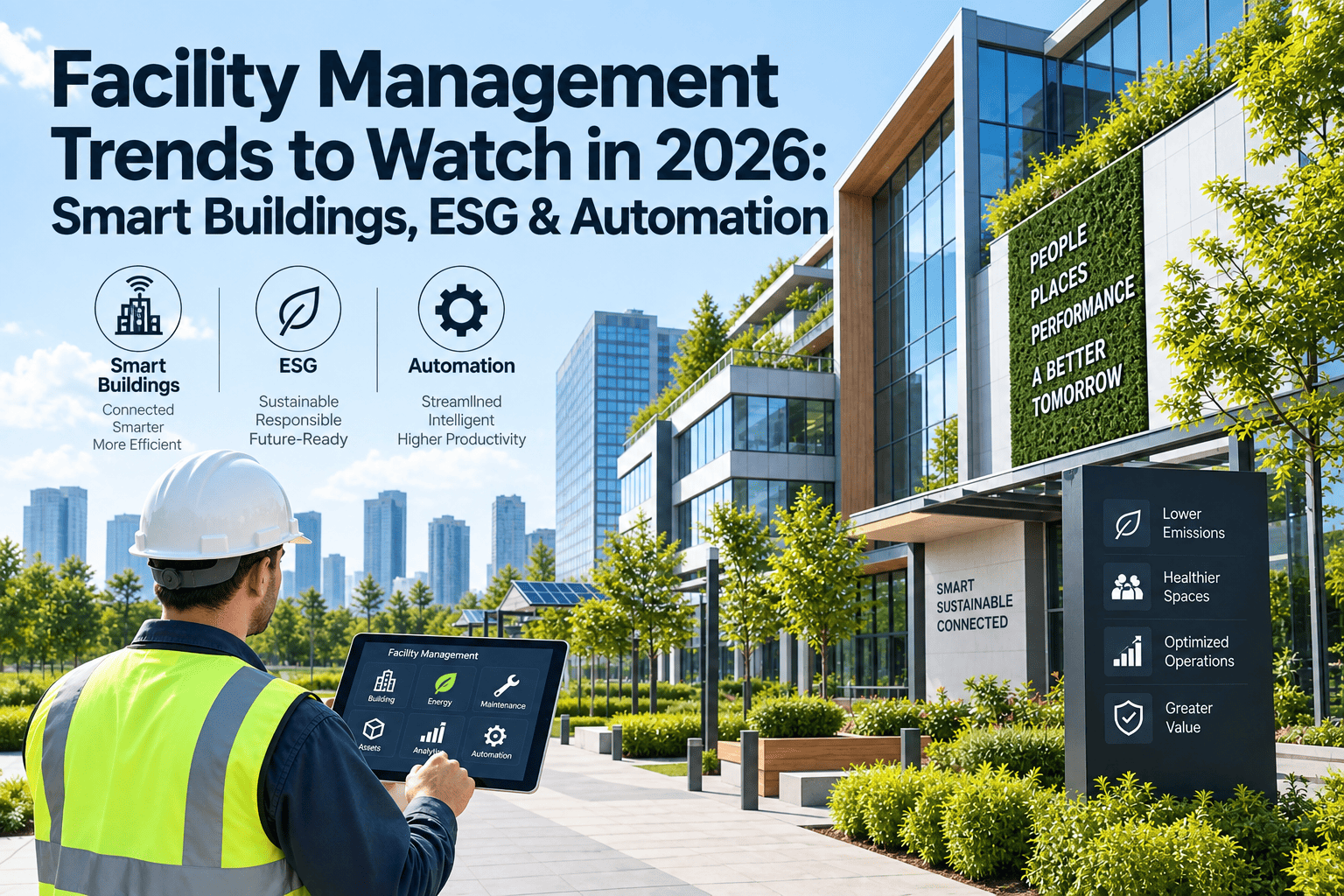
Facility Management Trends to Watch in 2026
Smart buildings, ESG reporting and AI automation are converging on one requirement: maintenance and compliance data that is accurate the moment it is recorded, not reconstructed weeks later from memory and paperwork.
The Six Trends Defining 2026
These are not distant predictions — each of the following is already live in UK facility operations this year, and each one depends on maintenance data being trustworthy enough to act on automatically. Together they mark a shift away from facility management as a reactive, paperwork-heavy function toward one that runs on live, connected data across every site in a portfolio.
AI-Assisted Work Order Routing
Jobs are triaged and assigned based on asset history, engineer skill and urgency, cutting the manual scheduling work that used to sit with a single planner. For multi-site operators, this also means jobs get routed to the nearest available engineer rather than whoever happens to be free at head office.
IoT-Connected Plant Rooms
Chillers, boilers and AHUs increasingly report run hours and fault codes directly into the maintenance system, replacing manual gauge readings on paper logs. This shortens the time between a fault developing and an engineer being dispatched, often from days down to hours.
ESG Reporting Pulled From Maintenance Records
Energy performance and equipment efficiency data is now expected to feed sustainability reporting directly, rather than being reconstructed at year-end from whatever paperwork can be found. Sustainability leads are starting to ask facility teams for this data quarterly, not annually.
Mobile-First Compliance Evidence
Engineers log F-Gas readings, Legionella temperature checks and PPM sign-offs from a handheld device, closing the lag between the visit and the record. This also removes a common audit failure point, where a paper checklist was completed but never made it back to the office file.
Predictive Maintenance Over Fixed Calendars
Run-hour and condition data is starting to adjust service intervals automatically, instead of every asset following the same generic calendar date regardless of actual usage or load. Over time this shifts spend away from parts and labour on equipment that did not need attention yet.
Portfolio-Level Building Analytics
Multi-site operators compare energy use, compliance status and maintenance spend across every property from a single dashboard rather than site by site, making it possible to spot an underperforming building months before its costs show up in the annual accounts.
Each of these trends sounds like a technology story, but underneath every one of them is the same operational question: can your team prove, on demand, that the right work happened on the right asset at the right time? That question is exactly where facility management starts to overlap with formal compliance, and it is where the next section picks up.
The Compliance Layer Behind Every Smart Building
Smart building technology gets the headlines, but underneath it sits a dense web of statutory maintenance obligations. HVAC and water systems alone carry several overlapping regimes, and confusing one for another is one of the most common compliance gaps facility teams run into — often discovered only when a lease renewal, insurance review or audit asks for evidence that was never centrally filed.
| Requirement | Governing Guidance | Typical Frequency | Evidence Needed |
|---|---|---|---|
| Air conditioning energy inspection | CIBSE TM44 | Every 5 years (systems over 12kW) | Lodged inspection report |
| Refrigerant leak checks | F-Gas Regulation | Quarterly to annual, by CO2e charge | Equipment logbook per system |
| Legionella risk control | HSE ACOP L8 / HSG274 | Reviewed at least every 2 years | Written scheme of control |
| Water temperature monitoring | HSG274 Part 2 | Monthly outlet checks | Temperature log per outlet |
| Ductwork cleanliness | BESA TR/19 | Risk-based interval | Inspection and cleaning record |
Requirements and frequencies vary by system size, use and risk category — always confirm current thresholds with your competent person or accredited assessor before relying on general guidance like this table.
Turn Compliance Regimes Into One Schedule
OxMaint tracks TM44 renewals, F-Gas leak checks, Legionella monitoring and PPM completion against every asset in your plant room, so compliance never depends on someone remembering a date on a personal calendar.
Where Each Building System Fits
Smart building technology is often discussed as one thing, but in practice it is several separate systems, each with its own compliance calendar and its own failure mode if records slip. Facility teams that map ownership clearly across these systems tend to have far fewer compliance surprises than teams treating maintenance as one undifferentiated task list, because each domain below needs a different specialist, a different evidence format, and a different review cycle.
HVAC & Plant Room
Chillers, boilers, AHUs and air conditioning units carry the densest set of statutory obligations of any building system, spanning energy inspection under TM44, refrigerant containment under F-Gas, and routine PPM against manufacturer guidance. A missed service here rarely stays hidden for long, since these are also the systems tenants notice first when something goes wrong, and complaints tend to escalate quickly once comfort conditions slip.
Water Systems
Hot and cold water services fall under ACOP L8 and HSG274, with a written scheme of control, a nominated responsible person, and monthly outlet temperature checks as the baseline expectation. Because Legionella risk changes with occupancy and plant condition, this is one of the few compliance areas where the underlying risk assessment itself needs periodic review, not just the routine monitoring that sits underneath it.
Electrical Infrastructure
Switchgear, distribution boards and fixed wiring sit under BS 7671 periodic inspection requirements, with condition reports feeding directly into a building's fire and life-safety risk profile. Electrical compliance tends to be the system most facility directors ask about first during an audit, simply because the consequences of getting it wrong are so severe, and because insurers now expect to see current inspection dates on request.
Building Management Systems
The BMS layer increasingly acts as the data source feeding automation and predictive maintenance, but it is only as reliable as the sensor calibration and asset tagging behind it. A BMS with clean, accurate asset data can trigger maintenance automatically; one with stale mappings just produces noisy alerts that engineers learn to ignore, which quietly undermines the whole point of investing in it.
Why ESG Reporting Now Runs Through the Maintenance Team
Sustainability disclosures used to be assembled from utility bills and rough estimates. That approach is losing credibility fast, because auditors and investors increasingly expect energy and equipment performance data to trace back to actual maintenance and monitoring records — the same records that already exist inside a well-run CMMS. Facility teams are quietly becoming one of the most important data sources in the entire ESG reporting chain, whether they have been asked for that role formally or not, and the estates that recognise this early tend to spend far less time scrambling before a reporting deadline.
Equipment Efficiency
Chiller and boiler performance data logged at every service feeds directly into energy efficiency reporting, rather than being estimated after the fact from utility totals.
Refrigerant Accountability
F-Gas logbooks double as an emissions record, since refrigerant type and charge size are already tracked for leak-check compliance across every system.
Asset Lifecycle Data
Run hours and replacement history support capital planning decisions that reduce embodied carbon from premature equipment replacement or over-specified new plant.
Audit-Ready Trails
Every inspection, reading and remedial action is timestamped and attributable, meeting the traceability auditors are now routinely asking for at year-end.
What Automation Actually Changes on the Ground
The numbers behind AI-assisted maintenance are consistent across UK and international facility operations: the gains come less from new technology and more from removing the manual steps that used to sit between an inspection and a usable record. None of these figures depend on replacing engineers — they depend on giving engineers a system that captures what they already know the moment they know it.
None of these figures come from a single flagship deployment — they are averages drawn from facility operations of very different sizes, which is why the same pattern shows up whether an estate has three buildings or three hundred.
Move From Spreadsheets to a Live Compliance Dashboard
See exactly how many of these gains apply to your own portfolio. OxMaint connects work orders, PPM schedules and inspection evidence into one system your whole team can trust and act on daily.
A Quick Checklist Before Year End
If your team is weighing up where to start, these are the checks worth running against your own portfolio before the next compliance cycle lands. None of them require new hardware or a lengthy procurement process — most can be done from your existing records in a single afternoon.
Confirm every air conditioning system over 12kW has a current TM44 report lodged on the register, not just a service history on file.
Check F-Gas leak-check frequency against each system's CO2-equivalent charge, rather than applying one blanket interval across the whole estate.
Verify your Legionella written scheme of control has been reviewed within the last two years, or sooner after any plant or occupancy change.
Map which PPM schedules still rely on a spreadsheet reminder rather than an automated, recurring work order in a connected system.
Identify which sites in your portfolio have no live view of open compliance items for a director to check on demand at any time.
The pattern above plays out the same way across most estates once they move from spreadsheet-based compliance to a connected system, as this facility engineering lead found within a single audit cycle.
We used to find out about a lapsed F-Gas check the same week as an insurance renewal, which is the worst possible time. Now every refrigerant system on our estate shows its next due date on one screen, and the engineer who did the last check is logged against it. It has taken the panic out of our compliance calendar entirely, and our last insurance audit took a single afternoon instead of a week of chasing paperwork.
Head of Engineering, UK Commercial Property GroupFrequently Asked Questions
What is the difference between a TM44 inspection and an F-Gas leak check?
A TM44 inspection is an energy-efficiency assessment carried out every five years on air conditioning systems above 12kW, lodged on a national register. An F-Gas leak check is a separate refrigerant-containment duty, carried out by a certified engineer at intervals set by the system's CO2-equivalent charge. Passing one does not satisfy the other.
How often does a Legionella risk assessment need reviewing?
HSE guidance under ACOP L8 and HSG274 recommends review at least every two years, and sooner after any significant change to the water system, building use or responsible person. Many well-run estates choose an annual review as standard practice rather than waiting for the two-year trigger to force the issue.
Can a CMMS actually replace a spreadsheet for PPM scheduling?
Yes, and it typically does more than replace it — recurring PPM tasks generate automatically from set intervals, and completion evidence is attached to the record itself rather than living in a separate file that has to be cross-referenced manually. You can sign up free to see this against your own asset list.
Does ESG reporting really depend on maintenance records?
Increasingly, yes. Energy performance, refrigerant accountability and asset lifecycle data are all easier to defend in a sustainability report when they trace back to timestamped maintenance and inspection records rather than year-end estimates pieced together from utility bills and memory.
How do I know if my building needs a TM44 inspection?
The threshold is based on combined cooling output across every air conditioning unit under single control, not any one unit alone — several smaller split units can add up past 12kW even when no single unit looks large enough to matter on its own. Book a demo to walk through your specific plant list.
Get Ahead of 2026's Compliance Calendar
OxMaint gives UK facility teams one connected view of PPM schedules, HVAC and water compliance evidence, and portfolio-wide maintenance performance — built for the standards your buildings are actually held to, whether that is a single site or a multi-property estate.