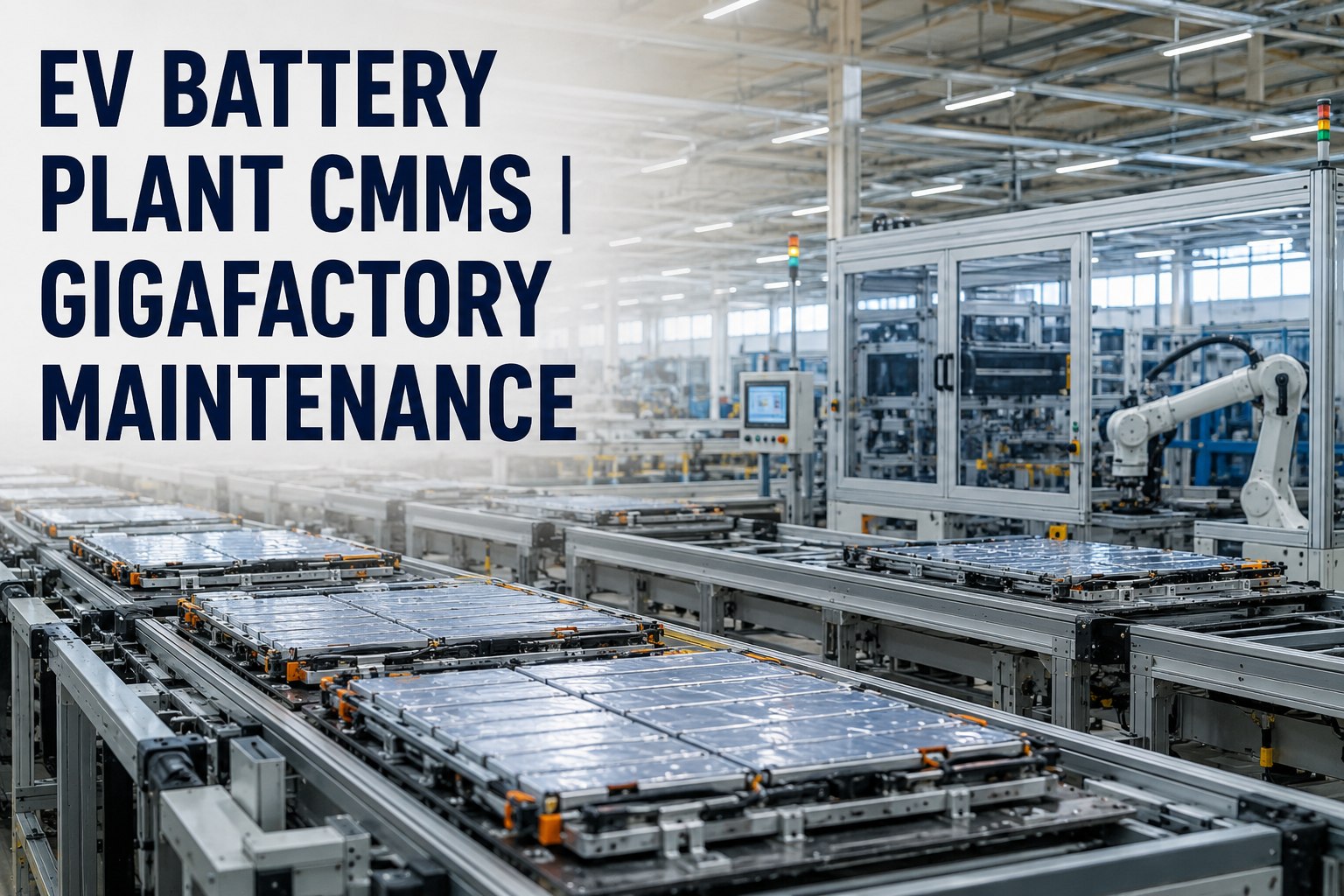
Inside a lithium-ion gigafactory, one hour of unplanned coater downtime can cost £75,000 in lost cell output. A dry-room dew point creeping from −55°C to −40°C can contaminate an entire electrolyte-filling batch. A single winder alignment drift can push cell tab welds out of spec — and the defect will not show up until formation, two weeks later. Traditional CMMS platforms were not built for this. An EV battery plant CMMS — sign up free to explore Oxmaint tracks the equipment, environment, and traceability data that gigafactory maintenance actually depends on.
The Production Line
Where Battery Cells Are Made — and Where Maintenance Decides Yield
Seven stages, each with its own failure signature, downtime cost, and evidence trail
01
Slurry Mixing
Ambient
MIX Planetary mixers, dispersion mills
VLV ~5,000 control valves per gigafactory
Failure signature
Viscosity drift, seal wear, valve stiction
£ £12k/hr
02
Slot-Die Coating
Class 7 clean
CTR Roll-to-roll coaters (80 m/min)
DRY 70m flotation dryers, 150°C
Failure signature
Coat weight drift, streaks, edge defects
£ £75k/hr
03
Calendering
Class 7 clean
CAL Multi-tonne roll presses
TNS Web tension controllers
Failure signature
Roll surface wear, tension oscillation
£ £45k/hr
04
Slitting
Class 7 clean
SLT Rotary shear slitters
BLD Precision blade sets
Failure signature
Burr formation, edge waviness, blade dulling
£ £30k/hr
05
Winding / Stacking
Dry room −40°C dp
WND Prismatic / cylindrical winders
STK Z-fold stackers
Failure signature
Tab misalignment, tension loss, mandrel wear
£ £60k/hr
06
Assembly + Filling
Dry room −55°C dp
WLD Ultrasonic + laser tab welders
FIL Electrolyte filling nozzles
Failure signature
Weld porosity, fill volume drift, moisture ingress
£ £85k/hr
07
Formation + Aging
Climate chamber
FMT Formation channels (1.5–3 weeks)
AGE Aging racks, HVAC chambers
Failure signature
Channel drift, contactor wear, HVAC fault
£ £40k/hr
7
production stages, one CMMS record chain
32.6%
of total mfg cost sits in formation + aging alone
75%
of plant energy consumed by drying + dry rooms
Why Standard CMMS Platforms Break in a Gigafactory
A gigafactory is not a scaled-up factory — it is a different beast. Battery cells fail in ways that no other product does: silently, weeks after the fault, and sometimes catastrophically. That means your CMMS needs to hold environmental data alongside asset data, connect maintenance events to specific cell serial numbers via a digital thread, and treat dry-room dew point as a monitored condition equivalent to bearing vibration. Standard platforms handle none of this natively.
Where Generic CMMS Fails Battery Manufacturing
Generic CMMS handles
Calendar-based PMs
Basic work orders
Manual spare lookup
Asset-only records
One-file PDF reports
A gigafactory needs
Runtime + web-length + cycle triggers
Cell-serial linked work orders
Consumables with lot traceability
Dew point + particle count as monitored conditions
Live yield-vs-maintenance dashboards
The Dry-Room Threat: Every Degree of Dew Point Matters
Ordinary factories worry about temperature. Gigafactories worry about dew point. Lithium reacts with atmospheric moisture to form hydrofluoric acid inside the cell — a reaction so aggressive that battery assembly and electrolyte filling are held at dew points of −55°C or lower, with some solid-state pilot lines running down to −70°C. If dry-room HVAC drifts, or a desiccant wheel fails, or a door interlock is bypassed, the cells produced during that window are scrap. And you may not know for two weeks. To see how condition-based dry-room monitoring integrates with maintenance workflows, book a free demo of the dry-room monitoring stack.
Dry-Room Dew Point Escalation Ladder
What happens as humidity creeps up during a desiccant wheel drift
−55°C dp
Target · production nominal
Assembly + filling zones running to spec. Cells forming to nameplate capacity.
−45°C dp
Drift · investigate now
Desiccant wheel efficiency dropping. Cell impedance beginning to shift. CMMS auto-generates HVAC inspection WO.
−35°C dp
Threshold breach · quarantine cells
Moisture reactive with electrolyte. Every cell filled in this window flagged in the digital thread for extended aging inspection.
−25°C dp
Line stop · full batch scrap
HF formation risk. All cells in the moisture window scrapped. Maintenance escalation, containment, and root-cause opened automatically.
Traceability: One Cell, One Digital Thread
Every cell that leaves a gigafactory carries an RFID or barcode tying it back to the slurry batch, coater lane, calender pass, slitter blade set, winding station, filling nozzle, and formation channel that produced it. When a field failure occurs — or when a warranty claim lands three years later — that thread is what enables root-cause analysis. Your maintenance records must live on that same thread. If a coater bearing was replaced on a specific date, every cell coated after that event is traceable. Teams ready to see cell-serial linkage working inside a live workspace can book a free demo of the digital-thread module.
The Cell Digital Thread
One serial number pulls every maintenance touchpoint that produced this cell
Cell Serial
GF-2026-A-4471982
Produced 14:22 · 18 Feb 2026
Coating history
Coater CTR-03, Lane 2
Last PM: 12 Feb, bearing pack replaced
Coat weight: within Cpk 1.67
Winding history
Winder WND-07
Last cal: 15 Feb, tab alignment verified
Cycle count since PM: 8,412
Filling history
Filler FIL-11, Nozzle 4
Dry-room dp: −56.2°C at fill time
Fill volume: nominal +/− 0.3%
Formation history
Rack FMT-24, Channel 118
Formation cycle: completed OK
Aging temp stability: passed
See the Gigafactory Workspace in a Live Demo
Watch how one cell serial pulls maintenance, environment, and consumable data across all seven production stages. 30 minutes, tailored to your line configuration.
Expert Perspective: The Two-Week Feedback Loop Problem
The hardest thing about running a battery plant is that the feedback loop is two weeks long. A coating defect today shows up as a formation failure next Tuesday. A winder tension drift this shift shows up as a low-capacity cell at aging. If your maintenance and production data are not on the same digital thread, you cannot close that loop — and you will burn scrap for weeks before anyone connects the dots. The plants that hit yield targets are the ones where every maintenance event is instantly retrievable by cell serial.
Signal
Condition monitoring beats calendar PM
Coater bearings, calender rolls and winder mandrels all give vibration and thermal warnings weeks in advance. Runtime-triggered PMs miss the drift.
Chain
Maintenance data on the digital thread
A PM record isolated from cell serials cannot close the two-week feedback loop. Every WO must link to affected production timestamps.
Guard
Environment as an asset condition
Dew point, particle count, differential pressure — treated as monitored parameters, not just facility alarms.
UK Gigafactory Context: The Buildout Is Now
The UK EV battery buildout is at an inflection point. The Agratas plant at Bridgwater (Somerset), AESC's expansion at Sunderland alongside Nissan, and the West Midlands Gigafactory programme are all moving from construction into ramp. Each of these facilities is starting with a blank asset register and no historical maintenance data. That is a rare window: choose the CMMS foundation now, or spend the next decade retrofitting one. UK maintenance leaders can book a free demo scoped to a UK gigafactory workspace before the ramp begins.
01
Greenfield asset registers
New builds arrive with vendor OEM manuals but no maintenance history. The CMMS foundation you pick now defines the next ten years.
02
Skills scarcity
The UK battery workforce is being built from scratch. Your CMMS must onboard technicians new to cell chemistry, not assume tribal knowledge.
03
OEM off-take pressure
JLR, BMW MINI and other UK OEMs need cells to spec, on time, first year. Ramp reliability is a contractual metric, not an aspiration.
Yield, Scrap, and the True Cost of a Bad Cell
The economics of battery manufacturing are unforgiving. A cell scrapped at end-of-line testing has already consumed slurry, foil, electrolyte, formation channel time, energy, and labour across all seven stages. Industry benchmarks put the fully-loaded scrap cost per prismatic cell at £15 to £40, and formation-stage scrap can push far higher because 32.6% of total manufacturing cost has already been sunk before that cell ever reaches an aging rack. Every point of first-pass yield is real money, and maintenance quality is the single largest lever plants can pull to move it. To see how yield-linked maintenance dashboards are built inside a live workspace, book a free demo of the yield-vs-maintenance view.
Where Yield Loss Actually Hides
Cost multiplier as a defect travels down the line
Caught at Coating
£1 per m²
Caught at Slitting
£3 per m²
Caught at Winding
£8 per cell
Caught at Filling
£18 per cell
Caught at Formation
£35+ per cell
Caught in Field (warranty)
£800+ per pack
A Realistic 90-Day CMMS Rollout for Battery Manufacturing
A gigafactory CMMS rollout cannot follow the standard factory playbook. You are onboarding brand-new equipment, first-time technicians, and processes where the failure modes are still being catalogued. The suppliers who succeed sequence the work — foundation first, then integration, then intelligence — and treat the first 90 days as building the audit-ready spine, with PdM and yield-linked layers coming later.
Weeks 1–4
Foundation
Load asset register across all 7 stages
Import OEM PM schedules and manuals
Configure technician sign-off + digital SOPs
Set up spares catalogue with lot tracking
Weeks 5–8
Integration
Connect dry-room sensors (dew point, particles)
Add runtime + cycle-count PM triggers
Link work orders to cell-serial digital thread
Configure escalation rules per production stage
Weeks 9–12
Intelligence
PdM signals from coater + calender + winder
Yield-vs-maintenance dashboards
Dry-room alarm-to-WO workflow live
Root-cause loop from formation to source
Build Your Gigafactory Maintenance Spine From Day One
Choose the CMMS foundation before the ramp begins. Let Oxmaint show you a battery-plant workspace configured for your line, your dry rooms, and your OEM off-take commitments.
Frequently Asked Questions
Can Oxmaint monitor dry-room dew point alongside asset condition?
Yes. Dry-room parameters — dew point, particle count, differential pressure and desiccant wheel efficiency — are held as monitored parameters against the room asset record, in the same way vibration or temperature is held against a rotating asset. Threshold breaches automatically generate escalated work orders and flag any production activity that took place during the excursion window, so cells affected by moisture drift can be quarantined in the digital thread.
How does the CMMS link maintenance events to individual cell serial numbers?
Every production asset — coater, calender, slitter, winder, filler, formation rack — is tagged with its runtime and production window. When a maintenance event occurs, the CMMS holds the timestamp and asset ID. During root-cause analysis, a cell serial can be queried and the platform surfaces every maintenance event on every asset the cell passed through — from slurry batch to formation channel. This is the digital thread that gigafactory quality teams depend on.
What predictive maintenance signals matter most on a battery production line?
Vibration and thermal signatures on coater bearings and roll drives, tension oscillation on web-handling equipment, blade force curves on slitters, mandrel wear on winders, weld energy variance on tab welders, and impedance drift on formation channel contactors. Oxmaint accepts these signal feeds through open APIs and generates work orders when defined thresholds are crossed, without requiring a specialist to interpret raw sensor data.
Is Oxmaint suitable for a greenfield UK gigafactory with no historical data?
Yes — in fact greenfield is the easiest starting point. Asset registers are loaded from OEM equipment lists, PM schedules from vendor manuals, and spares catalogues from the initial commissioning package. There is no legacy data to migrate or reconcile. Within 90 days a new plant can be operating with condition-based PMs, digital-thread linkage, and dry-room integration live across the production line.
How does the platform handle the formation and aging step, which runs for weeks?
Formation channels and aging racks are held as long-cycle assets in the CMMS, with per-channel status tracked continuously. Channel drift, contactor wear, and chamber HVAC events are all associated with the specific cell batch occupying that channel at the time. When a low-capacity cell is identified at end-of-line testing, the platform allows the quality team to walk backwards through the formation history to the responsible channel and any maintenance events that occurred during that cell's residence.