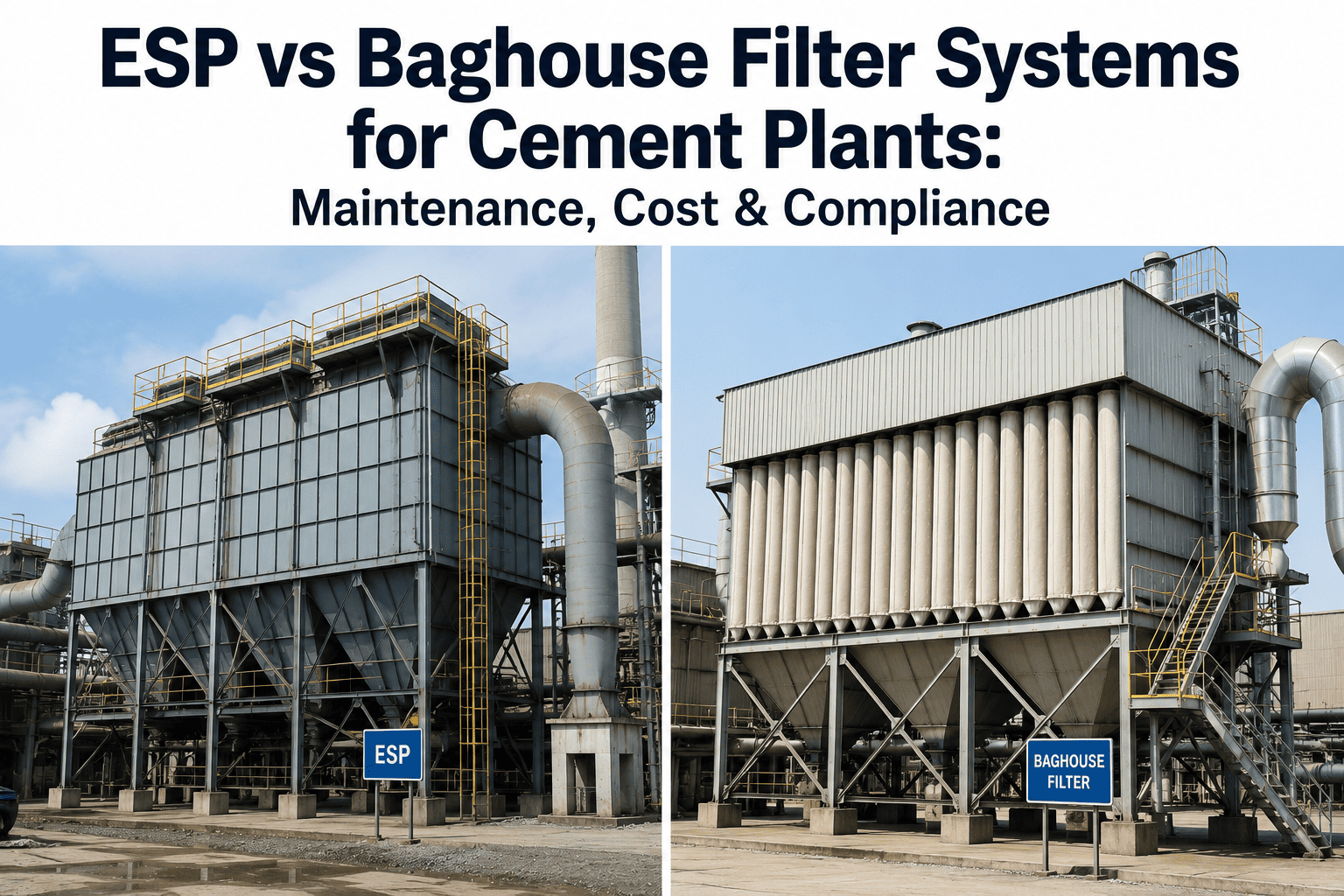
An electrostatic precipitator and a baghouse solve the same problem, keeping cement dust out of the stack, but they fail in completely different ways and on completely different maintenance clocks. An ESP loses collection efficiency quietly as dust resistivity drifts and back corona creeps in, while a baghouse gives you a hard number the moment a bag blinds or tears: differential pressure. Picking the wrong maintenance rhythm for either one is how an opacity exceedance shows up before anyone in maintenance sees it coming. Start a free trial to see how Oxmaint tracks ESP and baghouse condition data in one compliance-ready record.
99.5%+
Fine particulate (PM2.5) capture typically achieved by a well-maintained baghouse
85-92%
Typical ESP efficiency on fine particulate, more sensitive to dust resistivity swings
24-48
Months of service life for aramid or PTFE-laminated bags in kiln-duty applications
15%
Annual maintenance cost reduction reported by a cement plant after moving to bag filters
Why This Is Never Just a Filter Decision
Dust collection equipment is the last thing between the kiln and the stack, so a degradation event is never a "fix it next outage" problem. Opacity exceedances can trigger compliance notices within hours, and repeated violations lead to consent orders, financial penalties, and mandated load reductions. Whichever system a plant runs, the maintenance program needs to catch the drift long before it becomes a documented violation.
ESP vs Baghouse: Head to Head
| Factor |
ESP |
Baghouse |
| Fine particle capture |
Weaker on PM2.5, sensitive to dust resistivity changes |
Strong and consistent, less affected by material variation |
| Primary failure mode |
Back corona and electrode fouling under high-resistivity dust |
Bag blinding, tears, and hopper-related pressure buildup |
| Maintenance complexity |
Higher, involves rapper sequencing and TR set diagnostics |
Lower, mainly scheduled bag and cage replacement |
| Key health signal |
Secondary current and voltage trend at the TR set |
Differential pressure across the compartment |
One Compliance Record, Whichever System You Run
Oxmaint tracks TR set diagnostics and rapper sequencing for ESPs, bag differential pressure and hopper schedules for baghouses, and keeps every opacity reading logged for audit. Sign up for a free trial to see it against your own dust collection system, or book a demo and we'll walk through your compliance documentation workflow.
The Maintenance Calendar Each System Actually Runs On
ESP Maintenance Rhythm
Monthly visual inspection of corona electrodes and collection plates
Quarterly comprehensive internal inspection and insulator bushing checks
Annual transformer-rectifier oil condition testing
Baghouse Maintenance Rhythm
Differential pressure trended continuously by compartment
Proactive bag replacement scheduled on performance decline, not failure
Pulse cleaning system and hopper evacuation checked on a fixed interval
How Oxmaint Supports Emissions Control Reliability
Oxmaint schedules PM tasks specific to each system type, whether that's rapper intensity checks and TR set diagnostics for an ESP or differential pressure trending and bag replacement forecasting for a baghouse, and keeps every reading timestamped for audit. Maintenance logs, calibration records, and exceedance root-cause documentation all export in one compliance package instead of being reconstructed from separate files. Book a demo to see it mapped against your own dust collection system.
Frequently Asked Questions
Q
Why are cement plants increasingly switching from ESP to baghouse systems?
Baghouses capture fine particulate more consistently, above 99.5% for PM2.5 in many installations, and aren't as vulnerable to dust resistivity swings that cause back corona in an ESP. As emission limits tighten, that consistency is why many plants are converting even when the ESP is technically still functional.
Q
What is back corona and why does it hurt ESP performance?
Back corona happens when dust resistivity is too high for the electrical field to work as intended, and it develops as raw material and fuel variations shift dust characteristics inside the precipitator. Once it sets in, collection efficiency drops even though the ESP looks mechanically fine, which is why current and voltage trending matters more than visual inspection alone.
Q
How long do baghouse filter bags actually last in kiln service?
It depends heavily on media and duty. Aramid and PTFE-laminated bags in kiln applications typically run 24 to 48 months, while standard polyester bags in less demanding areas may only reach 18 to 24 months. Replacing on performance decline rather than waiting for failure is what protects that range.
Q
Why does an opacity exceedance escalate so quickly compared to other equipment issues?
Dust collection sits directly between the process and the stack, so its degradation is visible to regulators almost in real time through continuous opacity monitoring. That leaves no buffer between a developing maintenance issue and a compliance notice, which is why trending, not just scheduled inspection, matters for both system types.
Keep Emissions Compliant, Whichever System You Run
Oxmaint gives cement plant teams system-specific PM scheduling, continuous condition trending, and audit-ready compliance documentation for both ESP and baghouse assets. Sign up for a free trial to explore it yourself, or book a demo and we'll walk through it against your own emissions control system.