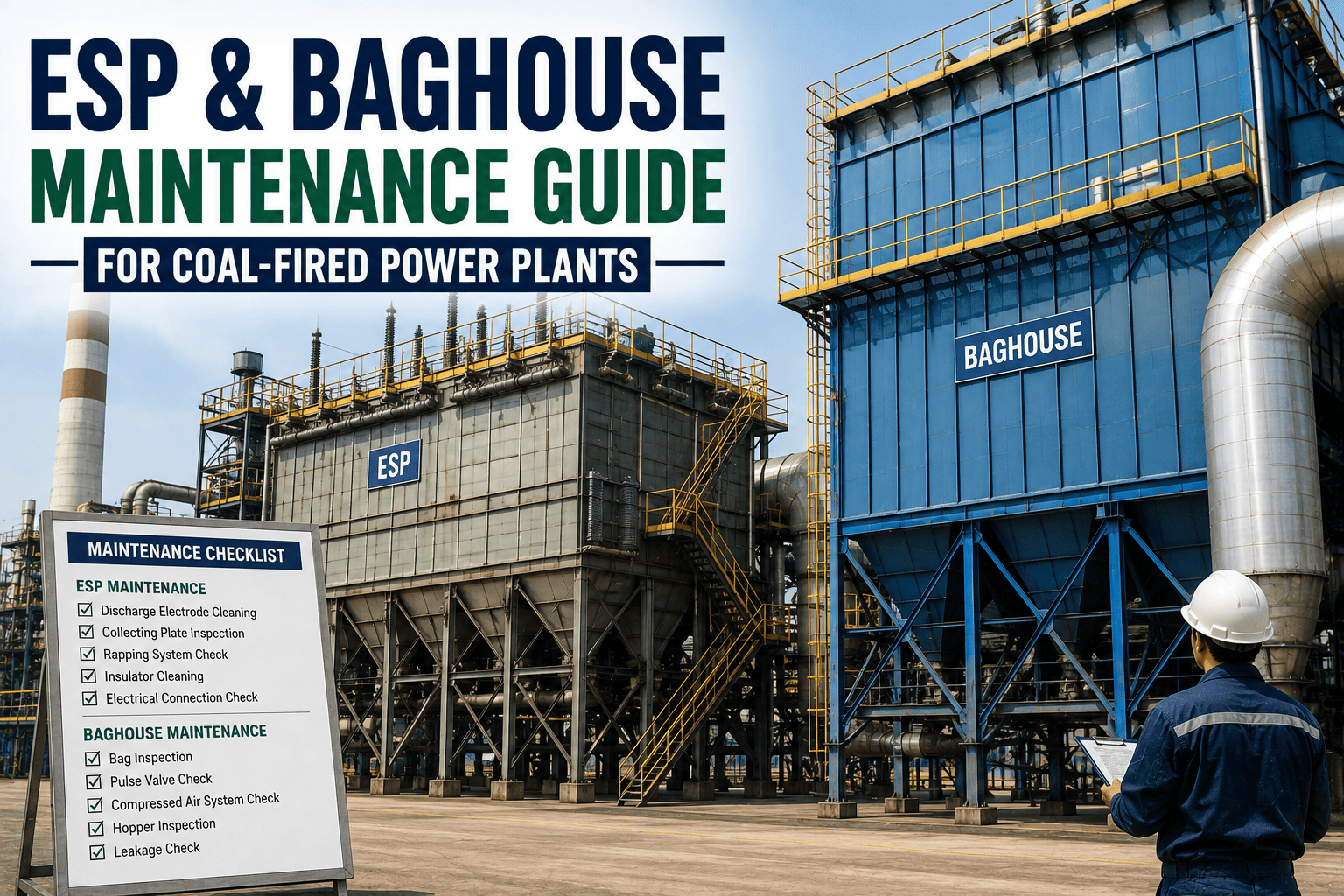
An ESP or baghouse degrading is not a problem that waits for the next outage, opacity is monitored continuously and transmitted to regulators in real time on most coal plants, so a rapper that's stopped cycling or a bag that's split can turn into a compliance notice within hours. The frustrating part is that most of these failures give a clear signal well before opacity ever spikes, a TR set losing voltage, a bag differential pressure climbing steadily, a hopper that isn't evacuating on schedule. Sign up to track rapper sequences, TR set performance, and bag DP against every field, or book a demo to see it built around your emission control system.
Why It Matters
An ESP running with misaligned electrodes or a baghouse running with a torn bag isn't just underperforming, it's producing a compliance violation in slow motion. Repeated opacity exceedances lead to consent orders and mandated load reductions, which makes rapper condition, TR set health, and bag differential pressure some of the highest-stakes readings on the entire plant.
Checks Worth Doing On Every Round
TR set voltage and current trended per field: a steady decline often shows up before a spark rate increase or an outright trip, especially with high dust resistivity conditions
Rapper sequence confirmed active on every field: under-rapping lets dust cake build up and re-entrain at high velocity, over-rapping strips the cake before it can fall into the hopper
Bag differential pressure logged against baseline: a rising trend signals blinding or fouling, a sudden drop often points to a torn or blown bag
Hopper evacuation confirmed on schedule: a hopper that isn't emptying reliably backs dust up into the field and can short electrodes or plug bags above it
Opacity trend reviewed against known events: correlating an opacity spike back to a specific rapper cycle, TR set trip, or hopper alarm turns a mystery exceedance into a known fix
Catch An Opacity Problem Before It Becomes A Notice
OxMaint tracks TR set performance, rapper sequences, and bag DP trends against each field and flags degradation before it reaches an exceedance. Sign up for a free trial to load your first field, or book a demo to see it set up for your ESP or baghouse.
Four Subsystems That Decide Whether You Stay In Compliance
Rapper System
The most maintenance-intensive subsystem, tuned so dust cake falls without being re-entrained
TR Sets
Supplies the high voltage charge that gives an ESP its collection efficiency
Bag Filters
Woven or felted media that collects particulate at well above 99 percent efficiency when intact
Hoppers
Collect and remove captured dust, and back up the entire field when they stop evacuating
Signal, Likely Cause & What To Check
| Signal |
Likely Cause |
What To Check |
| Sudden opacity spike |
Torn bag, TR set trip, or hopper overflow |
Correlate timing against DP, TR trend, and hopper alarms |
| Rising bag differential pressure |
Cake buildup, blinding, or cleaning cycle underperforming |
Cleaning sequence timing, compressed air pressure, bag age |
| Declining TR set voltage and rising spark rate |
High dust resistivity or internal arcing developing |
Secondary current, dust resistivity conditions, insulator condition |
| Hopper level alarm or high dust temperature |
Evacuation system not clearing dust on schedule |
Rotary valve or conveyor operation, heater function |
The Takeaway
ESP and baghouse failures rarely show up as an opacity spike out of nowhere, rapper sequence, TR set trend, and bag DP all move first. Watch those three readings together and most compliance events become a scheduled fix instead of a regulatory notice.
Frequently Asked Questions
Q
Why is over-rapping just as much a problem as under-rapping?
Under-rapping lets dust cake build up until high gas velocity picks it back up and carries it out with the flue gas, but over-rapping strips the cake off the plates before it has fully formed and can fall cleanly into the hopper. Both end with more particulate escaping collection, which is why rapper sequence is usually tuned through a dedicated optimization study rather than set once and left alone.
Q
What does dissolved gas analysis tell you about TR set health?
TR sets are oil-filled, and a rising hydrogen or ethylene level in the oil is a recognized early sign of internal arcing or overheating happening inside the unit, well before it shows up as an obvious voltage or current problem. Running DGA on a regular schedule, especially for TR sets over ten years old, gives a chance to address that damage before it forces an unplanned TR set failure.
Q
Why can a blocked hopper affect the whole field, not just that one hopper?
When a hopper stops evacuating, dust backs up into the space above it, and in an ESP that buildup can reach high enough to short electrodes to the collecting plates, while in a baghouse it can plug the bottom of adjacent bags. Either way, one hopper falling behind schedule can drag down collection efficiency across the whole field it sits under, which is why hopper evacuation gets checked as closely as the rapper and TR set.
Keep Every Field Ahead Of An Opacity Exceedance
OxMaint tracks rapper sequences, TR set trends, and bag differential pressure against each field and raises a work order the moment a reading drifts toward a compliance risk. Sign up for a free trial to start monitoring your ESP or baghouse, or book a demo to see it configured for your plant.