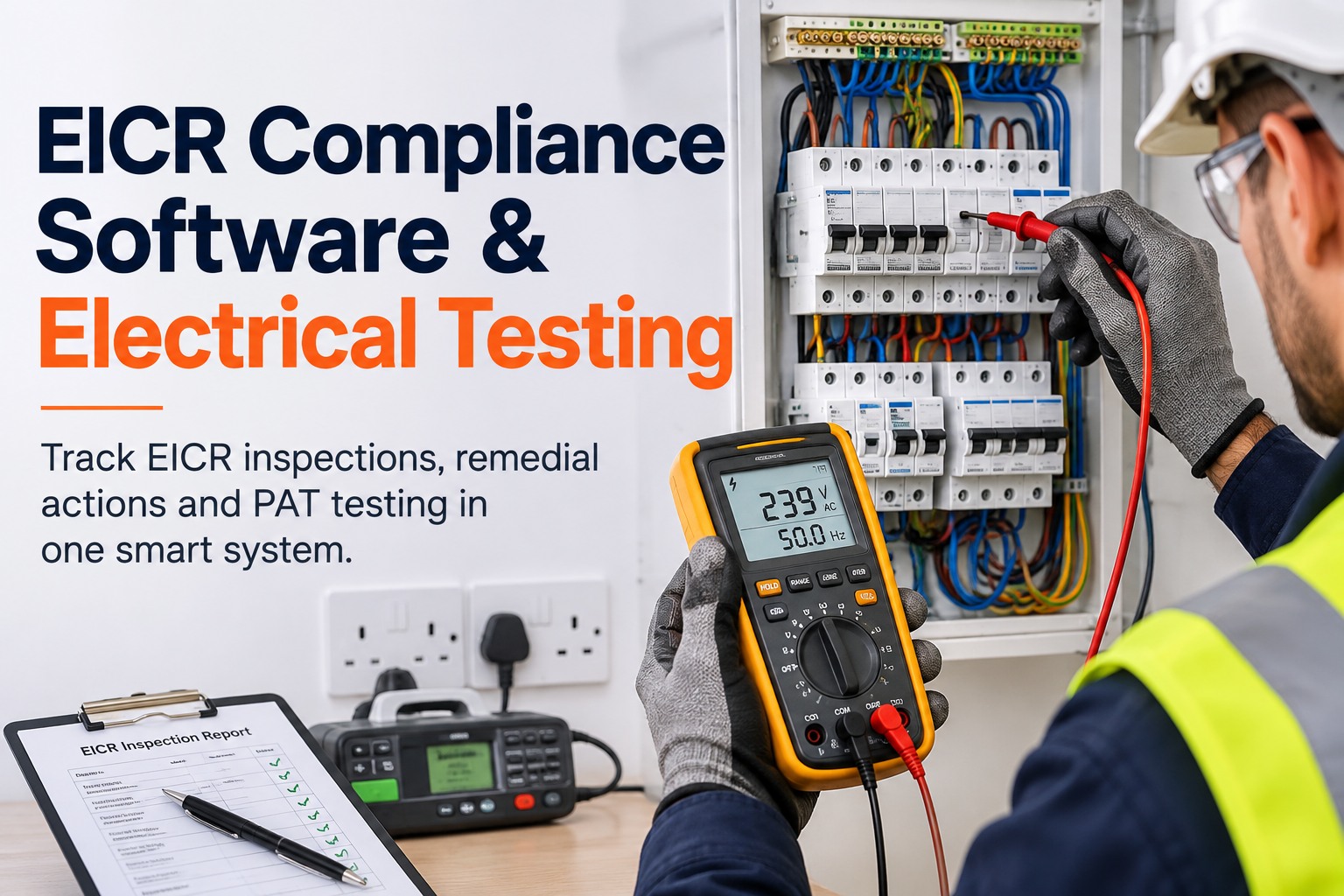
An EICR is not a certificate — it's a legally binding verdict on your fixed electrical installation and the four codes an inspector can assign (C1, C2, C3, FI) determine whether you have 28 days to fix things or five years to breathe. Under the Electrical Safety Standards Regulations 2020, a single C1 or C2 makes the report unsatisfactory and starts £30,000-£40,000 penalty exposure. Oxmaint gives property teams one platform for EICR tracking, C1/C2/FI remedial workflow with 28-day deadlines, PAT testing and BS 7671 evidence. Book a demo to see EICR workflows in action.
UK Electrical Compliance · At a Glance
Every 5 years · every property · zero exceptions
5yr
maximum EICR cycle on every let property in England under the 2020 Regulations
28d
to complete C1, C2 or FI remedial work after any unsatisfactory report
£30k+
civil penalty exposure per breach — LA-tier fines reach £40k in some jurisdictions
The Four EICR Codes — A Verdict Dial for Every Observation
Every observation on an EICR carries one of four BS 7671 codes. Three of them (C1, C2, FI) render the report unsatisfactory and start the 28-day clock; one (C3) is advisory only. Reading them right is the whole game — miss a C2 deadline and it becomes an enforcement case; treat a C3 as a C2 and you pay for remedial work the law never required.
C1
DANGER
C2
POTENTIAL
FI
INVESTIGATE
C3
ADVISORY
UNSATISFACTORY
SATISFACTORY
C1
Danger Present · Act Immediately. Immediate risk of electric shock or fire — inspector typically disconnects on site. Repair without delay; 28-day window is a maximum, not a target. Examples: exposed live conductors, no earthing continuity.
C2
Potentially Dangerous · 28 Days. Real hazard, not immediately life-threatening. Statutory 28-day remedial window under the 2020 Regs. Most commonly assigned unsatisfactory code. Examples: absent RCD, deteriorated insulation.
FI
Further Investigation · 28 Days. Inspector can't classify without additional testing. Report stays unsatisfactory until the investigation completes and result becomes C1, C2 or C3. Examples: unexplained test result, unclear earthing.
C3
Improvement Recommended · Not Mandatory. Doesn't meet current BS 7671 but is not dangerous. Report remains satisfactory. Ethical electricians do not over-code C3 as C2 to generate work. Examples: absent SPD, older cable colours.
The 28-Day Clock — A Countdown, Not a Deadline
An unsatisfactory EICR starts a 28-day statutory countdown from the report date. The clock runs against three separate obligations, not one — remedial work, written confirmation, and distribution. Miss any of the three and the breach is documented. The gauge below shows how the days should actually get spent.
Day 0
Day 7
Day 21
Day 28
01
Instruct qualified electrician
C1 hazards require same-day action. C2 remedials must be booked in the first week — leaving contractor scheduling to week three routinely misses the deadline.
02
Complete remedial works
Work carried out by a competent electrician working to BS 7671. May be the same electrician or a different one — the report author has no monopoly.
03
Obtain written confirmation
Minor Works Certificate (small works) or Electrical Installation Certificate (larger works) confirming the installation now meets BS 7671. Verbal is not evidence.
04
Distribute to tenant & council
Written confirmation supplied to tenant and (if requested) the local authority. This closes the loop — until this step lands, the 28-day compliance is not fully discharged.
Oxmaint locks the countdown against the report date, generates work orders per C1/C2/FI code, and timestamps every distribution automatically. Sign up free to run the 28-day countdown across your portfolio.
EICR vs PAT — Different Assets, Different Regimes
Electrical compliance splits into two entirely separate regimes covering different things. An EICR covers the fixed installation — wiring, consumer unit, sockets, earthing. PAT covers portable appliances — kettles, lamps, extension leads, anything plugged in. A property can pass one and fail the other. Both need tracking; neither substitutes.
Kettles · lamps · leads · anything plugged into a socket
StandardIET CoP 5th ed.
CycleRisk-based · typically annual
VerdictPass / Fail per appliance
LawElectricity at Work 1989
See EICR & PAT Compliance Live
Walk through the property register with EICR status, C1/C2/FI work orders with 28-day countdown, PAT testing schedules and appliance-level records — configured against your specific portfolio. Thirty minutes with the Oxmaint team.
A single EICR is trivial to manage. A portfolio of 100 properties, each with different 5-year inspection cycles, some with active C2 remedials, mixed with commercial premises operating under Electricity at Work Regulations 1989 rather than the 2020 rented-sector rules — that's where spreadsheets collapse. The failure modes are always the same: an inspection date drifts past 5 years, a C2 deadline gets missed because nobody was tracking day-count from report date, a written confirmation exists but was never sent to the tenant. Portfolio-level dashboards with automated countdowns exist precisely to prevent these administrative gaps at scale. Sign up free to build your portfolio-level EICR dashboard.
Expert Perspective — What Councils Actually Look At
"
Local authority housing enforcement teams don't audit EICRs by opening PDFs one at a time. They pull the property register, filter for last-inspection-date greater than 5 years, cross-reference the borough's own housing licence data, and generate a hit list. The landlords who get picked up are the ones whose portfolio-level tracking couldn't answer "which of your properties has an EICR older than 5 years?" in under 30 seconds. The 28-day remedial deadline is enforced the same way — councils receive tenant complaints about unrepaired C2 issues and open a case immediately. The pattern is administrative: the landlords in trouble aren't wilfully non-compliant; they've lost visibility across a growing portfolio.
01
5-year renewal calendar
Every property carries its own inspection anniversary. Portfolio-level alerts at 6 months, 3 months and 30 days prevent slip.
02
C2 day-counter from report date
28-day window runs from inspection date, not the date the landlord opens the PDF. Automated counters remove ambiguity.
03
Remedial certificate against report
Minor Works or EIC certificate uploaded against the original EICR closes the loop with a full evidence chain.
04
Tenant/council distribution proof
Timestamped distribution to tenant (and council where requested) proves the final compliance step happened.
Who Uses Oxmaint for EICR & Electrical Compliance
The platform is used by the UK operational roles that carry electrical compliance accountability: property managers running 5-year EICR renewals across residential portfolios, letting agents managing electrical compliance for landlord clients, housing associations and local authority housing teams under the 2025 social-housing extension of the 2020 Regulations, facilities managers coordinating EICR and PAT across commercial premises under Electricity at Work Regulations 1989, FM contractors delivering electrical compliance services to multi-site clients, HMO managers under enhanced tenant safety obligations, and commercial estate operators. Each role sees the same data filtered to their view — renewal dashboard, C1/C2 remedial queue, PAT schedule or audit evidence pack. Sign up free to configure roles for your electrical team.
Getting EICR Compliance Live
Deployment starts with importing your existing property register — addresses, current EICR dates, any open C1/C2 remedials, PAT testing schedules. Each property is tagged by tenure (let / commercial / HMO / social housing) so the correct regulatory regime is applied automatically. Qualified electricians get scoped access to upload EICRs, Minor Works and EIC certificates directly against the correct property, with C1/C2/FI observations automatically generating remedial work orders on the 28-day deadline. Most portfolio deployments move from initial scoping to live renewal calendar operation inside 30 days. Book a walkthrough to see live UK deployments.
Turn EICR Compliance Into a Portfolio-Level System
Oxmaint gives property and facilities teams one platform for EICR renewals, C1/C2/FI remedial workflow, PAT testing schedules and evidence retention — with 28-day deadlines and portfolio-wide visibility across every property.
An Electrical Installation Condition Report (EICR) is a formal assessment of the fixed electrical installation in a building — circuits, consumer unit, sockets, switches, earthing and bonding — carried out by a qualified electrician against BS 7671 (the IET Wiring Regulations). Under the Electrical Safety Standards in the Private Rented Sector Regulations 2020, every let property in England must have an EICR at least every 5 years. The 2025 amendment extended this to social housing. Commercial premises fall under the Electricity at Work Regulations 1989, typically inspected on a 5-year cycle as good practice.
What do C1, C2, C3 and FI mean on an EICR?
C1 = Danger Present, immediate action required, report unsatisfactory. C2 = Potentially Dangerous, remedial work required within 28 days, report unsatisfactory. C3 = Improvement Recommended, does not meet current BS 7671 but not dangerous, report remains satisfactory, no legal obligation to fix. FI = Further Investigation required, cause of defect unclear without additional testing, report unsatisfactory until investigation completes. C3 codes are frequently over-classified by inspectors as C2 to generate remedial work — landlords should challenge coding they believe is inappropriate.
Can C1 and C2 remedial actions be linked to work orders?
Yes — that's the specific design of the Oxmaint EICR module. The moment an unsatisfactory EICR is uploaded against a property, C1/C2/FI observations automatically generate individual remedial work orders with the 28-day deadline locked from the report date. Each work order carries the specific code, the observation text, an assigned electrician and the countdown to statutory deadline. Completion requires uploading the corresponding Minor Works or Electrical Installation Certificate against the work order, which then closes the compliance loop against the original EICR.
Can PAT testing be tracked in the same system?
Yes. PAT (Portable Appliance Testing) sits alongside EICR management in the same electrical compliance module. Appliance registers can be maintained per property or per building, with pass/fail results captured at appliance level. PAT frequency is risk-based rather than annual by law — the platform supports custom recurrence based on appliance category (Class I, Class II, high-risk environments). Both EICR and PAT records live against the same property record so audit response covers all electrical compliance in a single export, not two separate systems.
Does Oxmaint replace a qualified electrician?
No — and it isn't intended to. Only a qualified, competent electrician working to BS 7671 can carry out EICRs, PAT testing or remedial work in the UK, and only they can issue the Minor Works, Electrical Installation Certificates or condition reports that the compliance system requires. Oxmaint is the property-side platform managing the workflow around those inspections: portfolio-level renewal calendar, electrician scoping, certificate upload, 28-day remedial countdown, tenant/council distribution and audit evidence.