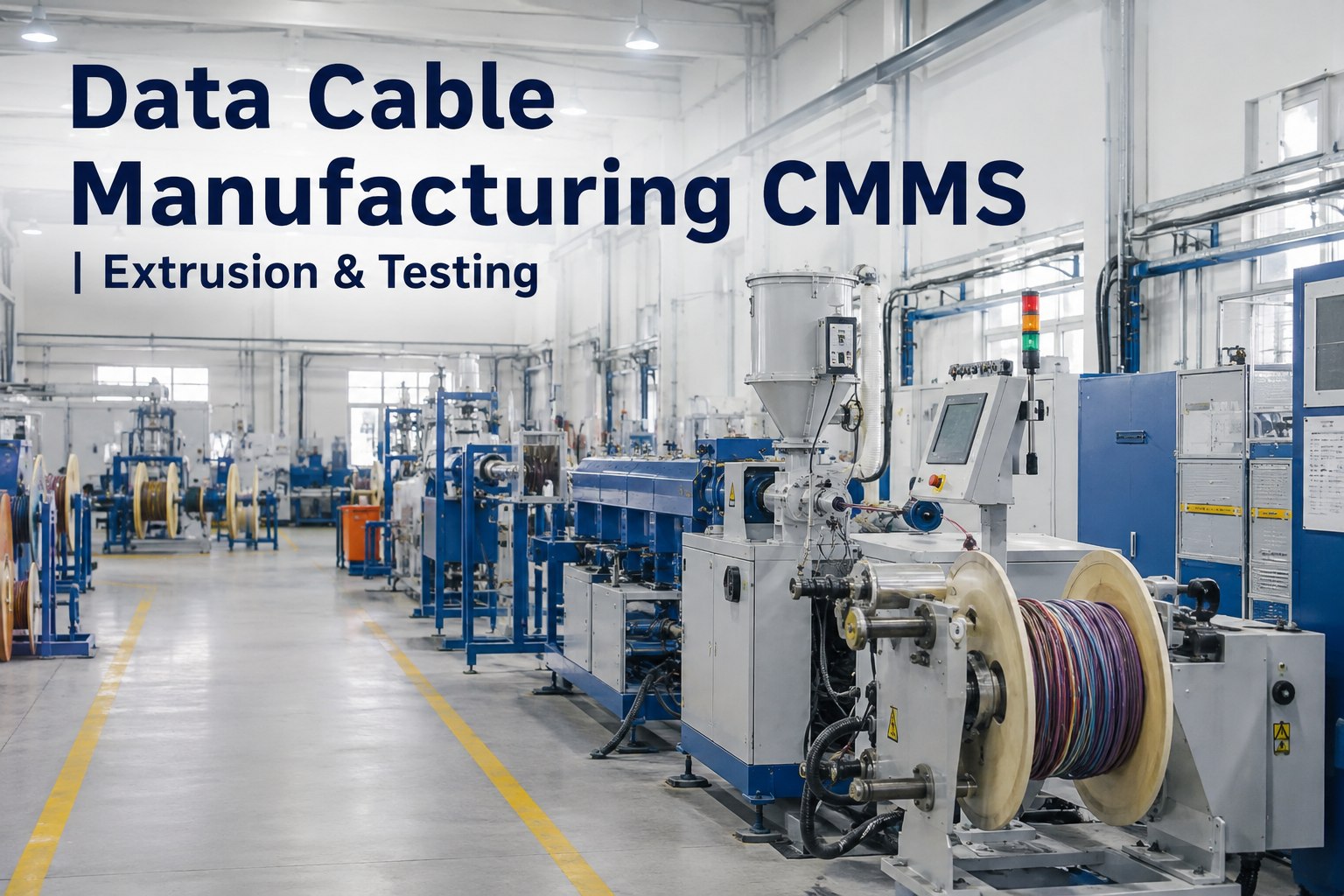
Data Cable Manufacturing CMMS | Extrusion & Testing

By Riley Quinn on September 2, 2026

data-cable-manufacturing-cmms

Data cable manufacturing is a continuous process at speed. Copper rod enters at 8mm diameter and leaves as a Category 6a cable at 1,200 metres per minute, having passed through wire drawing, annealing, insulation extrusion, pair twisting, cabling and jacket extrusion — all synchronised so tightly that any single station stopping ends the line. The maintenance discipline here is closer to running a power station: continuous parameter monitoring, tolerance-envelope enforcement, and predictive intervention long before anything breaks. Book a 30-minute demo to see a live data cable plant workspace.

The Continuous Line Profile
Seven Stations. One Continuous Line. 1,200 Metres Per Minute.
Everything runs synchronised · any station stopping ends the line · this is where maintenance discipline earns its keep
01
Wire drawing
8mm rod → 0.5mm wire through progressive dies
02
Annealing
Heat treatment restores ductility
03
Insulation extrusion
Molten polymer applied · diameter set here
04
Pair twisting
Twist rate defines data cable category
05
Cabling
Pairs assembled into final cable
06
Sheath extrusion
Outer jacket · PVC or LSZH
07
Testing + spooling
Impedance, continuity, capacitance
Line synchronisation
1,200 m/min
All 7 stations must hold speed within ±0.5% · any drift produces off-spec cable that can only be discovered at the end-of-line test — hundreds of metres later

The Diameter Tolerance Envelope — Where the Whole Game Is Played

In data cable, cable diameter is the master variable. A Cat 6a specification demands the insulation over each conductor sit within a ±0.01mm tolerance envelope — that is 10 micrometres, running continuously at 20 metres per second. The extruder screw, cooling trough temperature, line speed, and polymer viscosity all conspire to push diameter around that centreline. Live monitoring against the envelope is the difference between shipping a compliant spool and scrapping 3 kilometres of copper. Book a demo to see the live tolerance envelope workflow in action.

Live Diameter Trend Against Tolerance Envelope
Cat 6a insulation diameter · target 0.98mm · tolerance ±0.01mm
0.99 0.98 0.97 +0.01 target -0.01 Excursion caught Cooling trough drift 0m 1,500m 3,000m Length produced (metres) Diameter (mm) vs Length (m)
Target
0.98mm nominal · ±0.01mm envelope · gold band = safe production zone
Alert
Live diameter drifts toward upper limit · maintenance work order fires · cooling trough investigated before envelope breach
Loss avoided
Without live monitoring · drift becomes breach · 1.5km of cable produced out of spec before end-of-line testing catches it

The Four Defect Signatures Every Cable Plant Knows

Cable extrusion defects follow predictable patterns. The plants that spot them early are the ones that map each defect back to its maintenance cause and configure the CMMS to raise the right work order the moment the signature appears. Want to see the defect-signature workflow in action? Book a demo and we will walk you through defect-to-work-order automation.

01
Diameter drift
Live diameter creeping toward tolerance limit
Cause · cooling trough temperature drift · extruder screw wear · line speed instability
02
Concentricity loss
Insulation wall thickness varies around circumference
Cause · extrusion die worn or misaligned · uneven polymer flow · conductor centring drift
03
Surface roughness
Visual imperfections · orange peel · rippling
Cause · melt temperature wrong · polymer contamination · die tip build-up
04
Twist rate drift
Pair twist rate deviates from Cat spec
Cause · twister motor drift · capstan wear · line tension imbalance

The Extruder: Where Most of Cable Production's Trouble Actually Lives

The extruder is where insulation quality is set and where most cable line downtime originates. Its screw grinds molten polymer through defined barrel temperature zones and pushes it through a precision die around the conductor. Every one of these elements has its own wear signature, its own PM cadence, and its own contribution to defect rate. Want to see the extruder asset structure mapped in a live workspace? Book a demo of the extruder anatomy module.

Extruder Asset Anatomy — Six Wear Signatures
Screw
Flight erosion · barrel scoring · torque climb
Melt pressure trends · motor current signature
Extrusion die
Land wear · concentricity loss · surface damage
Diameter variance · concentricity gauge
Barrel heaters
Element failure · zone temperature drift
Zone temperature deviation from setpoint
Melt pump
Gear wear · pressure fluctuation
Pressure oscillation · flow rate variance
Cooling trough
Water temperature drift · nozzle blockage
Trough temperature trend · downstream diameter
Take-up capstan
Belt wear · tension slip · encoder drift
Line speed variance · pay-off tension
See a Live Cable Line Workspace
Watch a 30-minute demo of Oxmaint configured for drawing, extrusion, twisting, cabling, testing and spooling — with tolerance envelope monitoring and defect-signature triggers built in.

Pair Twist Rate: The Signal-Integrity Discipline Nobody Talks About

For data cables specifically, pair twist rate defines the category. Cat 5e, Cat 6, Cat 6a and Cat 7 are essentially distinguished by twist consistency — how many turns per metre each pair holds and how consistently it holds them along kilometres of production. Twist drift produces impedance mismatch, crosstalk, and end-of-line test failure. The maintenance systems that matter for data cable plants treat the twisting stations as signal-integrity CCPs, not as mechanical afterthoughts. Teams evaluating twist-rate monitoring can book a demo of the pair-twist signal integrity module.

Data Cable Categories · Twist Discipline Per Standard
Cat 5e
100 MHz · 1 Gbps
Twist tolerance moderate · commodity install
Cat 6
250 MHz · 1 Gbps
Tighter twist consistency · improved crosstalk
Cat 6a
500 MHz · 10 Gbps
Precise twist rate · pair-to-pair separation critical · data centre standard
Cat 7
600 MHz · 10 Gbps
Shielded pairs · individual + overall screening · exacting production discipline
Twist rate drift = impedance mismatch = end-of-line test failure · maintenance owns this parameter

Expert Perspective: Continuous-Line Maintenance Is a Different Discipline

Discrete manufacturing plants think in cycles. Cable plants think in kilometres. When your line runs at 1,200 metres per minute and end-of-line testing catches a diameter breach, the last three kilometres of cable are already spooled — and that is if the operator catches it in the first minute. The plants that hold high yield in this segment do it by pushing detection upstream to the extruder itself. Live diameter measurement immediately after the die, live melt pressure trending, live cooling water temperature, live line speed synchronisation — all fed into the CMMS as maintenance triggers rather than dashboard curiosities. This is what turns a continuous line from a scrap generator into a compliant production asset.

Curious how the upstream-detection model maps onto your specific line configuration? Book a demo and we will scope the tolerance-envelope workflow against your production speed.

UK Cable Sector Context: Fibre Rollout, Data Centres and OEM Demand

UK cable manufacturing sits in the middle of three concurrent demand waves. The Openreach, CityFibre and Virgin Media O2 fibre-to-the-home rollout continues through 2026-2027 with tens of thousands of kilometres of new fibre optic cable installed annually. Data centre construction across London, Slough, Manchester and the North East is pulling Cat 6a and OM4/OM5 fibre demand. Automotive wiring harness demand from JLR, Nissan Sunderland, BMW MINI Oxford and the emerging EV supply chain adds another lane. A CMMS producing per-spool traceability, tolerance-envelope evidence, and per-machine PM records serves all three sectors from one backbone. Teams new to unified traceability can sign up free to explore the per-spool traceability workspace.

01
Fibre-to-the-home rollout
Openreach, CityFibre, Virgin Media O2 pulling fibre optic cable at UK scale · production reliability directly determines rollout pace.
02
Data centre structured cabling
Cat 6a copper and OM4/OM5 fibre demand from data centre buildout across London, Slough, Manchester, North East.
03
Automotive wiring harness
JLR, Nissan, BMW MINI plus EV supply chain · IATF 16949 traceability flows down to wire and cable suppliers.

A Realistic Rollout for a UK Cable Plant

A cable plant CMMS rollout follows the value stream. Extrusion first — because that is where the majority of yield loss originates. Wire drawing and testing second. Cabling and spooling third. A phased plan captures diameter-envelope value inside the first month. Teams planning phased deployment can book a demo and we will build a rollout plan scoped to your line topology.


Weeks 1–4
Extrusion + envelope
Extruder asset register · full topology
Live diameter monitoring configured
Tolerance envelope triggers live
Melt pressure + zone temperature PM
Weeks 5–8
Drawing + testing
Wire drawing die cadence per line
Annealer temperature verification
End-of-line tester calibration
Per-spool traceability chain
Weeks 9–12
Twisting + audit
Twister motor + capstan cadence
Pair twist rate monitoring
Category-specific spec filters
IATF 16949 evidence packs

Frequently Asked Questions

Can Oxmaint monitor live cable diameter against a tolerance envelope?
Yes. Live diameter measurements from laser gauges immediately downstream of the extruder are ingested into the CMMS with configurable tolerance envelopes per product code (Cat 5e, Cat 6, Cat 6a, Cat 7, and fibre optic specifications). Drift toward either boundary auto-generates a maintenance work order routed to the correct technician before the envelope is breached. Full per-metre diameter history is retained against each spool for downstream investigation and customer audit response.
Does the platform capture per-spool traceability?
Yes. Every finished spool carries a unique identifier linking to the specific extruder run, wire drawing batch, twisting station, cabling run, jacket extruder, and end-of-line test result. Every maintenance event on any of these assets during the production window is linked to the spool record. Field failure investigations trace back through this chain to identify affected batches — critical for automotive wiring harness supply where IATF 16949 traceability requirements flow down from OEM customers.
How does the platform handle extruder screw and die wear?
Extruder screws are held as tracked assets with running-hours counters, torque-trend monitoring, and melt-pressure signature capture. Screw wear reveals itself as rising torque draw at constant output, which triggers a scheduled inspection work order well before production impact. Extrusion dies are held per part number with concentricity-check cadence tied to running hours; die tip build-up flags via downstream diameter drift and triggers a cleaning work order that can be scheduled into the next changeover window.
Can we track pair twist rate for data cable categories?
Yes. Twist rate per pair is monitored continuously per twisting station with per-category tolerance bands configured (Cat 5e through Cat 7 and beyond). Drift beyond the category tolerance triggers a maintenance work order on the twister — motor drift, capstan wear, or line tension imbalance are the typical causes. Twist history is retained per spool as part of the traceability chain and forms part of the end-of-line test evidence pack for the customer.
Does the CMMS support UK cable sector customer audits?
Yes. Automotive customers (JLR, Nissan, BMW MINI and the EV supply chain) expect IATF 16949-aligned traceability; fibre rollout customers (Openreach, CityFibre, Virgin Media O2) expect per-drum test evidence and calibration records; data centre integrators expect per-spool test certificates aligned to structured cabling standards. One evidence backbone captures the underlying maintenance and quality data; filtered evidence packs are generated per customer contract scope on demand — removing the reconstruction scramble that characterises pre-audit weeks.
Bring Every Metre of Cable Onto One Traceable Backbone
Let Oxmaint show you a cable plant workspace configured for your extruders, wire drawing lines, twisting stations and end-of-line testers — with live tolerance monitoring built in.

Share This Story, Choose Your Platform!





