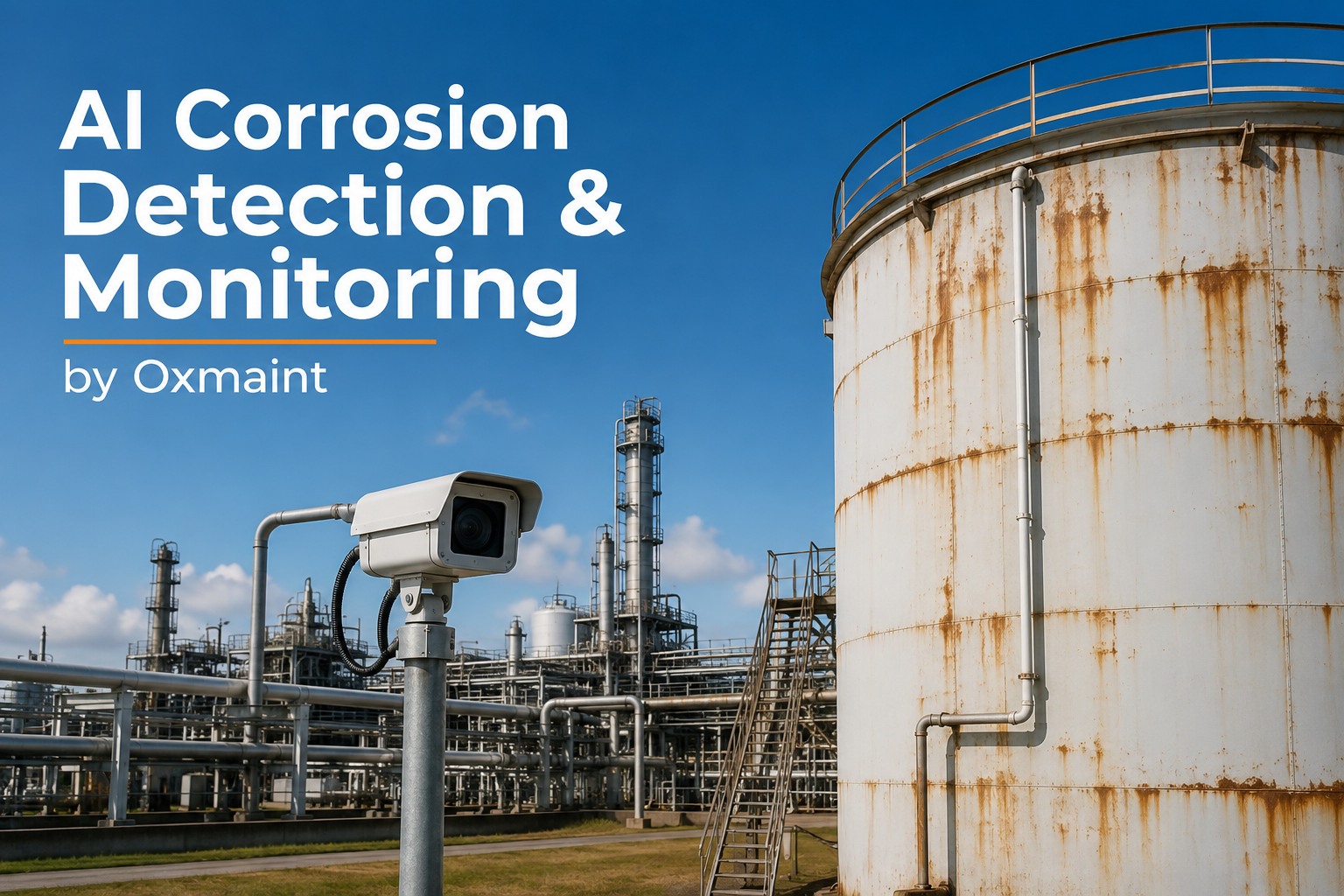
Manual corrosion inspections happen once a quarter, once a year, or once every five years. Corrosion itself develops every day. Between one inspection and the next, coating failures, pitting and surface deterioration progress silently — and the first evidence of failure often arrives as a leak, a strength loss or a regulatory finding. Oxmaint AI Vision uses your existing industrial cameras to continuously monitor pipes, tanks, vessels and steelwork, detects visible corrosion at first appearance, and captures dated visual evidence for asset-integrity records. Book a demo to see AI corrosion detection live.
£1.4tn
global annual cost of corrosion per NACE — roughly 3-4% of GDP across most developed economies
35-45%
reported downtime reduction inside 12 months for operators moving to AI corrosion prediction
400+
inspection data points a single API 653 tank cycle can generate — mostly still on paper
The Five Corrosion Types Your Inspection Regime Has to Cover
Corrosion isn't one failure mode — it's a family of them, each with its own visual signature, progression rate and inspection technique. An AI vision model trained across the full family classifies what it sees rather than just flagging "rust". That distinction matters because the maintenance response is different for each: a pitting alert on a pipeline needs a very different work order to a coating breakdown on structural steel.
Corrosion Types & Visual Signatures
Uniform
Even surface degradation across an area. Predictable rate. Most detectable in early stages via colour/texture change.
Pitting
Localised deep pits — the most dangerous form. Small surface signature, disproportionate structural risk. Classic pipeline killer.
Crevice
Attacks confined gaps — under gaskets, bolts, flanges. Hard to detect until it emerges. AI catches the boundary staining.
Galvanic
Dissimilar metals in electrical contact — one corrodes preferentially. Visual pattern concentrated at joint interfaces.
Erosion-corrosion
Fluid flow accelerates metal loss. Elbows, valves, pump impellers. Directional pattern in the flow direction.
Coating failure
Cracking, blistering, delamination, holidays. Precursor to base-metal corrosion — catching it here prevents the more expensive repair.
How AI Vision Actually Sees Corrosion
The AI stack for corrosion detection uses three complementary computer vision techniques, each answering a different question about the image. Together they turn a raw camera frame into a specific, actionable finding: not "something looks wrong" but "Grade 3 pitting on segment 4 of pipeline P-102 covering 8% of visible surface, progressed 12% since last inspection". That level of specificity is what makes the resulting work order useful.
01
Classification
Is corrosion present in this image?
Answers a yes/no or multi-class question on the whole frame. Fastest technique — used to filter thousands of routine frames down to the ones needing closer analysis.
02
Object detection
Where in the image is it?
Draws bounding boxes around each corrosion region. Locates the fault against the asset for work-order routing — which flange, which weld, which section of the tank.
03
Segmentation
Exactly what area is affected?
Pixel-level mask of the corroded area. Enables quantitative tracking — surface area affected, growth rate between inspections, remaining coating percentage.
Manual corrosion inspection under regimes like API 570 (piping), API 510 (vessels) and API 653 (tanks) sets minimum intervals — but "minimum" means exactly that. Between statutory inspections, most sites run blind on visible surface condition. Continuous AI vision doesn't replace the certified inspector's role: it fills the gap between visits so a developing coating failure gets a work order in the same month it appears, not the year it's next scheduled.
Manual Regime
Visual inspection frequencyAnnual to 5-yearly
Detection lagUp to full interval
Data capturedPaper / spreadsheet reports
TrendingManual, if at all
Access requirementPhysical inspection, often confined space
Best fit forStatutory sign-off cycles
Continuous AI Vision
Visual inspection frequencyContinuous — every camera cycle
Detection lagMinutes to hours
Data capturedTime-stamped image evidence
TrendingAutomatic surface-area calculation
Access requirementUses existing cameras
Best fit forBetween-inspection continuous coverage
See AI Vision Detect Corrosion on a Real Asset
Walk through a live demo — ingest a camera feed of a real pipe or tank, run classification/detection/segmentation, and see the resulting time-stamped evidence and CMMS work order. Thirty minutes on your own asset types.
The technology fits several distinct industrial contexts, each with its own priority failure modes. The applications below are the ones Oxmaint deploys most often — chosen because they meet three criteria: existing cameras can be reused, the corrosion failure carries significant safety or continuity risk, and the site holds statutory inspection obligations that benefit from continuous evidence.
Process piping
API 570
External corrosion on process lines — flanges, elbows, insulation gaps. Pitting under insulation (CUI) is a top industry failure mode.
Storage tanks
API 653
External shell and roof monitoring between statutory inspections. Coating failure detection at the earliest visual stage.
Pressure vessels
API 510 / PSSR
External surface monitoring on separators, drums, exchangers. Complements internal UT inspection with continuous external coverage.
Structural steelwork
Asset integrity
Support structures, walkways, load-bearing steel. Coating breakdown detected before base-metal loss occurs.
Offshore & splash-zone
Marine environment
Jacket legs, splash zone piping, deck steel. Fixed cameras plus scheduled drone imagery, both processed through the same AI pipeline.
Water / wastewater assets
Utility infrastructure
Reservoirs, treatment tanks, digester vessels. Continuous monitoring closes the gap between infrequent physical entries.
Expert Perspective — What Corrosion Programmes Actually Get Wrong
Every mature inspection regime has statutory visits scheduled. Very few have anything meaningful in between. Corrosion is called the silent destroyer precisely because it progresses invisibly — and the industry's response for decades has been to inspect more thoroughly on a fixed calendar. AI vision doesn't change that regime, it fills the gap between visits with continuous evidence-capture, which is exactly where most catastrophic failures actually develop.
Between-inspection blind spot
Statutory inspection intervals of 1-10 years leave enormous visibility gaps — the gap AI vision closes with continuous coverage.
Coating failure first
Coating breakdown almost always precedes base-metal corrosion. Catching it earlier turns a re-coat into a full asset replacement avoided.
Evidence trails matter
Regulatory defensibility requires time-stamped visual evidence tied to specific assets — spreadsheets don't provide it, image databases do.
Trending beats snapshots
Corrosion rate calculation needs multiple observations over time. Continuous vision produces the observation series that manual regimes can't.
Who Uses AI Corrosion Detection in Practice
The workflow is used by the specific roles that own asset-integrity outcomes: asset integrity engineers managing pipeline, tank and vessel inspection cycles against API and industry standards, maintenance managers extending PdM programmes to visual-condition monitoring on structural assets, HSE managers responsible for producing evidence trails to insurers and regulators, and operations directors reducing unplanned outage risk on high-value equipment. Each role sees the same underlying camera data filtered to their view — asset risk dashboard, coating condition trend, or audit evidence pack. Sign up free to scope your corrosion monitoring pilot, or book a walkthrough to see camera integration on your existing assets.
Getting Corrosion Monitoring Live in 30 Days
Deployment doesn't require ripping out existing camera infrastructure. A site survey confirms which existing ONVIF-compliant cameras are usable, where new positioning would improve detection, and which assets should be prioritised. Within the first month cameras are connected, baseline images captured, and the AI classification, detection and segmentation stack starts running. First alerts, evidence packs and CMMS work orders fire in the same cycle. Sign up free to start the site survey conversation and get corrosion monitoring quoted inside the first week.
Close the Gap Between Inspections
Turn your existing industrial cameras into continuous corrosion monitors. Oxmaint AI Vision classifies, locates and segments corrosion at first appearance, captures dated visual evidence, and raises work orders in your CMMS automatically.
Does AI corrosion detection replace certified inspectors?
No — statutory inspections under API 510, API 570, API 653, PSSR and equivalent regimes still require a certified inspector, physical measurement (typically ultrasonic thickness testing), and a written report against the standard's acceptance criteria. What AI vision replaces is the assumption that nothing happens between inspections. Continuous monitoring fills the visibility gap, catches issues at first visual appearance, and produces the evidence trail that supports fitness-for-service assessments and — in some jurisdictions — justifies extended inspection intervals on assets with demonstrated low corrosion rates.
Can we use our existing CCTV or process cameras?
In most cases, yes. ONVIF-compliant industrial cameras — including most Axis, Hikvision, Bosch, and Hanwha models used for security and process monitoring — connect directly. Resolution matters: general-purpose CCTV is often sufficient for coating and gross corrosion detection, while pitting detection or fine surface analysis may benefit from higher-resolution or macro-optimised cameras. Oxmaint's scoping process confirms which existing feeds are usable and where new camera positioning would materially improve detection.
How does the AI handle changing lighting and weather?
Robust corrosion detection has to work across daylight, dusk, overhead lighting, wet surfaces, condensation and seasonal changes. The AI models are trained on datasets covering these conditions, and preprocessing steps normalise illumination and contrast before classification. False alerts caused by shadow, reflection or water staining are one of the historical failure modes of naive computer vision — modern models trained on industrial imagery handle these substantially better than earlier generations.
How is the corrosion severity graded?
Severity classification follows an established framework — either an industry standard like ISO 4628 (paints and varnishes rust grades Ri0-Ri5) or NACE inspection criteria, depending on the asset type and customer preference. The AI outputs a grade against the chosen framework, plus quantitative measures like affected surface area percentage. That combination — standard grade plus quantitative area — is what makes the finding useful for both engineering judgement and regulatory reporting.
Can this run on edge hardware without cloud dependency?
Yes. The AI vision stack is deployed on Oxmaint's NVIDIA Jetson edge appliance for sites requiring on-premises inference — offshore installations, sites with limited connectivity, or facilities with data-sovereignty policies that prevent camera feeds leaving the site. Inference runs locally, only alerts and evidence packs sync to the CMMS, and the appliance continues operating through any internet outage. Cloud-based deployment is also available for sites that prefer that model.