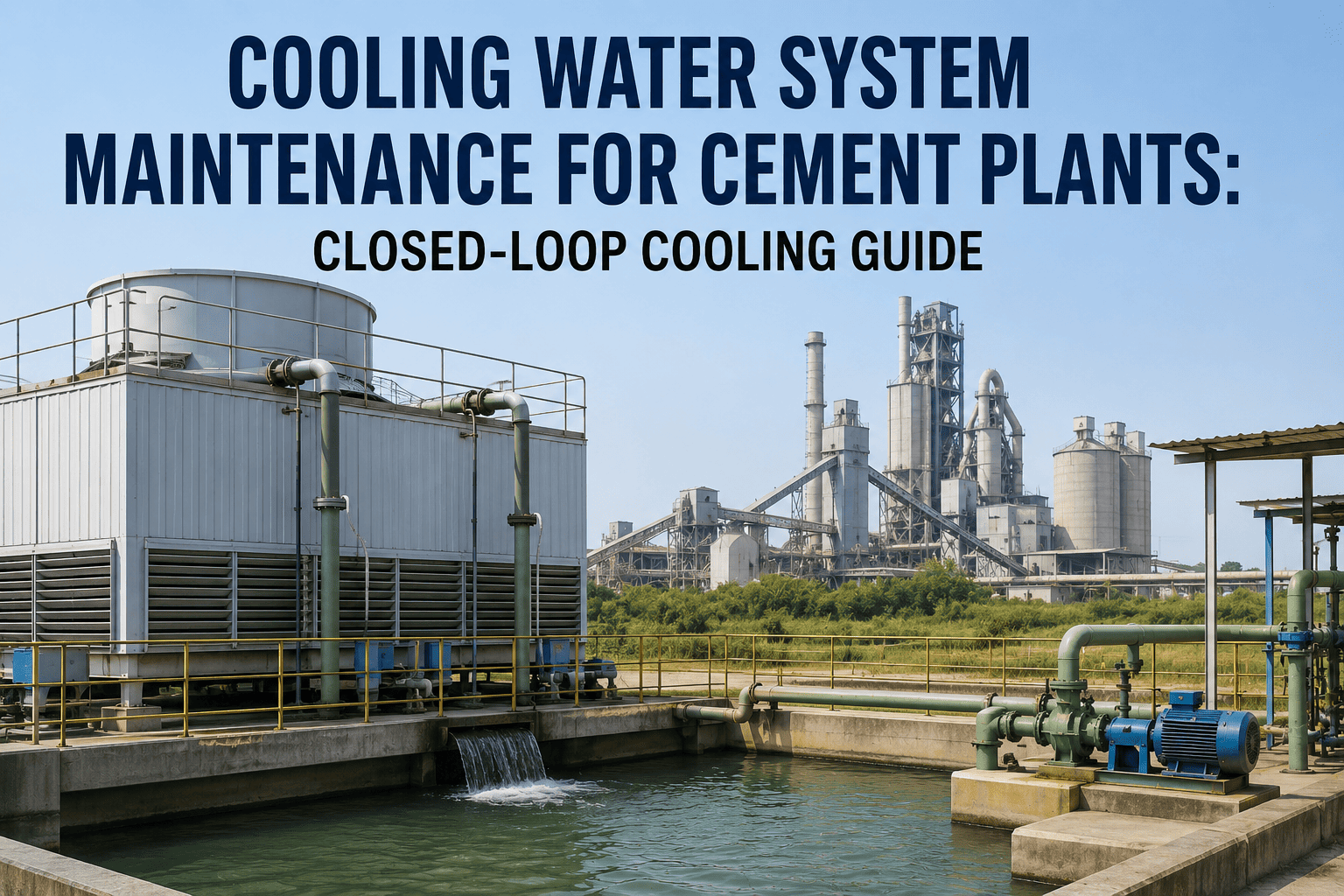
Every kiln bearing, clinker cooler fan, and mill gearbox in a cement plant depends on a steady loop of cooling water that almost nobody watches until it fails. Scale builds inside a heat exchanger a fraction of a millimeter at a time, and by the time a bearing starts running hot, the water side has usually been losing efficiency for months. Sign up to see how Oxmaint tracks cooling water trends against equipment history before a hot bearing turns into a forced shutdown.
1 mm
Scale buildup this thin inside a heat exchanger can cut heat transfer sharply
3-6°C
Approach temperature rise that signals fouling long before an alarm trips
6.5-8.5
Typical pH band closed-loop cooling water should be held within
24/7
Duty cycle for kiln shell and bearing cooling, leaving little room for surprise downtime
Why Cooling Water Gets Overlooked
Cooling water rarely gets its own maintenance line item. It shows up as a symptom on someone else's asset, a hot bearing, a tripped gearbox, an alarm on the clinker cooler, long after the water side has quietly drifted out of spec. By the time the root cause is traced back to scale, corrosion, or biological fouling, the fix is usually bigger than routine treatment would have been.
Closed-Loop vs Open Cooling in a Cement Plant
| System Type |
Common Use |
Main Risk |
| Closed-loop |
Kiln bearings, gearboxes, mill drives |
Internal corrosion and glycol or inhibitor depletion going unnoticed |
| Open recirculating |
Cooling towers feeding compressor and process heat exchangers |
Scale, biological growth, and evaporative mineral concentration |
| Once-through |
Legacy setups drawing from a local water source |
Sediment and debris fouling strainers and exchanger tubes |
Catch Fouling Before It Reaches a Bearing
Oxmaint logs approach temperature, pH, and pump readings against each cooling asset's history, so a slow drift toward fouling shows up as a flagged trend, not a surprise trip. Sign up for a free trial to start tracking your first cooling loop, or book a demo to see how the alerts map to work orders.
Heat Exchanger, Pump, and Water Treatment Checkpoints
| Checkpoint |
What Drifting Values Reveal |
| Approach temperature |
A widening gap between inlet and outlet water temperature points to fouling on the exchanger surface |
| Pump discharge pressure |
A steady decline suggests impeller wear or a partially blocked suction strainer |
| Mechanical seal condition |
Weeping or dripping at the seal face is usually the earliest visible sign of pump wear |
| Water pH and conductivity |
Values drifting outside the treatment plan's range accelerate corrosion or scale formation |
| Inhibitor and biocide dosing |
Under-dosing lets scale, corrosion, or biological growth take hold faster than expected |
Fixing Fouling After the Fact vs Catching It Early
After the Fact
A bearing runs hot before anyone connects it back to the cooling loop
The exchanger is opened for a full mechanical clean once flow has already dropped
Water treatment gets adjusted only after a corrosion or scale problem is visible
Caught Early
Approach temperature and pump pressure trends flag fouling while flow is still adequate
A cleaning or descaling task is scheduled around production, not forced by a trip
Water chemistry is logged and dosed against a set range instead of guesswork
Where a CMMS Ties the Water Side to the Asset Side
Cooling water problems usually show up on someone else's equipment first. Oxmaint links approach temperature, pump readings, and water chemistry logs directly to the kiln bearing, gearbox, or exchanger they cool, so a drift on the water side turns into a work order on the right asset before a trip happens.
Frequently Asked Questions
Q
How often should closed-loop cooling water be tested?
Most closed loops need pH, conductivity, and inhibitor level checks on a set schedule, with more frequent sampling after any top-up or repair, since a small volume of makeup water can shift the chemistry more than expected.
Q
What is the earliest sign of fouling in a heat exchanger?
A gradual increase in the approach temperature, the gap between water inlet and outlet readings, almost always shows up before flow drops enough to trigger a low-flow alarm.
Q
Why do cooling water issues so often get blamed on the wrong equipment?
Because the failure surfaces on the cooled asset, a hot bearing or a tripped gearbox, while the actual cause sits upstream in the water loop, so without linked history the maintenance team ends up chasing the symptom instead of the source.
Keep Cooling Water From Becoming Tomorrow's Downtime
Oxmaint links approach temperature, pump readings, and water chemistry to the exact bearing, gearbox, or exchanger they protect, turning early drift into a scheduled work order instead of a forced shutdown. Sign up for a free trial and start tracking your first cooling loop, or book a demo to see it in action.