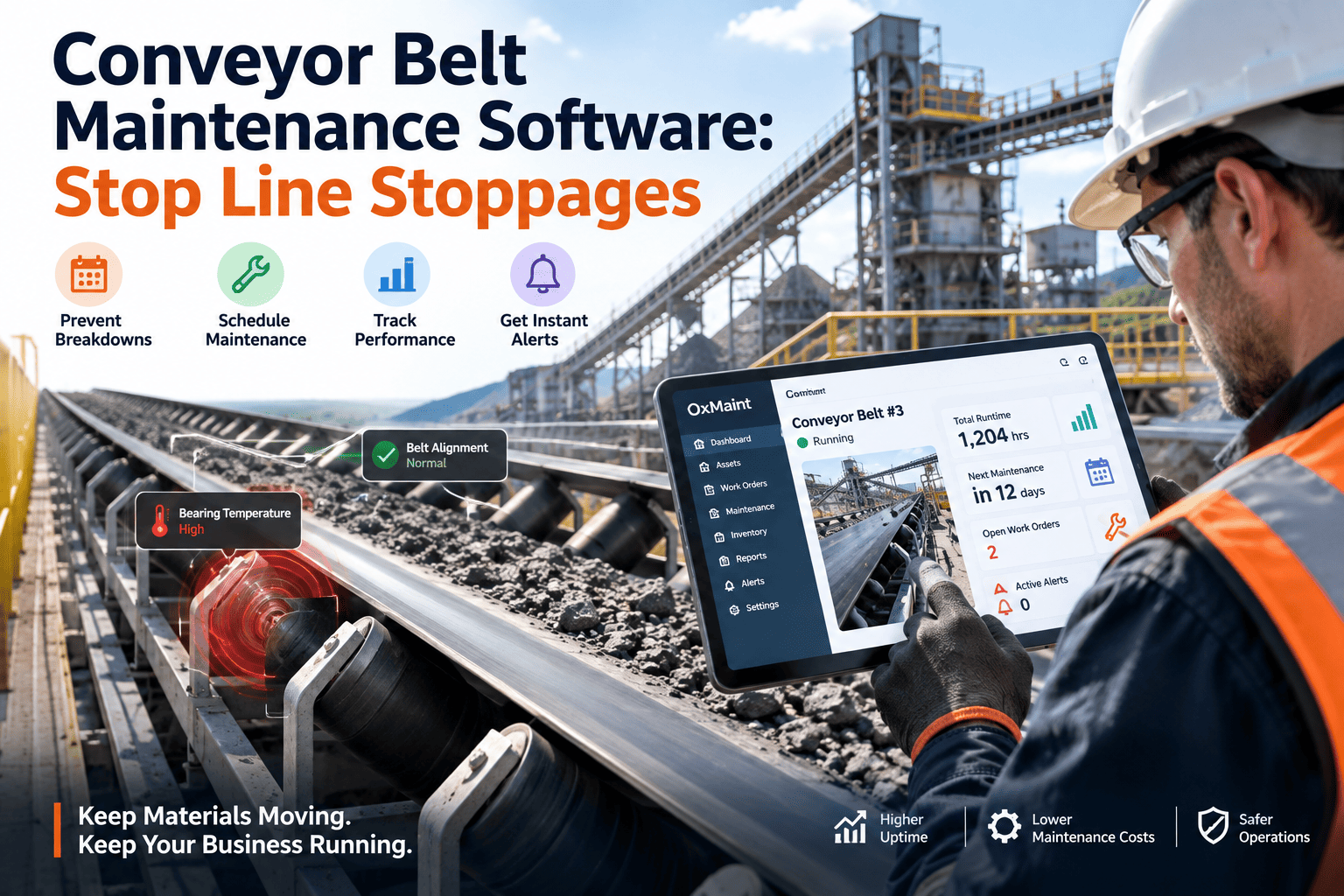
A production conveyor rarely fails without warning. It frays, mistracks, runs hot at a bearing or slips under load for weeks before the belt finally tears and takes the whole line down with it. The problem is that those early signals live in a technician's head or on a clipboard, not in a system that can act on them. Conveyor belt maintenance software turns every inspection, tension check and fault report into scheduled, trackable work against the specific belt, pulley and drive that needs it. If your line has ever stopped for a failure someone had already noticed, start a free trial and see the difference a structured belt programme makes.
Conveyor belt maintenance software
One torn belt can stop everything downstream of it
Conveyors are the one asset class that touches every other asset on the line. When a belt splice separates or a drive pulley seizes, production does not slow down — it stops, and stays stopped until someone finds a splice kit, a spare idler or a contractor. OxMaint keeps belt condition, tension history, splice records and fault reports on a single asset record, so the next failure is scheduled work instead of an emergency.
Where conveyor belts actually fail, and what the warning looks like
Belt failure is almost never a single event. It is a sequence: something changes at a pulley, an idler or a loading point, the belt responds by wandering or wearing unevenly, and the damage accelerates until the belt gives out at its weakest section. Maintenance teams that log the early symptom against the asset catch the sequence at stage one. Teams that only log the failure catch it at stage three, when the fix costs ten times more. The table below maps the failure modes that account for most production conveyor stoppages against the signal that precedes them.
| Failure mode | Early warning signal | Root cause to check | Cost if missed |
|---|---|---|---|
| Edge fraying and belt wander | Belt drifting off centre at the tail pulley | Pulley misalignment, uneven loading, worn idler | Progressive edge loss, eventual belt replacement |
| Splice separation | Visible lifting or gapping at the joint | Over-tension, splice age, contamination in the joint | Full line stoppage and emergency re-splice |
| Belt slip under load | Drive motor current rising, squeal on start-up | Low take-up tension, worn lagging, wet surface | Friction burn through the belt carcass |
| Idler seizure | Hot bearing, grooved roller shell, noise change | Bearing failure, seal contamination, missed greasing | Belt cut through by a stationary roller |
| Impact damage at loading | Gouges or punctures near the feed point | Worn impact bed, high drop height, oversized material | Carcass exposure, rip propagation along the belt |
| Cover wear and carcass exposure | Thickness dropping below the minimum cover spec | Abrasive product, scraper pressure, cleaner misadjusted | Moisture ingress, ply separation, sudden failure |
Each of these has a maintainable trigger. Mistracking needs alignment work. Slip needs a take-up adjustment. Cover wear needs a thickness reading trended over time. Once those checks sit inside a preventive maintenance schedule instead of a technician's memory, the conveyor stops being the asset everyone braces for.
A conveyor is six assets, not one
One of the most common mistakes in a maintenance system is recording the whole conveyor as a single asset. When everything from the gearbox to the belt cleaner sits under one record, cost history becomes meaningless and nobody can tell whether the line stops because of the drive or because of the loading zone. Splitting the conveyor into its functional components is what makes failure trending possible.
Drive unit and gearbox
Motor, coupling, reducer and backstop. Watch oil condition, vibration signature, temperature and motor current draw. A rising current trend on an unchanged load almost always means resistance has appeared somewhere in the system.
Pulleys and lagging
Drive, tail, bend and snub pulleys. Check lagging wear depth, shaft alignment and bearing condition. Worn lagging is the quietest cause of belt slip and the easiest one to correct before it damages the carcass.
Idler sets and return rollers
Carrying, impact and return idlers. Each is a small, cheap component whose failure destroys a very expensive one. Position tagging matters here, so a seized roller is reported by chainage rather than described as somewhere near the middle.
The belt and its splices
Cover thickness, edge condition, splice age and repair history. Keeping a splice date on record is what tells you whether a joint is approaching its service life or has failed prematurely for a fixable reason.
Take-up and tensioning
Gravity or screw take-up, travel position and tension reading. Tension logged as a number and trended over months turns a subjective feel-the-belt judgement into evidence you can act on.
Cleaners, skirts and guarding
Primary and secondary scrapers, skirt rubber, impact beds and guards. Carryback from a worn cleaner builds material on return rollers, which is one of the fastest routes to mistracking and belt damage.
What a conveyor stoppage actually costs
Most plants can quote the price of a belt but not the price of losing it mid-shift. Putting a real figure on stoppage cost is what changes a conveyor PM schedule from a nice-to-have into a funded line item, and it is simpler arithmetic than most teams expect.
Conveyor downtime cost
(Units lost per hour × contribution per unit) + labour recovery cost + expedited parts and contractor premium = true cost of one stopped hour
Once the cost of a stopped hour is known, the business case writes itself. A conveyor programme that prevents two unplanned stoppages a year on a single production line usually pays for the entire maintenance system several times over, which is why belt reliability tends to be the first place a plant looks when it wants a visible return from digitising maintenance.
A conveyor inspection cadence that people actually complete
Inspection schedules fail for one of two reasons: they ask for too much, or they ask for it on paper. A workable cadence separates the two-minute walk-past from the shutdown-only task, and puts every item on the operator or technician who is already in that part of the plant.
Operator walk-past
Belt tracking, unusual noise, carryback and material spillage, guard condition, emergency pull-cord function. Thirty seconds per conveyor, logged from a phone against the asset so a trend is visible even when nothing is raised.
Technician condition round
Idler noise and temperature by hand or thermal reading, scraper blade wear, skirt rubber gap, take-up travel position, splice visual. Anything outside tolerance becomes a work order from inside the inspection rather than a note to raise one later.
Measured checks
Cover thickness readings at fixed measurement points, belt tension value, pulley alignment, gearbox oil condition, drive vibration reading. These are the numbers that make wear rate calculable instead of estimated.
Planned intervention
Idler replacement batches, lagging renewal, splice replacement, impact bed change, full alignment survey. Driven by the trend data collected above, so shutdown scope is decided on measurement rather than on whatever people remember being noisy.
The value of the cadence is not the checklist itself. It is that four levels of inspection feed one asset history, so a belt approaching replacement announces itself in the data months ahead of the day it fails.
There is a second benefit that most plants do not anticipate. When operators complete a daily walk-past on a phone, they start reporting things they previously would have mentioned to a colleague and forgotten. A scraper that needs adjusting, a guard that is loose, a spillage building under the return run — small items that individually mean nothing and collectively predict the next failure. Giving that observation somewhere to land costs thirty seconds per conveyor and turns the people standing closest to the equipment into the earliest part of your detection system, which no amount of instrumentation can replicate.
See your conveyor line mapped in OxMaint
Book a 30-minute walkthrough and we will set up a live conveyor asset tree — drive, pulleys, idlers, belt and cleaners — with inspection rounds, tension logging and fault-to-work-order routing already configured, using your own line layout as the example.
How OxMaint runs a conveyor programme
OxMaint is an AI-powered maintenance management platform built for plants where equipment stops production when it stops working. For conveyors specifically, it handles the three things paper and spreadsheets consistently lose track of: position-level detail, measurement history and the gap between spotting a fault and getting it fixed.
Component-level asset tree
Each conveyor is built as a parent asset with drive, pulleys, idler positions, belt and cleaners beneath it, so cost and failure history land on the component that actually failed.
Result: real failure trending per component
Mobile inspection rounds
Operators and technicians complete the daily and weekly rounds from a phone at the conveyor, with readings, photos and pass or fail results captured at the point of inspection.
Result: no clipboard-to-computer delay
Fail-to-work-order routing
A failed check raises a work order automatically with the asset, location, photo and inspector already attached, routed to the right trade with a priority set by the check that failed.
Result: faults stop dying in a notebook
Measurement trending
Cover thickness, tension values and idler temperatures are stored as trended readings, so wear rate and remaining life are calculated from your own data rather than from a supplier estimate.
Result: belt replacement planned, not reacted to
Spares linked to the asset
Idlers, splice kits, scraper blades and lagging are held against the conveyor they fit, with reorder levels triggered by consumption rather than by someone noticing an empty shelf.
Result: the spare exists when the line stops
Downtime capture
Every stoppage is logged with duration, cause and the component responsible, building the evidence needed to justify a belt upgrade or a change in inspection frequency.
Result: budget conversations backed by data
Four habits that keep conveyor failures coming back
Plants that struggle with belt reliability usually do not have a knowledge problem. The technicians know what to look for. What they lack is a structure that captures what they see and converts it into scheduled work, and these four habits are where that structure most often breaks down.
Treating the conveyor as one asset
Everything gets logged against the line, so nobody can tell whether the problem is the drive, the loading zone or the belt itself. Failure history becomes a list of dates with no pattern in it.
Recording condition as words
Noting that a belt looks worn or tension feels about right gives you nothing to trend. A thickness figure and a tension value, recorded at the same point each month, give you a slope and a forecast.
Fixing the belt, not the cause
A belt that keeps damaging in the same place has a pulley, an idler or a chute problem behind it. Replacing the belt without correcting the alignment or the loading simply resets the clock on the same failure.
Running idlers to failure
An idler is one of the cheapest components on the line, and a seized one can cut through a belt worth hundreds of times its price. Batch replacement during shutdowns is almost always the cheaper policy.
Conveyor belt maintenance software questions, answered
What does conveyor belt maintenance software actually do?
It schedules belt inspections, records tension and thickness readings against each conveyor, and turns failed checks into work orders automatically. Everything sits on one asset history instead of a clipboard. Start a free trial to see it on your line.
How often should a production conveyor be inspected?
A short daily operator walk-past, a weekly technician condition round, monthly measured checks and a shutdown-based intervention covers most production lines. Abrasive or high-speed applications usually need the measured checks moved to fortnightly.
Can it track individual idlers and pulleys separately?
Yes. Each conveyor is built as a parent asset with drive, pulleys, idler positions, belt and cleaners beneath it, so a repeat failure at one position is visible immediately rather than buried in line-level history.
Does this replace vibration or condition monitoring hardware?
No, it gives that data somewhere useful to land. Readings from handheld or fixed monitoring are recorded against the component and trended, and threshold breaches raise work orders. Book a demo to see the workflow.
How long does it take to get a conveyor programme running?
Most plants have their conveyor asset tree, inspection rounds and spares list configured within a fortnight. Useful trend data on tension and cover wear typically appears after the first month of consistent readings.
Stop finding belt faults after the line stops
Put every conveyor inspection, tension reading and fault report into one system that schedules the work, tracks the component and tells you which belt is closest to failing. No clipboards, no spreadsheets, no waiting for the tear.
Free 14-day trial. No credit card required.