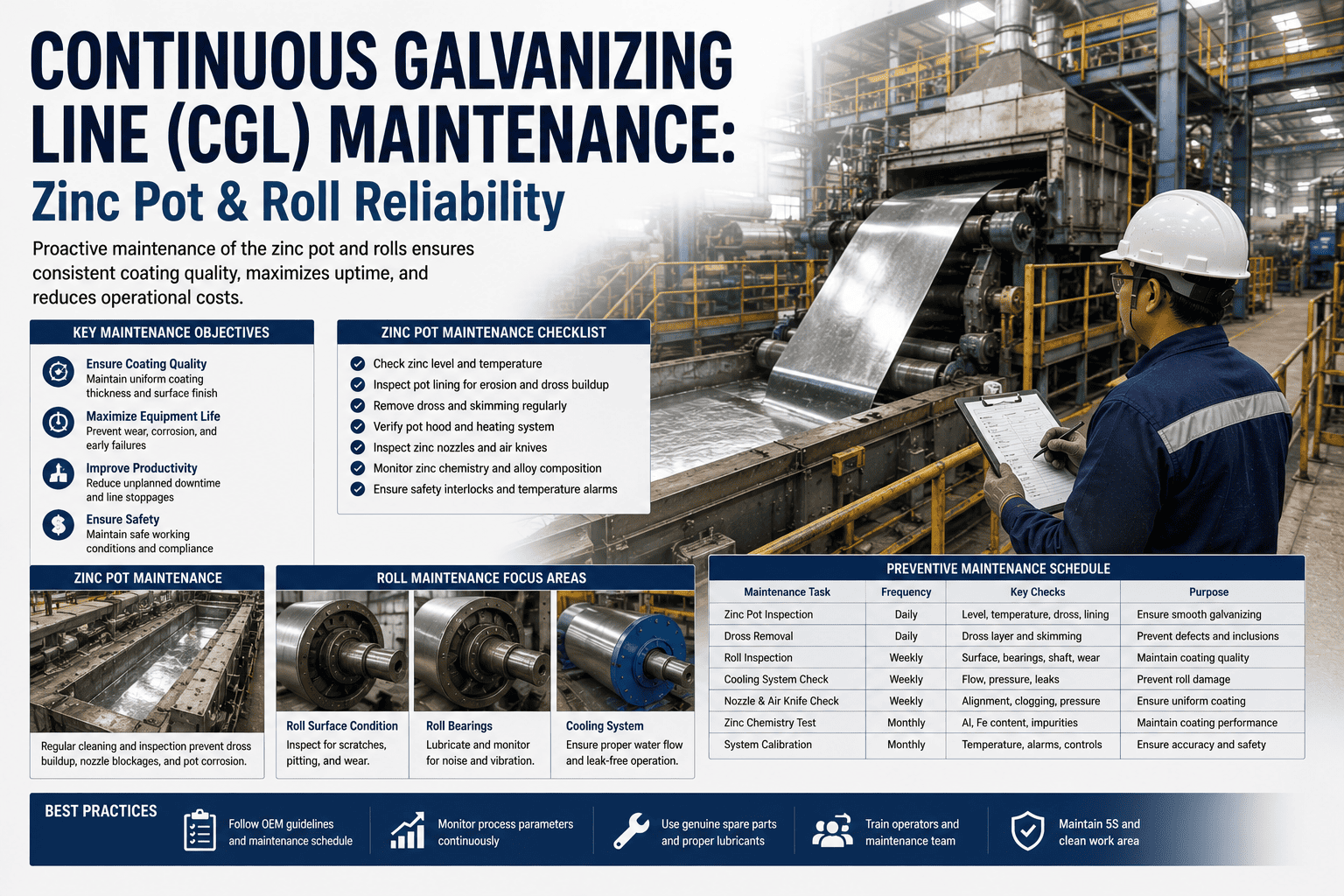
Every meter of strip on a continuous galvanizing line passes through a bath of molten zinc running past 840°F, held under the surface by a sink roll that has to keep turning true for weeks at a time. Let a bearing seize or dross build up unnoticed in that bath, and the line doesn't slow down, it stops, at a cost that can run past $25,000 an hour. Sign up for a free trial to see how Oxmaint tracks zinc pot and roll reliability across your galvanizing line.
840°F
Molten zinc bath temperature sink rolls and stabilizer rolls run submerged in
$25,000/hr
Typical cost of a line stop caused by submerged bearing failure or dross buildup
±5 g/m²
Coating weight tolerance air knife pressure has to hold across the full strip width
0.05mm
Roll tolerance every reconditioned sink or stabilizer roll must meet before reinstall
Why the Zinc Pot Is the Line's Highest-Stakes Zone
Everything that keeps coating quality consistent, roll bearings, dross control and air knife pressure, has to work correctly inside a bath you can't see into while it's running. A submerged bearing failure doesn't give much warning before it locks up, and by the time strip quality drops enough to notice, the fix usually means pulling hardware out of molten zinc instead of catching it on a planned changeout.
The Strip's Path Through the Zinc Pot
Step 1
Sink Roll
Holds the strip under the bath surface, taking the full weight of submerged operation
Step 2
Stabilizer Rolls
Keep the strip flat and tensioned as it clears the sink roll and heads for the surface
Step 3
Air Knife
Wipes excess zinc from both sides of the strip to set final coating weight
Give Every Sink Roll a Serial Number and a History
Oxmaint tracks roll campaign tonnage, bearing condition and reconditioning tolerance so submerged hardware gets swapped on a schedule, not after strip quality already slipped. Sign up for a free trial to start tracking your own roll shop and zinc pot data, or book a demo and we'll walk through your CGL reliability program.
Top Dross vs Bottom Dross: Two Problems, Two Fixes
| Dross Type |
Where It Forms |
Removal Approach |
| Top dross |
Floats at the bath surface near the strip exit and air knife zone |
Skimmed on a standardized interval before it reaches the strip path |
| Bottom dross |
Settles near the sink roll grooves where aluminum and iron concentrations run high |
Manual or robotic drossing, guided by pot temperature and aluminum tracking |
Air Knives Deserve as Much Attention as the Pot
Clogged nozzles or an uneven pressure profile across the strip are the leading cause of coating weight that drifts outside spec, even when the pot itself is running clean. Pairing a regular nozzle-cleaning schedule with real-time pressure monitoring is what keeps coating weight inside that tight gram-per-square-meter window, heat after heat.
Frequently Asked Questions
Q
What actually causes a sink roll bearing to fail?
Continuous submersion in near-840°F molten zinc pushes bearings and coatings to their limits, and dross adhesion on the roll surface adds mechanical stress on top of the thermal load. Tracking roll campaign tonnage against a known service life catches wear before a bearing seizes mid-run.
Q
Can dross buildup really be predicted before it shows up as a defect?
To a meaningful degree, yes. Pot temperature stability and aluminum concentration in the bath are strong leading indicators of dross formation, so tracking both lets a team schedule drossing cycles proactively instead of reacting once groove-clogging or surface defects already show up on the strip.
Q
Why does air knife pressure matter more than most teams assume?
Because coating weight is decided in the fraction of a second the strip passes through the air knife jet, and any inconsistency across the strip width shows up directly as uneven zinc distribution. Clogged nozzles are the most common root cause, which is why routine cleaning paired with pressure monitoring matters as much as pot condition itself.
Q
What tolerance should a reconditioned sink roll meet before it goes back in the pot?
Reconditioned rolls should come back within 0.05mm tolerance to hold coating consistency at line speed. Treating each roll as a tracked asset with its own service history, rather than interchangeable spare hardware, is what keeps that tolerance from slipping over repeated grinding and rebalancing cycles.
Keep the Zinc Pot Running Between Planned Changeouts
Oxmaint gives galvanizing teams roll campaign tracking, air knife pressure monitoring, dross scheduling and submerged hardware history in one platform built for CGL reliability. Sign up for a free trial to explore it yourself, or book a demo and we'll walk through it against your own zinc pot operation.