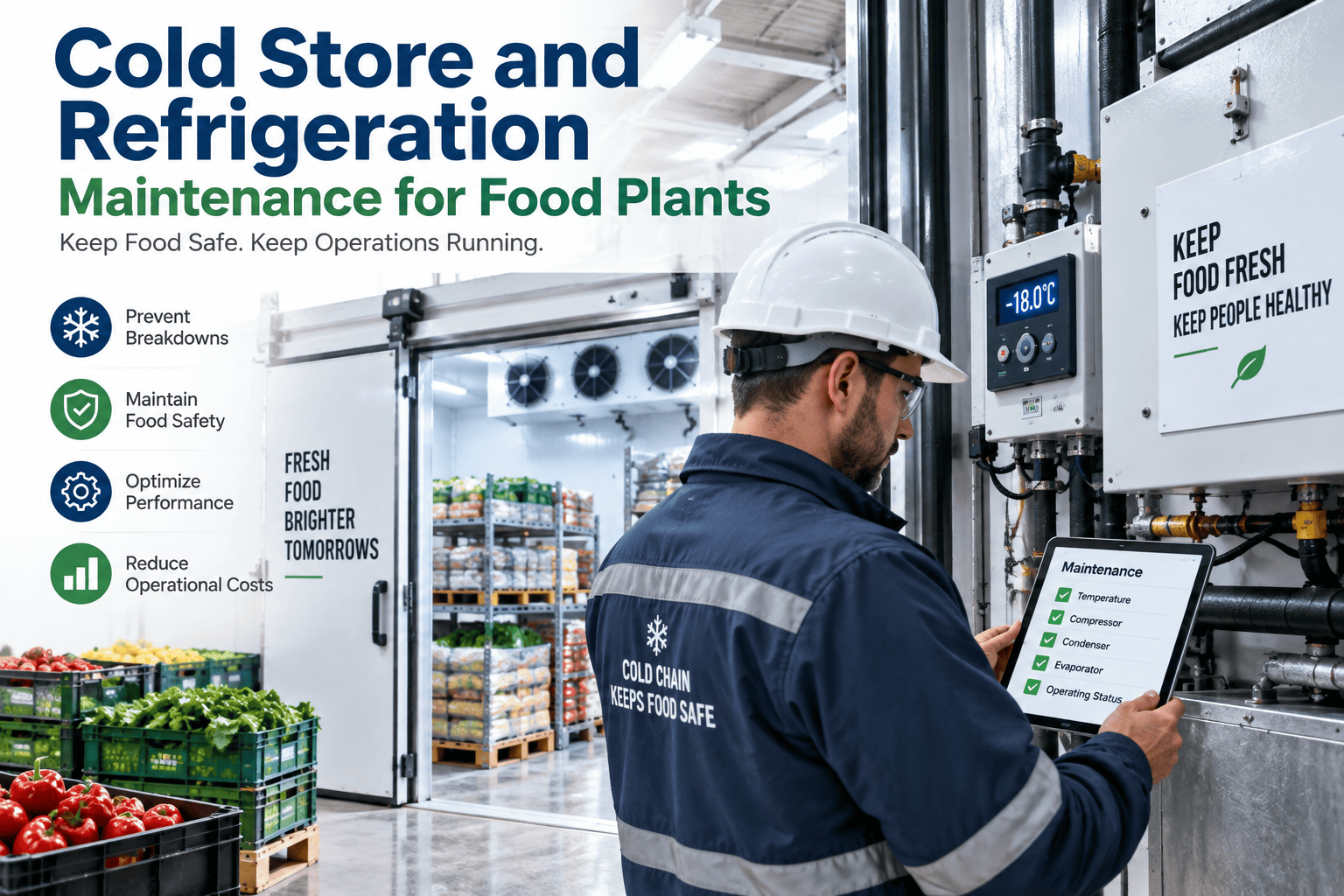
Cold storage is the only part of a food plant where a maintenance failure can destroy the product without touching it. A compressor that trips overnight, a defrost cycle that stopped working three weeks ago, a door seal nobody replaced — each one moves stock through the temperature band where shelf life quietly disappears, and the loss is usually discovered by a quality check rather than an alarm. Refrigeration maintenance is cold chain protection, and it depends on scheduled work plus a response route for every temperature alarm. To see how that looks in a live system, start a free trial.
Cold store and refrigeration maintenance
Your cold store is holding more value than any other asset on site
A single chamber can hold weeks of finished product, and the equipment protecting it runs continuously with almost no visibility until something goes wrong. Compressors, evaporators, condensers, defrost controls and door seals all degrade slowly, and the first honest indication is usually a temperature trend rather than a breakdown. OxMaint puts that equipment on a real schedule and turns every temperature alarm into a tracked, time-stamped response instead of a phone call someone remembers making.
The refrigeration circuit, stage by stage
Nearly every refrigeration fault a food plant sees can be located at one of four stages of the circuit. Understanding which stage a symptom belongs to is what separates a targeted repair from a week of guesswork, and it is also the cleanest way to structure a preventive maintenance schedule that covers the whole system without duplicating work.
Stage one
Compression
The compressor raises refrigerant pressure and is the single most expensive component to lose. Oil level and condition, discharge temperature, vibration, suction pressure and run hours are the values that predict failure. Short cycling is the clearest early warning and almost always has a cause elsewhere in the circuit.
Stage two
Condensing
Heat rejection through the condenser. Fouled fins, failed fan motors and blocked airflow raise head pressure, which raises energy use and shortens compressor life. Condenser cleaning is the highest-return routine task in the whole system and the one most often skipped.
Stage three
Expansion and control
Expansion valves, solenoids, controllers and sensors set how much refrigerant reaches the evaporator. Superheat drifting out of range starves or floods the coil, and a controller running on a sensor that has drifted will hold the chamber at a temperature nobody intended.
Stage four
Evaporation and defrost
The evaporator absorbs heat from the chamber, and defrost clears the ice that accumulates while it does. A defrost circuit that has silently failed is one of the most common causes of a chamber slowly losing capacity over weeks without ever raising an alarm.
Building the asset register around these four stages, rather than around a single entry called cold store, makes cost and failure history meaningful. It also makes the maintenance plan self-evident: each stage has its own checks, its own intervals and its own set of measurable values.
It also helps when diagnosing a chamber that is simply not holding temperature. Rather than starting with the most expensive component, the stage model gives a logical order of elimination: confirm the chamber is not being loaded warm or left open, check the evaporator for ice and airflow, confirm the defrost is terminating correctly, check superheat and the expansion device, then look at head pressure and the condenser, and only then question the compressor. Most faults are found in the first three checks, and the ones that are not are far easier to justify escalating to a contractor once the earlier stages have been ruled out on record.
What goes wrong, and what it costs you before you notice
Refrigeration faults are rarely dramatic. Most present as a gradual loss of capacity that the plant absorbs by running longer, setting colder or working around a chamber. The table below maps the faults that most commonly sit undetected in food plants, alongside what they are actually costing while they go unfixed.
| Fault | How it presents | Hidden cost while unfixed | Preventive check |
|---|---|---|---|
| Fouled condenser coil | High head pressure, longer run times | Significant extra energy and shortened compressor life | Scheduled coil cleaning and pressure trending |
| Failed defrost cycle | Ice build-up on the evaporator, falling capacity | Chamber drifts warm, airflow blocked, coil damage | Defrost termination and heater circuit check |
| Refrigerant leak | Low suction pressure, bubbles at sight glass | Lost capacity, regulatory exposure, expensive top-ups | Leak detection and documented gas inventory |
| Worn door seals and strip curtains | Frost around the door frame, condensation | Constant heat and moisture ingress, iced floors | Seal inspection on a fixed interval |
| Sensor calibration drift | Panel and product temperatures disagreeing | Records show compliance the product does not have | Documented calibration against a reference |
| Compressor oil degradation | Dark oil, rising discharge temperature | Bearing wear leading to total compressor loss | Oil analysis and scheduled change |
| Fan motor failure in the pack | Uneven chamber temperature, hot spots | Product at the far end of the store out of specification | Motor current and airflow verification |
Turning a temperature alarm into a tracked response
Most food plants have temperature alarms. Far fewer have a documented, time-stamped record of what happened after each one. That gap is where product decisions get made informally and where audit questions become uncomfortable. A clear escalation ladder, with each rung raising a record, closes it.
Deviation detected
Chamber temperature moves outside its band. The alarm is logged with the chamber, the time and the reading, creating the start of the record whether or not anyone acts immediately.
First response and assessment
A named responder checks whether the cause is operational, such as a door left open or a delivery in progress, or a plant fault. That assessment is recorded against the alarm rather than resolved verbally.
Work order raised
If the cause is a plant fault, a work order opens against the specific component with the alarm history attached, priority set by chamber criticality and by how far the temperature has moved.
Product decision
Quality decides whether stock is held, released or downgraded, based on time above threshold rather than on recollection. The decision and its reasoning sit alongside the technical record.
Root cause and schedule change
Repeat alarms on the same chamber trigger a review of the underlying cause and an adjustment to the maintenance interval, so the same excursion stops recurring quarter after quarter.
The value of the ladder is cumulative. After a few months, the alarm history shows which chambers are genuinely unstable, which are suffering from operational behaviour, and which maintenance intervals need to move — evidence that is impossible to assemble from memory.
See your cold store set up in OxMaint
Book a 30-minute walkthrough and we will configure a live example using your own chambers and plant room — assets by circuit stage, the PM schedule behind them, calibration records for the temperature sensors, and the alarm-to-work-order route that keeps the cold chain documented.
A refrigeration PM schedule worth running
Refrigeration maintenance schedules tend to be either a service contract nobody reads or a list so long that it is never completed. A workable schedule separates what site staff can do from what needs a qualified refrigeration engineer, and puts a measurable value against each line so trends are possible.
| Frequency | Task | Owner | Value recorded |
|---|---|---|---|
| Daily | Chamber temperature check, door and seal visual, ice inspection | Site team | Temperature reading, pass or fail |
| Weekly | Plant room walk, oil level, unusual noise, alarm log review | Site engineer | Oil level, alarm count |
| Monthly | Condenser coil condition, fan operation, defrost confirmation | Site engineer | Head pressure, defrost result |
| Quarterly | Coil clean, superheat and subcooling check, leak inspection | Refrigeration engineer | Superheat, subcooling, leak result |
| Biannual | Sensor calibration, control verification, electrical inspection | Refrigeration engineer | Calibration offset |
| Annual | Compressor service, oil analysis, full system performance test | Specialist contractor | Oil condition, capacity result |
Recording a value rather than a tick is the part that changes outcomes. Head pressure trending upward over four months tells you the condenser needs attention before the compressor complains, and superheat drifting month on month identifies a control problem long before capacity visibly drops.
The ownership column matters just as much as the frequency. Plants that hand every line to the refrigeration contractor pay specialist rates for tasks a site engineer could complete, and they lose the daily familiarity that catches problems early. Plants that keep everything in house eventually miss the technical checks that need calibrated instruments and refrigerant handling qualifications. The split above works because it puts observation and simple verification with the people already in the building, and reserves the contractor for work that genuinely requires their competence and their equipment.
There is an energy argument sitting alongside the food safety one, and it is usually the argument that gets a refrigeration programme funded. A cold store runs continuously, which means every inefficiency is paid for every hour of every day rather than only when the plant is in use. Fouled condensers, iced evaporators and leaking door seals each force the compressor to work harder for the same result, and the cost accumulates silently in an electricity bill that nobody attributes to maintenance. Fixing them protects the product and reduces the bill at the same time, which is a rare combination in a maintenance business case.
How OxMaint protects the cold chain
OxMaint is maintenance management software built for operations where equipment condition directly affects product. In a cold store, that means connecting the refrigeration plant, the chambers it serves and the records that prove both were under control.
Plant and chamber asset hierarchy
Compressor packs, condensers, evaporators, controls and doors are held individually and linked to the chambers they serve, so a fault is immediately traceable to the stock it puts at risk.
Risk visible immediately
Alarm-driven work orders
A temperature excursion raises a work order with the chamber, reading and time already attached, routed by criticality so the response is tracked from the first minute instead of reconstructed later.
Every alarm has a record
Reading capture and trending
Head pressure, superheat, oil condition and motor current are stored as trended values against each component, turning a service visit into data rather than a signature on a sheet.
Degradation seen early
Sensor calibration register
Every temperature sensor used for compliance carries its calibration interval, offset and certificate, with alerts before expiry so records are never built on an instrument that has drifted.
Trustworthy temperature records
Contractor visit tracking
Refrigeration contractor visits, findings and recommendations are logged against the asset, so recurring recommendations that have never been actioned become visible rather than filed.
Contract value you can see
Audit and compliance export
Temperature excursion history, response times, corrective work and calibration evidence are retrievable by chamber and date range, which covers most cold chain questions an auditor will ask.
Audit answers on demand
Four signs your refrigeration plant is being nursed
Refrigeration rarely fails without a run-up. These four patterns show a plant that is being kept going by adjustment rather than maintained, and each one has a maintainable cause behind it.
Setpoints have been lowered over time
Setting a chamber colder to hold the same product temperature is compensation for lost capacity, and it is being paid for in energy every hour of every day.
Ice keeps returning to the same coil
Recurring ice is a defrost, airflow or moisture ingress problem. Chipping it off treats the symptom and leaves the chamber losing capacity again within days.
Refrigerant top-ups are routine
A system that needs regular gas is leaking. Beyond the cost and the lost capacity, it carries regulatory exposure that grows the longer it goes undocumented.
Nobody can produce last quarter's alarm history
If excursions cannot be counted, they cannot be trended, and the plant has no way of knowing whether cold chain performance is improving or quietly getting worse.
Cold store and refrigeration maintenance questions
What does refrigeration maintenance software do for a food plant?
It schedules compressor, condenser, evaporator and defrost checks, stores readings as trends, and turns temperature alarms into tracked work orders. Start a free trial to set it up on your chambers.
How often should condenser coils be cleaned?
Quarterly suits most sites, moving to monthly where the plant sits near a dusty yard, a bakery exhaust or heavy vehicle traffic. Head pressure trending tells you whether the interval is right.
Can it record temperature excursions for audits?
Yes. Each excursion is logged with chamber, reading, time, responder and the corrective work that followed, giving a complete cold chain trail by date range. Book a demo to see it.
Does it work alongside our refrigeration contractor?
It works better with one. Contractor visits, findings and recommendations are logged against the asset, so repeated advice that has never been actioned becomes visible instead of sitting in an email.
How long before the data becomes useful?
Alarm tracking is useful immediately. Pressure, superheat and oil trends usually become genuinely predictive after a quarter of consistent readings across the full range of ambient conditions.
Protect the cold chain with a schedule, not luck
Put every compressor, condenser, evaporator and sensor on a maintenance plan, trend the values that predict failure, and give every temperature alarm a documented response you can show an auditor.
Free 14-day trial. No credit card required.