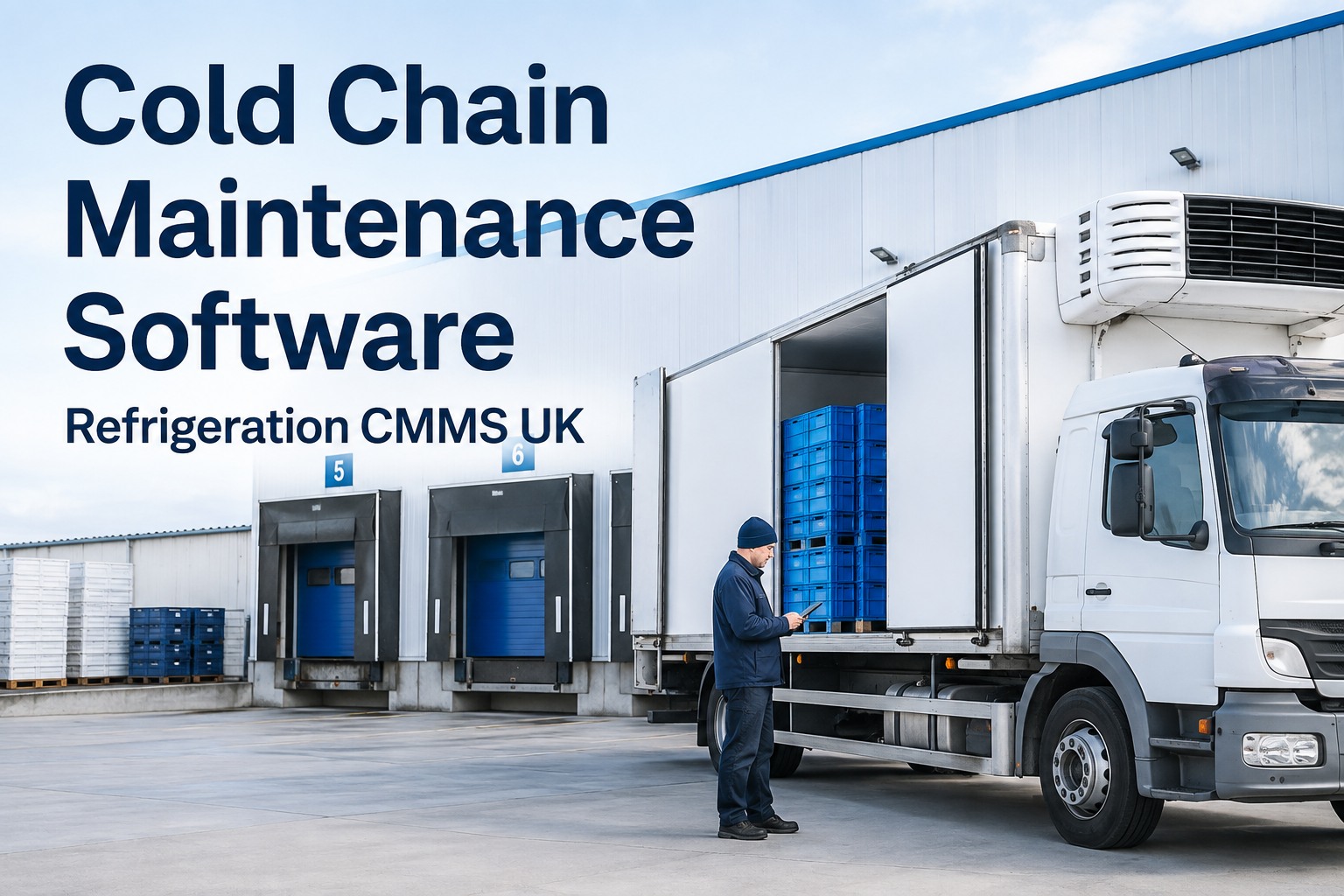
The cold chain is the most unforgiving maintenance environment in UK retail and logistics. A refrigeration failure isn't a defect — it's a countdown clock against product write-off, service penalties and food safety notifications. A single supermarket cabinet fail over a weekend can write off £3,000 of stock. A DC cold store trip in summer can breach £50,000 in hours. Operators keeping cold chain intact aren't the ones with newest kit — they're the ones where every alarm, F-Gas check and service sits in one platform. Book a demo to see cold chain in action.
◆ COLD CHAIN · F-GAS · TEMPERATURE INTEGRITY
A refrigeration failure isn't a defect. It's a countdown clock — against stock, against penalties, against food safety.
Every compressor, every evaporator, every temperature probe, every kilogram of refrigerant — under one continuity-driven maintenance system.
DEVIATION IMPACT · HOURS FROM ALARM TO WRITE-OFF
T+2h
Product at risk zone
T+4h
FSA notification threshold
T+8h
Full write-off likely
£3k
Single cabinet fail-open · Weekend stock loss
£50k+
DC cold store trip · Summer peak loss
4h
Typical FSA-critical window before action required
The Refrigeration Asset Map — Every Class Runs a Different Regime
Cold chain isn't one asset type. A supermarket display cabinet, a distribution centre chilled hall and a pharmaceutical cold room each demand entirely different PPM cycles, alarm thresholds and F-Gas obligations. Getting the classification right per asset is the difference between running a defensible cold-chain programme and drowning in generic PPM tickets that don't match how the plant actually fails. Sign up free to classify your refrigeration estate against the right regimes.
REFRIGERATION ASSET CLASSES
Class → Typical Kit → PPM Regime
CLASS A
Retail Cabinets
Chilled and frozen display cases across supermarkets, convenience stores, forecourts · Small hermetic units to remote-condensed sections
PPM · Quarterly clean + service · Monthly gauge check
CLASS B
Walk-In Cold & Freezer Rooms
Back-of-house cold rooms, restaurant walk-ins, food-service prep rooms · Fixed condensing units with evaporator fans and defrost cycles
PPM · Bi-annual full service · Quarterly evaporator clean · Door seal check
CLASS C
DC & Bulk Cold Storage
Distribution centre chilled and frozen halls, third-party logistics stores, blast freezers · Industrial ammonia or synthetic refrigerant plant
PPM · Manufacturer schedule · Weekly plant inspection · Redundancy verification
CLASS D
Pharma & Ultra-Low
Pharmaceutical cold stores (2-8°C), vaccine storage, ultra-low freezers (-70 to -80°C), specialised biotech cold storage
PPM · GxP-aligned · Continuous monitoring · Backup verification
F-Gas Compliance — The Regime That Sits Behind Every Service
The UK F-Gas Regulation (retained EU 517/2014) applies leak-check frequency based on refrigerant charge measured in CO₂-equivalent tonnes. Getting the classification wrong doesn't just risk environmental fines — it invalidates the operator's F-Gas records and puts the operator out of compliance the moment an Environment Agency check happens. A working CMMS holds refrigerant charge, CO₂e calculation and leak-check frequency per asset, generating the required inspection schedule automatically. Book a demo to see F-Gas records workflow live.
< 5 tCO₂e
Tier 0 · No Statutory Leak Check
Small hermetically-sealed units below threshold · No mandatory F-Gas leak inspection · Good practice maintenance still applies
Best Practice
5 - 50 tCO₂e
Tier 1 · Annual Leak Check
Small commercial refrigeration and heat-pump systems · Annual leak check by F-Gas certified engineer · Records held 5 years
12 months
50 - 500 tCO₂e
Tier 2 · 6-Monthly Leak Check
Medium-large commercial systems including most supermarket packs · 6-monthly check · Automatic leak detection halves the frequency
6 months
> 500 tCO₂e
Tier 3 · Quarterly Leak Check
Large industrial refrigeration and DC plant · Quarterly leak check mandatory · Automatic leak detection compulsory · Full record-keeping
3 months
The Alarm-to-Work-Order Workflow — Where Cold Chain Actually Lives
Every serious cold chain platform lives in the gap between an alarm firing and a work order closing. Miss that gap and stock spoils, penalties trigger, food safety records get exceptions filed against them. Structured response workflow — alarm ingestion, severity classification, on-call routing, contractor dispatch, resolution capture — is the single most important cold chain discipline, and where a properly configured CMMS shows its value most concretely.
ALARM RESPONSE WORKFLOW
From Trip to Resolution · Every Alarm Owned
01
Alarm Ingested
BMS or telemetry alarm hits platform · Auto-attached to affected asset with temperature history · Severity auto-classified
→
02
Triage & Route
Class 1 nuisance filtered · Class 2-3 route to on-call rota · Class 4 critical raises emergency contractor dispatch immediately
→
03
Work Order
Auto-generated with SLA countdown, contractor allocation, part lookup and estimated stock-loss impact if breach continues
→
04
Fix & Verify
Contractor arrives with mobile app · Root cause captured · Refrigerant added logged for F-Gas · Temperature return-to-normal verified
→
05
Close & Report
Alarm cleared · Stock impact reconciled · Food safety record annotated · Analytics update for chronic-failure patterns
◆ COLD CHAIN MAINTENANCE DEMO
See the Full Cold Chain Workflow in 30 Minutes
Multi-site refrigeration asset registers with CO₂e classification, F-Gas leak-check calendars, BMS alarm ingestion with SLA-driven contractor dispatch, temperature record integration and audit-ready evidence packs for FSA and Environment Agency.
Where Cold Chain Actually Deploys — Four UK Operating Contexts
Cold chain platforms deploy across very different operating contexts, and each context stresses the workflow differently. The four below cover the majority of UK deployments and share a common CMMS backbone but tune the alarm thresholds, F-Gas priorities and contractor dispatch rules to context. Sign up free to configure the right context tuning for your operation.
01 · SUPERMARKET ESTATES
Multi-Site Retail
Cabinet-level asset registers across hundreds of stores · Central F-Gas team coordinating national leak-check programme · SLA-driven contractor dispatch to any store within contracted response window
02 · DISTRIBUTION CENTRES
3PL & Grocery DCs
Large industrial ammonia or F-gas plant with redundancy · Critical-asset condition monitoring · Backup compressor verification cycles · Failover testing routines
03 · FOOD MANUFACTURING
Processing & Blast Freezing
Process refrigeration integrated with production PPM · BRCGS-linked temperature record integration · Blast freezer duty cycle tracking · Cook-chill workflow
04 · PHARMACY & VACCINE
GxP Cold Storage
Pharmaceutical 2-8°C stores and ultra-low freezers · Continuous monitoring with alarm redundancy · Excursion investigation workflow · MHRA-defensible temperature records
Expert Perspective — Why Cold Chain Rewards a Single System
"
Cold chain is one of those operational areas where the fragmentation of systems does more damage than any individual piece of equipment failure. In a typical UK supermarket estate you'll have a temperature monitoring platform running one way, an F-Gas record system running another, a BMS alarm output firing into a helpdesk queue, contractor dispatch happening through a third system, and stock impact reconciliation happening in a spreadsheet a week after the incident. What that means in practice is that when a cabinet fails on a Saturday afternoon, nobody has a single view of the incident — the temperature data, the F-Gas implications, the contractor status, the stock at risk and the SLA countdown all live in different places. The operators solving cold chain aren't running exotic technology; they've pulled everything into a single platform where an alarm becomes a classified incident becomes a work order becomes an F-Gas record becomes a stock reconciliation, all with one audit trail. That's the entire operational advantage — visibility of the same incident by everybody who needs to act on it, at the same time.
— UK Cold Chain & Retail Refrigeration Practice
01
Asset register with CO₂e
Every refrigeration asset held with charge, refrigerant type, CO₂e tonnage and F-Gas leak-check tier classification.
02
BMS alarm integration
Temperature and system alarms ingest per asset with severity classification and auto-routed contractor dispatch.
03
Contractor SLA workflow
On-call rota, contractor dispatch, mobile arrival capture, remedial work and cost tracking all in one chain.
04
F-Gas evidence chain
Refrigerant additions and recoveries logged per asset for statutory records and Environment Agency audit.
Who Uses Oxmaint for UK Cold Chain Operations
The platform is used by the UK roles that own cold chain reliability day-to-day: multi-site retail engineering directors running supermarket refrigeration estates, distribution centre facilities managers overseeing 3PL and grocery DC plant, food manufacturer engineering managers with integrated processing and storage refrigeration, cold-storage third-party logistics operators, pharmaceutical warehouse and cold store managers under MHRA GxP requirements, hospital and pharmacy service estates responsible for vaccine and biologics cold storage, and QSHE directors requiring defensible temperature and F-Gas evidence chains for FSA, EA and BRCGS audit. Sign up free to structure your cold chain evidence in one platform.
Getting Cold Chain Maintenance Live in 30-60 Days
Deployment starts with the refrigeration asset register — every unit with make/model, refrigerant type, charge kg, calculated CO₂e tonnage, F-Gas leak-check tier, associated PPM schedule and criticality classification. PPM templates configure per asset class. BMS alarm ingestion integration configures with severity classification and routing rules. Contractor rota and SLA workflow deploys with mobile arrival capture. F-Gas records structure captures refrigerant additions, recoveries and leak-check outcomes. Multi-site templating rolls the configuration across every store or DC in the estate. Most cold-chain operators see refrigeration register, alarm workflow and F-Gas records live within 30-60 days.
◆ EVERY ALARM. EVERY SITE. EVERY LEAK CHECK LOGGED.
One Estate. One Platform. Every Regulator Satisfied.
Oxmaint gives UK cold chain operators the full refrigeration cycle in one platform — CO₂e-classified asset registers, F-Gas leak-check calendars, BMS alarm-to-work-order workflow with SLA dispatch and audit-ready evidence chains for FSA and EA.
Frequently Asked Questions
What is cold chain maintenance software?
Cold chain maintenance software is a CMMS configured specifically for refrigeration reliability across retail cabinets, walk-in cold and freezer rooms, distribution centre plant, food manufacturing process refrigeration and pharmaceutical GxP cold storage. It holds each asset with refrigerant type, charge in kilograms, calculated CO₂-equivalent tonnage, F-Gas leak-check tier classification and criticality band. It integrates BMS alarm ingestion with severity classification, auto-routes work orders to on-call contractors with SLA tracking, captures F-Gas records for refrigerant additions and recoveries, and produces audit-ready evidence packs for FSA, Environment Agency, BRCGS and MHRA GxP audit.
How does it handle F-Gas compliance and leak-check cycles?
Every refrigeration asset holds refrigerant type and charge, from which the CMMS calculates CO₂-equivalent tonnage automatically using GWP values. The calculated tCO₂e drives F-Gas leak-check tier assignment per UK F-Gas Regulation (retained EU 517/2014) — below 5 tCO₂e no statutory check, 5-50 annual, 50-500 6-monthly (or 12-monthly with automatic leak detection), above 500 quarterly (with mandatory automatic leak detection). Leak checks schedule automatically per asset with alerts, F-Gas certified engineer verification, and record-keeping structure for 5-year retention. Refrigerant additions and recoveries capture per asset with cylinder tracking. Complete F-Gas evidence exports directly for Environment Agency audit — turning what was often a scrambled paper record into structural compliance.
Can it ingest BMS temperature and system alarms?
Yes. BMS alarm integration supports the major refrigeration and building management platforms used across UK retail and distribution — Danfoss, Emerson, Carel, Trend, JCI and equivalent — with alarm messages ingested via API or message-queue integration. Each alarm auto-attaches to the affected asset in the CMMS with temperature history context, severity classification (nuisance, minor, urgent, critical), and predefined routing rules. Nuisance alarms filter automatically to avoid alarm fatigue while retaining audit history; genuine excursions raise work orders with SLA countdown, contractor dispatch and stock-impact estimation embedded. Alarm response history becomes a reliability data source — chronic alarms on specific assets surface for engineering root-cause investigation rather than being lost in individual incident tickets.
Does it manage multi-site contractor dispatch and SLAs?
Yes. Multi-site refrigeration operations rely on national or regional contractor networks with tiered response SLAs (4-hour critical, 24-hour urgent, 5-day standard). The CMMS holds contractor rota, geographical assignment, competency and F-Gas certification records, and auto-dispatches based on alarm class and site location. Contractor arrival captures on mobile with photograph and geolocation, remedial work executes against structured work orders, refrigerant additions log for F-Gas compliance, and cost tracking integrates with purchase order and invoice reconciliation. Multi-site templating rolls the contractor rules across every store or DC in the estate — a single central engineering team can coordinate response across hundreds of sites without individual store engineering resources.
How long does deployment typically take for a UK cold chain operator?
A single supermarket estate or DC network with 50-500 refrigeration assets typically goes live within 30-60 days — refrigeration asset register import with per-asset refrigerant, CO₂e tonnage, F-Gas tier classification and criticality, PPM cycle configuration per asset class (retail cabinets, walk-in rooms, industrial plant), BMS alarm ingestion configuration with severity rules and routing, contractor rota and SLA workflow with mobile arrival capture, F-Gas records structure with refrigerant addition/recovery tracking, and multi-site templating for rollout across stores or DCs. Large multi-site retail estates (300+ stores) or national 3PL cold storage rollouts typically complete within a quarter to six months, with statutory calendar migration from legacy F-Gas records being the largest single scoping variable.