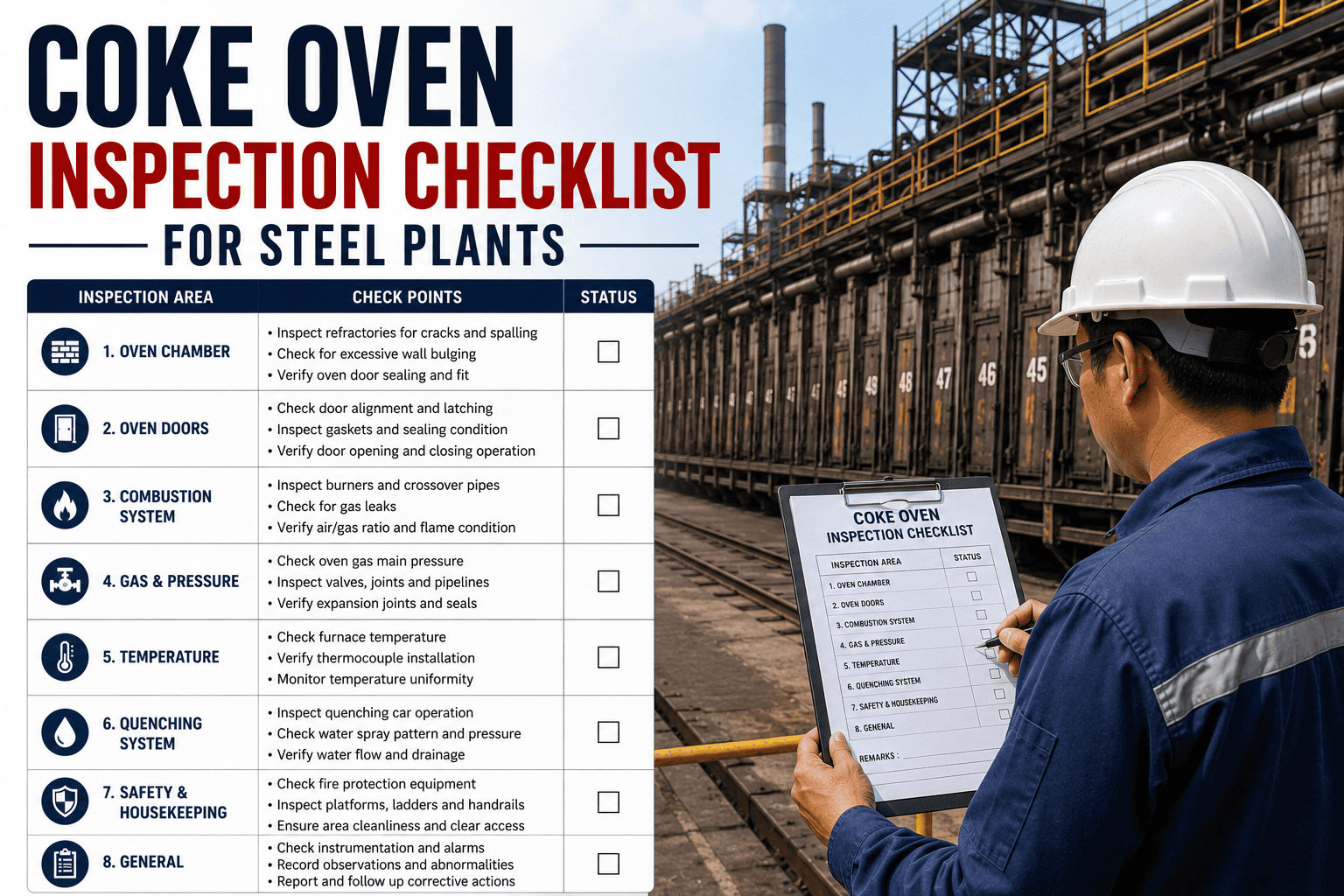
A coke oven battery runs at full heat for decades, and it almost never fails without warning first. The warning just shows up in small places: a door that's leaking a little more smoke than yesterday, a ram that takes half a second longer to push, a standpipe cap that's not sealing quite as tight. This checklist covers the eight points a coke oven inspection route should never skip. Sign up to turn this checklist into a recurring digital inspection your team can't miss a step on.
8 Points
Core checks that belong on every coke oven inspection route
Per Oven
Reading recommended at the individual oven level, not battery average
Every Push
Frequency recommended for pushing force and door seal checks
Zero Skips
Tolerance for missed checks, since drift rarely repeats itself
Why Oven-Level Checks Beat Battery Averages
A battery-wide average of 22 tons of pushing force can quietly hide one oven running at 38 tons. A battery-wide door leak rate of 3 percent can hide six doors leaking well above that. The only way to catch either one early is to log every reading against the specific oven, not the battery as a whole.
The Coke Oven Inspection Checklist
Oven Door & Seal Condition
Check knife edge sharpness, luting condition, and latch engagement on both the pusher side and coke side of every door
Pushing Machine & Ram Alignment
Record pushing force per oven and watch for a ram stroke that's starting to slow, bind, or drift out of alignment
Gas Collecting Main & Standpipe
Check standpipe cap sealing, collecting main joint integrity, and any visible smoke escaping at the topside
Charging Hole Lids & Larry Car
Confirm charging hole lids are seating fully and the larry car's charging sequence is running without leaks or delays
Refractory & Heating Wall Condition
Look for wall irregularity, taper, or carbon buildup that signals refractory wear or an uneven heating profile
Buckstay & Structural Framework
Check the steel buckstay framework for distortion, since lateral movement here is what causes taper and stuck pushes
Coke Guide & Quench Car
Verify the coke guide seals properly to the oven face and quench car travel time is within the normal range
Emission & Compliance Check
Scan for visible emissions after door reseat, since leak rates are the most frequently cited item in plant audits
Never Miss A Coke Oven Inspection Point
Oxmaint turns this eight-point checklist into a recurring digital route, logging every reading against the specific oven so drift is caught long before it becomes a stuck push. Sign up for a free trial to build your coke oven inspection route, or book a demo to see it in action.
What An Abnormal Reading Might Be Telling You
| What You Notice |
Possible Cause |
| Rising pushing force on one oven |
Progressive oven taper, often traced back to buckstay movement |
| Door leaking more than usual |
Framework distortion or luting and sealing material breaking down |
| Slight wall irregularity or taper |
Carbon buildup narrowing the oven or undercoking from a heating imbalance |
| Standpipe or lid not sealing fully |
Cap wear or misalignment, an early driver of topside emission violations |
Battery Average vs Oven-Level Tracking
Battery-Wide Average
A single average number hides which specific oven is drifting
Door leak logs recorded on paper are easy to skip during a busy shift
No trend line until someone manually pulls old sheets together
Oven-Level Digital Route
Every reading logged against the exact oven, with a timestamp automatically
A skipped point on a door or ram check flags itself instead of disappearing
Trend lines build on their own, so taper or leak drift is caught early
Where A CMMS Fits Into Coke Oven Inspections
Oxmaint turns this eight-point checklist into a recurring digital route, capturing each door, ram, and refractory reading against the individual oven so trends are visible instantly and a missed check never slips through unnoticed.
Frequently Asked Questions
Q
How often should a coke oven battery be inspected?
Door seals and pushing force are best checked on every push cycle, while refractory walls and buckstay framework are typically walked at least daily, with a full silica brick inspection per oven annually.
Q
Which check on this list matters most?
Pushing force per oven tends to reveal problems earliest, since a rising force usually points to taper from buckstay movement long before a push actually gets stuck.
Q
Can a CMMS track this checklist at the individual oven level?
Yes, a CMMS can schedule this checklist per oven, prompt the technician for each door, ram, and refractory reading, and build a trend history automatically instead of relying on a battery-wide average.
Turn This Checklist Into A Route Your Team Follows Every Push
Oxmaint schedules this eight-point coke oven inspection as a recurring digital route, capturing readings and trends automatically at the individual oven level. Sign up for a free trial to build your coke oven inspection route, or book a demo to see it in action.