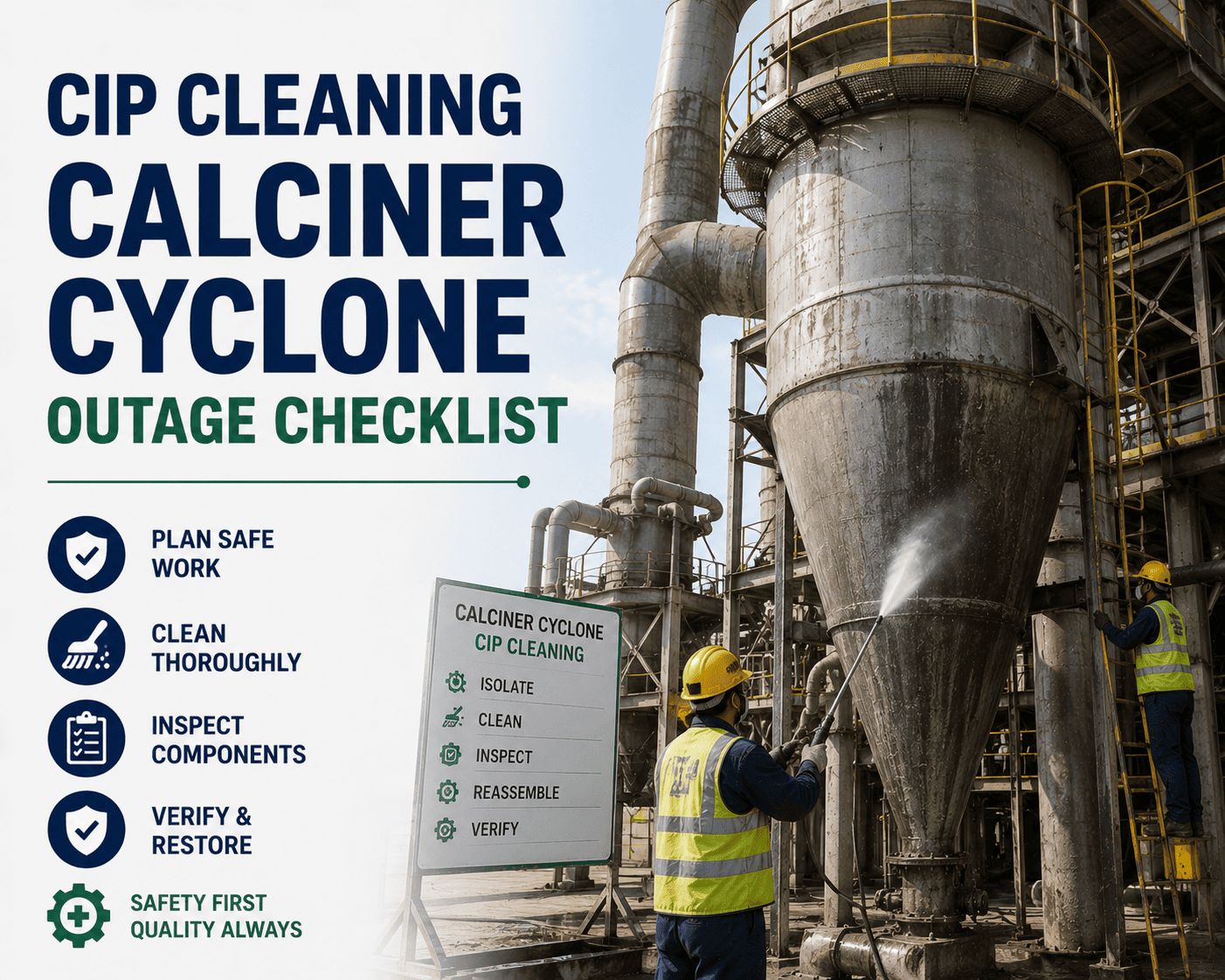
A calciner cyclone outage isn't a cleaning job you improvise once the tower is cold. Scaffold access, blower staging, and buildup removal on a 60 to 100 meter tower need to be sequenced before the shutdown starts, or the crew spends the first shift of a short outage window just figuring out how to reach the blockage. Sign up to plan every cyclone stage as its own scope item, track access setup against the outage clock, and log what was found so next campaign starts smarter.
Why It Matters
A preheater tower blockage costs a cement plant somewhere between 180,000 and 650,000 dollars in lost output and emergency clearing labor, and most of those events trace back to buildup that was visible at a prior inspection but never made it into a scheduled cleaning scope.
The Outage In Three Phases
Before Shutdown
Confirm scaffold and access plans for each cyclone stage, stage tools and blowers at the base of the tower, and review the last campaign's buildup map before the tower goes cold.
During Outage
Work top-down through the cyclone stages, inspect each cone and dip tube through the access door before clearing, and photograph buildup before and after removal.
Before Restart
Verify all access doors and inspection ports are resealed, confirm air cannon nozzles are clear and correctly aimed, and close out the scope against the outage record.
The Cleaning And Access Checklist
Verify scaffold rated for tower height and access points: a 60 to 100 meter tower needs platform access planned stage by stage, not improvised once the crew is already inside
Confirm the tower has cooled to safe entry temperature: lower cyclone stages and the calciner run at 850 to 880°C during operation and need adequate cooldown time before entry
Inspect each cone and dip tube before clearing: check through the inspection door first, using a borescope where the cone isn't directly accessible
Stage blower and clearing equipment at each level: moving equipment up and down the tower mid-shift is one of the most common causes of a cleaning outage running long
Log buildup location, volume, and likely cause: a documented pattern across campaigns points reliability toward the process or refractory fix that actually stops the recurrence
Every Stage Planned Before The Tower Goes Cold
Oxmaint maps every cyclone stage as its own scope item, tracks access setup and clearing progress against the outage clock, and keeps a buildup history that turns a recurring blockage into a fixed root cause. Sign up for a free trial to run it on your own next outage, or book a demo to see it configured for your tower.
Where Buildup Actually Accumulates
Buildup isn't distributed evenly through a preheater tower, it concentrates at specific points where minor elements in the raw meal condense and stick. The lower cyclone stages, the riser ducts feeding them, and the kiln inlet see the most accumulation, since temperatures there sit in the range where volatile compounds cycle between vapor and solid. A cone that looked clear at the last campaign can still develop a partial ring that narrows the discharge opening without fully blocking it, which is exactly why an inspection door check before clearing matters as much as the clearing itself. Skipping straight to blasting without confirming what's actually there risks damaging refractory that didn't need touching.
Common Buildup Points By Location
| Location |
Common Cause |
Detection Method |
| Lower cyclone cone |
Condensing minor elements narrowing the discharge |
Inspection door check, borescope where inaccessible |
| Riser ducts |
Material clinging to duct walls at flow transitions |
Pressure drop trend across the stage, visual walkdown |
| Kiln inlet |
High-temperature coating cycling near the sintering zone |
Shell temperature scan, physical inspection at outage |
Frequently Asked Questions
Q
Why does scaffold planning matter so much for this outage?
A preheater tower is a 60 to 100 meter vertical structure with four to six cyclone stages, and every stage needs its own safe platform access. Working this out after the outage has already started burns hours of a window that's usually short and expensive.
Q
Should every cyclone stage be cleared, even ones that look fine?
Every stage should at least be inspected through its access door, since a partial buildup that doesn't yet block flow can still be developing toward a blockage. Whether it needs active clearing or just documentation for next campaign depends on what the inspection shows.
Q
What should be logged before restart?
Buildup location, volume, and likely cause for each stage, along with confirmation that access doors and inspection ports are resealed and air cannon nozzles are clear. A recurring buildup pattern across several campaigns is what points reliability toward fixing the root cause instead of repeating the same clean-out every outage.
Plan The Tower Before The Tower Goes Cold
Oxmaint sequences access, blower staging, and clearing scope across every cyclone stage, and keeps a buildup history that shows exactly where the next blockage is most likely to form. Sign up for a free trial to run it on your own outage plan, or book a demo to see it configured for your tower.