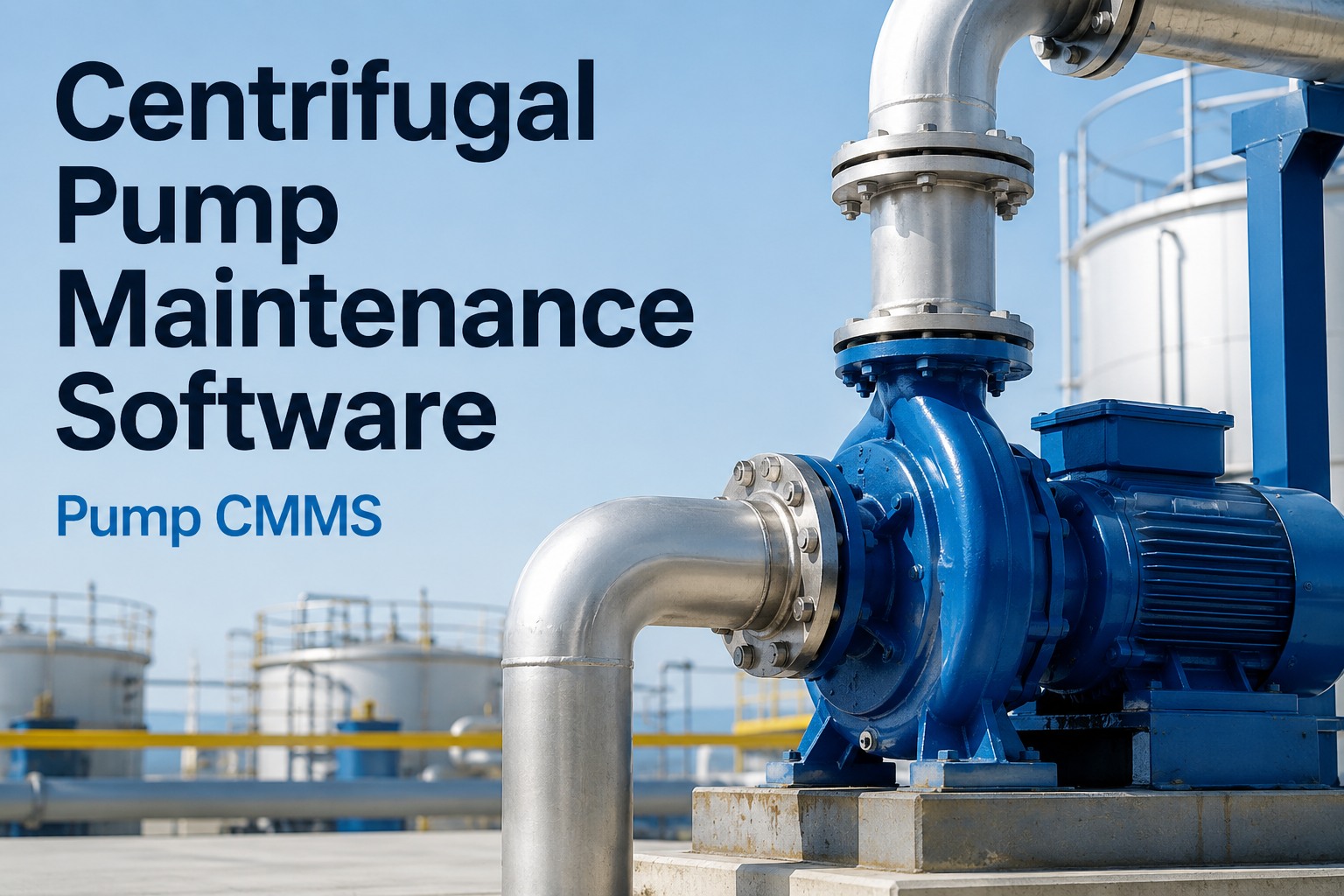
Every process plant runs on centrifugal pumps and every process plant loses money to them. Industry benchmarks put mean time between failure for typical process pumps at 24-36 months, but world-class operators run pump populations past 60 months — twice the reliability at a fraction of the reactive cost. The difference isn't the pumps. It's whether maintenance catches cavitation, seal drift, bearing degradation and misalignment weeks before failure, or discovers them at 3 a.m. on a Sunday shift. Book a demo to see pump reliability workflows in action.
World-class pump reliability isn't a mystery. It's a discipline — and the gap between 24 months MTBF and 60 months is entirely maintenance workflow.
Every seal, every bearing, every coupling, every impeller — under one condition-first maintenance system.
PUMP CURVE · BEP DRIFT
Q → Flow →
MTBF · UK Process Pumps
Reactive-driven
18 mo
PPM-driven
30 mo
Condition-driven
60+ mo
The Pump Failure Taxonomy — What Actually Kills Rotating Equipment
Field data across the process industries repeats a consistent pattern. Roughly 70% of centrifugal pump failures trace back to just three root causes, and understanding the split changes where a maintenance programme invests its attention. Sign up free to route failure data into structured reliability workflow.
FAILURE MODE DISTRIBUTION
Where Pump Failures Actually Come From
42%
MECHANICAL SEAL FAILURE
Causes · Dry running · Solids ingress · Wrong seal spec · Face wear · Elastomer chemistry incompatibility · System pressure fluctuation
Causes · Coupling misalignment · Impeller wear · Casing corrosion · Motor failure · Control system errors · Foundation and pipe strain
Detection · Laser alignment · Motor current signature · Efficiency trending · Casing UT thickness
Seal and bearing failures alone account for 60% of pump downtime — which makes seal condition and bearing condition the two highest-ROI monitoring investments in any pump programme.
The Condition Monitoring Stack — Reading a Pump Before It Fails
Modern pump reliability is a layered stack of monitoring techniques. No single method catches everything; the discipline is choosing the right stack for each machine based on criticality and running-cost impact. A working CMMS holds this stack per pump and translates every anomaly into a routed work order before the failure occurs. Sign up free to build the right monitoring stack for your critical pumps.
Bearing overheat · Motor connections · Coupling temperature · Seal running dry
Quarterly plant sweep · Alert-triggered scans
LAYER 2
PERIODIC VIBRATION
Trend early defects · Baseline drift · Post-maintenance validation
Monthly / Quarterly route-based data collection
LAYER 1
OPERATOR ROUNDS
Leaks · Unusual noise · Vibration by feel · Gauge readings · Base check
Daily · The foundation nothing replaces
◆ CENTRIFUGAL PUMP DEMO
See Pump Reliability Workflow in 30 Minutes
Pump asset hierarchies with per-machine PPM, seal and bearing tracking, vibration sensor integration, operator-round mobile capture, condition-driven work orders and MTBF trending against baseline.
Seals vs Bearings — Different Assets, Different Discipline
The two components that cause 60% of pump failures need two completely different maintenance approaches. Seals are consumable, chemistry-sensitive, and fail through leakage patterns that visual and instrumentation checks catch early. Bearings are longer-lived, wear predictably, and fail through vibration signatures that route-based collection catches weeks in advance. Managing them the same way — the classic mistake — leaves you exposed to both. The comparison below is what disciplined pump reliability actually looks like.
MECHANICAL SEAL
Design life · 2-3 years typical · Consumable
Failure modeLeakage · face wear
DetectionVisual · flush flow
PPM approachInspection + replace
Best dataBushing drip rate
Failure warningHours to days
BEARING SET
Design life · 5-10 years · Long-lived precision
Failure modeRace defects · fatigue
DetectionVibration · temperature
PPM approachMonitor + intervene
Best dataEnvelope acceleration
Failure warningWeeks to months
Criticality Tiers — Not Every Pump Deserves the Same Attention
The mistake most pump reliability programmes make is treating every pump identically. In practice, a 30-year process plant has hundreds of pumps in three roughly equal populations — the critical few that halt production if they trip, the important many that cause degradation but not stoppage, and the numerous minor that fail without immediate consequence. Investment should scale with criticality, and a CMMS worth its salt makes that criticality visible on every screen where a work order is prioritised.
TIER A
CRITICAL PUMPS
Single-point-of-failure pumps whose trip halts production. Main feed, boiler feed, cooling water main circulation, main product transfer.
Expert Perspective — Why Pump Reliability Is a Culture Problem
"
Pump reliability is often diagnosed as an engineering problem when it's actually an organisational one. The technical answers have been known for 30 years — vibration monitoring, laser alignment, condition-driven seal replacement, oil analysis, operator rounds. What separates the sites achieving 60-month MTBF from those stuck at 18-24 months isn't the technology; it's whether the maintenance workflow structurally supports the discipline. Sites where vibration data goes to a folder nobody opens perform no better than sites without instrumentation. Sites where operator round observations don't reach the CMMS lose the earliest warnings pumps ever give. Sites where seal replacements are calendar-scheduled instead of condition-triggered replace half their seals unnecessarily and let the other half run past failure. What a properly configured CMMS does isn't clever analytics — it's making every observation route to a tracked action, so the reliability discipline runs by structure rather than by memory.
— Rotating Equipment Reliability Practice
01
Pump hierarchies with criticality
Every pump tagged Tier A/B/C. Work order priority, spares strategy and monitoring stack scale automatically.
02
Operator rounds mobile-first
Rounds captured on mobile with observations routed into CMMS. First-line detection reaches maintenance immediately.
03
Condition data drives work
Vibration, oil, thermography anomalies auto-create work orders. Nothing sits in a report folder.
04
MTBF measured per population
Failure-to-failure interval trended per pump class. Programme performance measured, not assumed.
Who Uses Oxmaint for Pump Reliability in the UK
The platform is used by the UK roles that own rotating equipment reliability day-to-day: reliability engineers driving MTBF improvement across pump populations, maintenance managers running mixed process pump fleets across manufacturing sites, water utility engineers responsible for pumping station availability, chemical and pharmaceutical plant engineers with API-class critical duty, food and beverage engineers managing hygienic-service pumps, HVAC engineers overseeing chilled and heating water circulation pumps across facilities portfolios, and engineering directors reporting rotating equipment performance to production and finance leadership. Sign up free to configure pump reliability for your site.
Getting Pump Reliability Live in 30-60 Days
Deployment starts with the pump asset register — every machine with make/model/duty, seal spec, bearing spec, criticality tier and monitoring stack allocation. PPM templates configure per criticality tier with type-appropriate cadence. Operator round routes deploy on mobile with observation → CMMS routing. Vibration sensor and route-based collector integration for prioritised pumps. Oil analysis programme structural with sample scheduling and lab result ingestion. Failure work orders link back to root-cause tracking and MTBF trending per population. Condition-driven work orders auto-generate on threshold breach. Most process sites see pump register, PPM cycles and operator round workflow live within 30-45 days; full condition monitoring integration inside a quarter. Book a walkthrough to see UK pump reliability deployments.
◆ FROM 18 MONTHS TO 60 · THE WORKFLOW MAKES THE DIFFERENCE
Every Pump. Every Seal. Every Bearing.
Oxmaint gives UK plant operators the full pump reliability cycle in one platform — criticality tiering, monitoring stacks, operator round integration, condition-driven work orders and MTBF trending by pump population.
Centrifugal pump maintenance software is a CMMS configured specifically for rotating equipment reliability — process pumps, cooling pumps, transfer and circulation pumps across ANSI, ISO and API classes. It holds pump asset registers with per-machine seal specifications, bearing configurations, criticality tier (A/B/C), and appropriate monitoring stack allocation. It runs criticality-aware PPM (tighter cycles on Tier A critical pumps, run-to-failure economics on Tier C minor duty), integrates with vibration monitoring systems both continuous and route-based, ingests oil analysis lab results, deploys operator round routes on mobile with observations routing directly to CMMS work orders, and trends MTBF per pump population so reliability programme performance becomes measurable rather than assumed.
How does condition monitoring integrate with the CMMS workflow?
Condition monitoring is layered per pump. Tier A critical pumps typically get online continuous vibration monitoring with sensor telemetry feeding directly into the CMMS; anomaly detection against learned normal envelopes auto-generates work orders when RMS velocity, envelope acceleration or specific frequency amplitudes exceed thresholds. Tier B important pumps get route-based vibration on monthly/quarterly cycles, quarterly thermographic scans, and 6-monthly oil analysis with lab data ingested against asset. Tier C minor pumps rely primarily on operator round observations. Whatever the technique, the pattern is the same — anomaly detected becomes work order generated with priority, owner and target closure date rather than sitting in an analyst's folder.
Does it help with seal and bearing management specifically?
Yes. Seals and bearings account for roughly 60% of centrifugal pump failures and warrant dedicated workflow. The platform holds seal specifications per pump (face material, elastomer chemistry, flush plan, barrier fluid arrangement per API 682 where applicable), tracks seal running conditions (flush flow, buffer/barrier fluid pressure, bushing drip observations) and manages seal replacement history with root cause on each failure. Bearing management holds bearing designations per position (drive-end, non-drive-end), lubrication specification and cadence, vibration signature history, oil analysis wear-metal trending and thermography records. Chronic-failure detection surfaces when the same seal or bearing position fails repeatedly on the same pump — a strong signal of underlying installation or operating-envelope issues warranting engineering investigation.
Can it detect cavitation and off-BEP operation?
Cavitation and off-BEP (Best Efficiency Point) operation are two of the most damaging conditions a centrifugal pump can experience and both leave clear signatures. Cavitation generates high-frequency vibration (typically above 5 kHz) with distinctive random broadband character and audible signature that vibration analysis catches. Off-BEP operation shows in flow-vs-head deviation from the pump curve, correlates with elevated vibration especially at low-flow (recirculation) and high-flow (runout) extremes, and can be tracked in the CMMS through flow and pressure instrumentation where available. Work orders raise automatically when operating envelope deviates from BEP zone (typically 70-120% of BEP) for extended periods — catching design or control problems that would otherwise erode impellers over months.
How long does deployment typically take on a UK pump population?
A single site with a 50-200 pump population typically goes live within 30-45 days — pump asset register import with criticality tiering (A/B/C), PPM template configuration per tier with type-appropriate cadence, operator round mobile deployment, oil analysis lab integration for Tier A/B machines, and MTBF trending baseline established. Vibration monitoring integration typically phases in from month two onwards as sensors deploy on Tier A machines and route data flows into the platform. Large multi-plant deployments across process industry portfolios typically complete within a quarter to six months. Sites without existing vibration infrastructure often start with route-based collection on Tier A/B pumps and add online monitoring in a phased rollout.