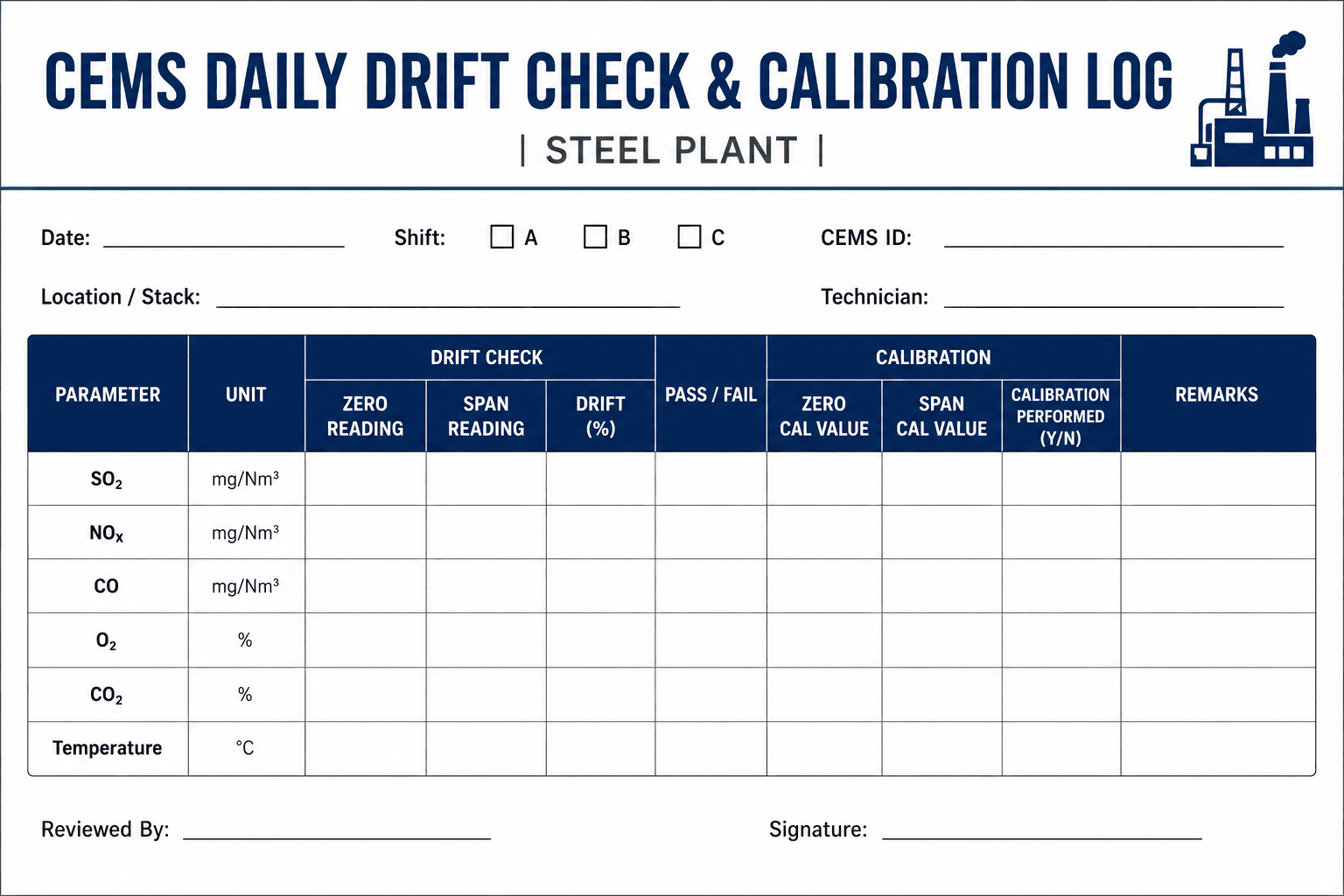
A CEMS analyzer doesn't fail on the day of a stack test, it fails quietly, one hundredth of a percent at a time, until a zero or span check finally catches it outside its limit. In a steel plant running BOF, EAF, and sinter stack monitors around the clock, that daily drift check is the only thing standing between clean data and a data-validity flag on your emissions report. Sign up to run your zero and span checks, calibration gas records, and deviation logs from one daily checklist.
Why It Matters
40 CFR 60.13 requires zero and span calibration drift to be checked at least once every operating day. Miss the check, miss the deadline to log it, or let a drift go unadjusted, and the data from that monitor can be ruled invalid, which turns a five-minute check into a reporting problem.
What Gets Checked Every Operating Day
Zero Drift
Zero-grade gas at 0 to 20 percent of span, reading should return to baseline
Span Drift
Certified span gas at 50 to 100 percent of span value, checks upper-range accuracy
Calibration Gas
NIST-traceable cylinders, expiration and certificate checked before every use
Linearity Check
Confirms the analyzer reads accurately across low, mid, and high concentration points
Sample System
Probe, filters, and heated line checked for leaks, moisture, and condensation
Deviation Record
Any drift, adjustment, or out-of-control period logged with time and corrective action
The Daily Drift Check, Step By Step
Verify calibration gas first: confirm the zero, span, and linearity cylinders show a valid certificate and an expiration date that hasn't passed
Run zero gas and hold two to three minutes: let the reading stabilize in the sample line before recording it
Run span gas and record the deviation: compare the analyzer reading against the certified concentration on the cylinder label
Compare drift against the limit: if either zero or span drift exceeds twice the applicable performance specification, the analyzer must be adjusted before it can resume compliance monitoring
Log the result immediately: record the reading, the drift value, and any adjustment made, this daily entry is what an auditor asks for first
Turn A Daily Check Into An Audit-Ready Log
Oxmaint records every zero and span reading, flags a drift the moment it crosses the limit, and keeps calibration gas expiration dates on a schedule. Sign up for a free trial to run it on your own CEMS data, or book a demo to see it set up for your stacks.
Why Drift Creeps Instead Of Jumping
Analyzer drift in a steel plant rarely comes from one bad part, it comes from the environment around the analyzer. Vibration from adjacent process equipment, dust loading in the sample line, temperature swings near the stack, and inconsistent electrical power all nudge a reading a fraction of a percent at a time. A single day's drift can look harmless, but a week of small drifts in the same direction is the pattern that predicts a probe, filter, or detector problem before it turns into a failed check.
Check, Acceptable Range & Corrective Action
| Check |
Acceptable Range |
Corrective Action |
| Zero drift |
Within applicable performance spec limit |
Adjust if drift exceeds 2x the limit, log the value either way |
| Span drift |
Within applicable performance spec limit |
Adjust if drift exceeds 2x the limit, verify span gas cylinder next |
| Calibration gas |
Certified, NIST-traceable, unexpired |
Pull the cylinder from service, replace before next check |
| Out-of-control period |
Begins at the failed check, ends at a passing check |
Flag affected data, document the correction, retest before resuming |
The Takeaway
The daily drift check isn't paperwork, it's the record that proves your emissions data can be trusted. A missed entry looks the same to an auditor as a failed calibration, so the log matters as much as the check itself. Catch the drift early, adjust before it doubles, and the record writes itself.
Frequently Asked Questions
Q
How often must a CEMS zero and span drift check be performed?
At least once every operating day, in accordance with a written procedure. The check has to happen whether or not the previous day's reading looked stable, since drift is cumulative and can shift between checks.
Q
What happens if a drift check fails?
The analyzer enters an out-of-control period starting at the failed check. Data collected during that period can be invalidated for compliance purposes, and the monitor must be adjusted and retested before it resumes normal reporting.
Q
Why does calibration gas expiration matter so much?
An expired or contaminated cylinder gives a false reading, which means the drift check itself is invalid even if the analyzer is working correctly. Checking the certificate and expiration date before every calibration protects the integrity of the whole day's log.
Keep Every Zero, Span, And Deviation On Record
Oxmaint tracks daily drift checks, calibration gas certificates, and out-of-control periods across every CEMS analyzer in your plant, turning a manual log into a record you can hand an auditor. Sign up for a free trial to run it on your own CEMS data, or book a demo to see it configured for your stacks.