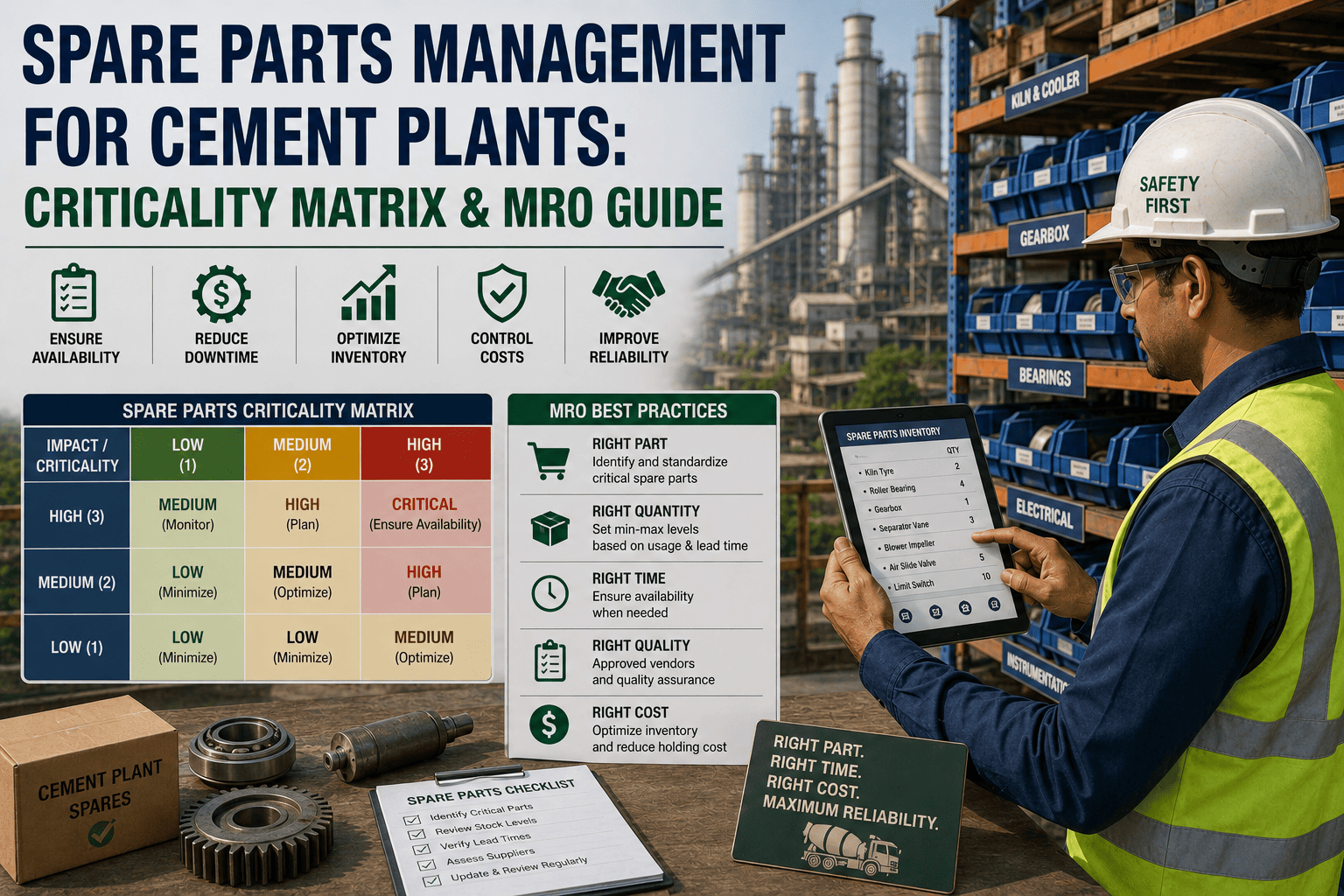
A cement plant can survive a slow quarter. It cannot survive a warehouse that doesn't have the right bearing when the raw mill seizes at 2 a.m. Spare parts management is the quiet discipline that decides whether a breakdown costs four hours or four days. Sign up to see how Oxmaint turns your spare parts list into a live criticality-driven inventory system.
20-30%
Of MRO inventory value typically sits in parts rarely used
3 Tiers
Critical, essential, and non-critical classes in a spares matrix
40%+
Of unplanned downtime traced back to a missing or wrong spare
6-12 Mo
Lead time on major refractory and gearbox components
The Real Cost Of Guessing On Stock
Most plants either over-stock everything out of fear, tying up cash in parts that never move, or under-stock and pray, betting that the kiln shell plate won't crack this quarter. Neither approach is planning. A criticality matrix replaces the guess with a rule: how important is this part to production, and how fast can it be replaced if it fails.
Building A Spare Parts Criticality Matrix
| Criticality Class |
What It Means |
Stocking Strategy |
| Critical |
Single point of failure, long lead time, stops the whole line |
Always in stock, condition-monitored, no exceptions |
| Essential |
Failure slows output but a workaround or backup exists |
Min-max stock levels tied to historical failure rate |
| Non-Critical |
Low impact, short lead time, easily sourced locally |
Order on demand, keep minimal or zero stock |
Stop Managing Spares In A Spreadsheet
Oxmaint links every part to the asset it serves, its criticality class, and its reorder point, so stockroom staff and planners see the same live picture. Sign up for a free trial to import your current stock list, or book a demo and we'll map your critical spares together.
MRO Categories That Need Their Own Rules
| Category |
Storage Consideration |
Common Mistake |
| Bearings |
Sealed, climate-controlled, rotated on a shelf-life schedule |
Stored horizontally near vibration sources, grease dries out |
| Refractory Materials |
Dry, moisture-sealed pallets, tracked by batch and cure date |
Ordered only after a shutdown is announced, missing the window |
| Electrical Spares |
Anti-static bins, labeled by drive or panel, firmware version noted |
Legacy VFD boards kept without checking if they're still supported |
| Consumables |
Bulk bins near point of use, simple min-max reorder triggers |
Treated as low priority until a line stops for a missing gasket |
Reactive Buying vs Planned Spares Management
Reactive Buying
Parts get ordered after the machine has already stopped
Emergency freight costs quietly eat the maintenance budget
No one can say which parts are actually critical until they fail
Planned Spares Management
Critical parts are pre-linked to the asset before failure happens
Reorder points trigger purchasing automatically at safe stock levels
Long lead-time items are flagged months ahead of a planned shutdown
How Oxmaint Supports Spare Parts Planning
Oxmaint attaches every spare part to its asset record, its criticality tier, and its supplier lead time, so reorder points update themselves instead of relying on a stockroom clerk's memory. Dashboards flag critical parts running low before they threaten a production line. Book a demo to see your own parts list scored and organized by criticality.
Frequently Asked Questions
Q
How do I decide which spare parts count as critical?
Score each part on two factors: how badly production suffers if it fails, and how long it takes to get a replacement. A part that scores high on both belongs in the critical tier, regardless of its price tag.
Q
Why do refractory materials need separate handling rules?
Refractory materials degrade if exposed to moisture and often have long procurement lead times tied to shutdown schedules. Treating them like a generic consumable risks missing a planned outage window entirely.
Q
Is over-stocking spares ever the right call?
Only for truly critical, long-lead-time parts where a stockout would halt the line for weeks. For everything else, holding extra stock just ties up cash that could fund actual reliability improvements.
Q
What's the fastest way to start a criticality matrix?
List your top twenty assets by production impact, tag their key spares, and score each part on failure impact and lead time. Expand the matrix plant-wide once that first pass is working.
Turn Your Parts List Into A Planned Inventory System
Oxmaint links every spare part to its asset, criticality tier, and supplier lead time, so your stockroom stops guessing and starts planning. Sign up for a free trial to import your current stock list, or book a demo and we'll build your first criticality matrix together.