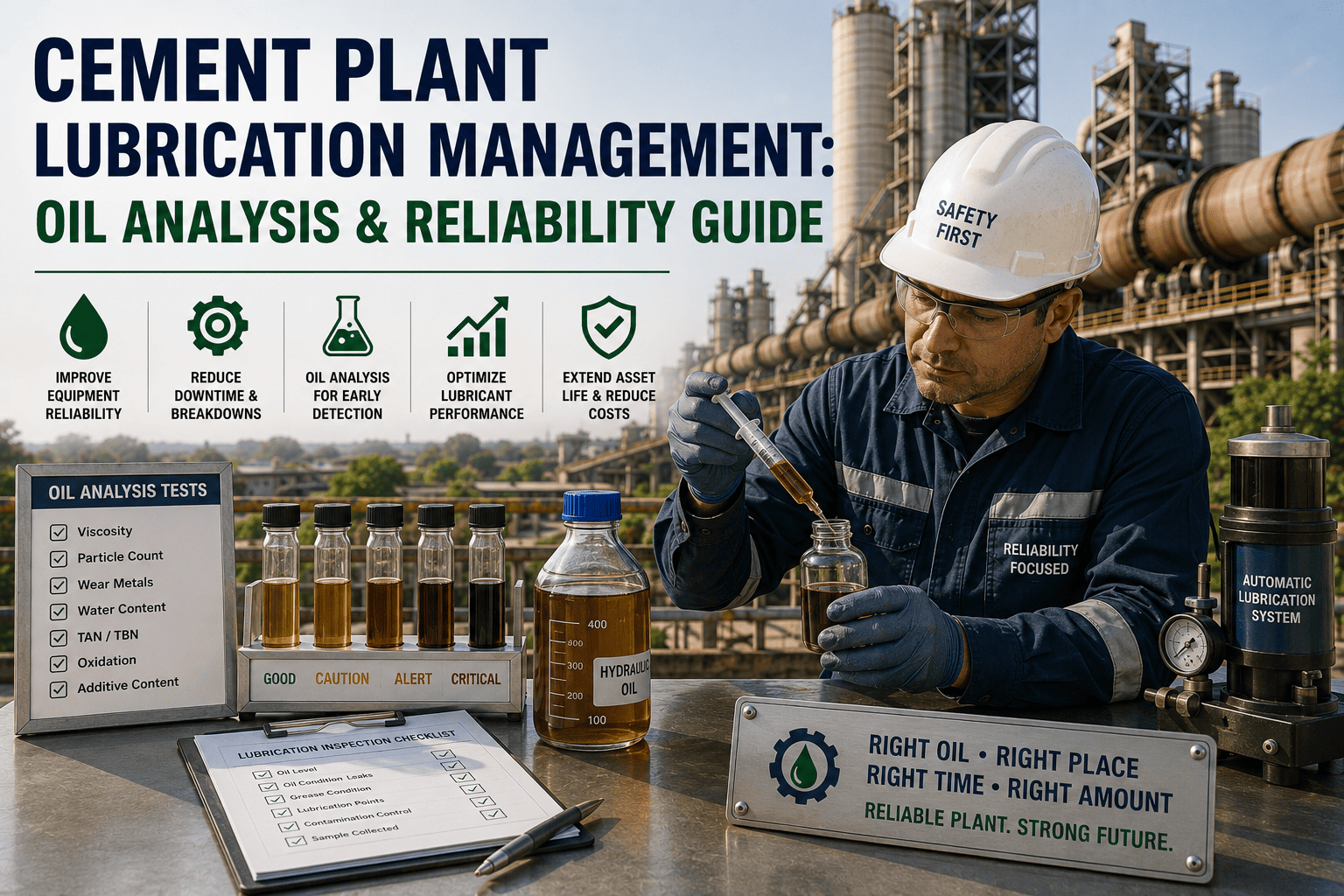
A gearbox rarely fails without warning, the oil usually tells the story first. Cement plant lubrication management is the discipline of reading that story early, through the right lubricant, the right interval, and a lab report instead of a guess. Sign up to see how Oxmaint tracks lubrication schedules and oil analysis results against every asset in your plant.
70%
Of bearing failures trace back to contamination or wrong lubricant
3-6 Months
Typical early-warning window oil analysis gives before a gearbox fault
20-30%
Extension in gearbox and bearing life with proper lubrication control
4 Checks
Viscosity, water content, particle count, and wear metals per sample
Why Lubrication Gets Overlooked in Cement Plants
Greasing a bearing feels routine, so it's easy to treat as a five-minute task instead of a reliability decision. But cement dust is one of the toughest contaminants a lubricant will ever face, and the wrong grease or a missed interval on the kiln support roller can undo months of otherwise solid maintenance work.
What an Oil Sample Actually Tells You
| Test |
What It Measures |
Early Warning Sign |
| Viscosity |
Whether the oil still flows and films the way it's meant to |
Thinning oil in a raw mill gearbox from heat or dilution |
| Water Content |
Moisture ingress from washdowns, condensation, or seal failure |
Rust forming inside a cooler drive before it's ever seen |
| Particle Count |
Cement dust and grit that have made it past the seals |
Accelerated abrasive wear on kiln support rollers |
| Wear Metals |
Iron, copper, and bronze particles shed by internal components |
A gearbox tooth or bearing race wearing faster than expected |
Track Lube Schedules and Lab Results in One Place
Oxmaint links every lubrication task and oil sample result directly to the asset, so a rising particle count on the raw mill gearbox flags itself before it becomes a breakdown. Sign up for a free trial to set up your first lube route, or book a demo and we'll map it to your gearboxes and bearings.
Building a Lubrication Program That Holds Up
| Step |
What It Involves |
What It Prevents |
| Select |
Match lubricant grade to load, temperature, and dust exposure per asset |
Using one generic grease everywhere, regardless of duty |
| Schedule |
Fixed lube routes with exact quantities, not top-ups by memory |
Over-greasing bearings, which causes its own kind of failure |
| Sample |
Pull oil samples from gearboxes on a set interval and send to a lab |
Contamination or wear going undetected until a breakdown |
| Act |
Turn an abnormal lab result into a work order right away |
A flagged report sitting in an inbox instead of triggering action |
Guesswork Lubrication vs a Managed Program
Without a Program
Grease is topped up whenever someone remembers to
Different technicians use whatever lubricant is closest
A gearbox failure is the first sign anything was wrong
With a Managed Program
Every asset has a fixed grade, quantity, and interval on record
Oil samples flag rising contamination months in advance
A lab result automatically becomes a scheduled work order
How Oxmaint Supports Lubrication Management
Oxmaint holds the lubricant grade, quantity, and interval for every asset in one record, so lube routes run the same way regardless of who's on shift. Oil analysis results can be logged against the same asset, and an out-of-range reading on wear metals or particle count creates a work order automatically instead of waiting in someone's inbox. Book a demo to see it set up against your kilns, mills, and gearboxes.
Frequently Asked Questions
Q
How often should gearbox oil actually be sampled?
Most critical gearboxes, like those on the raw mill or kiln drive, are sampled every one to three months. Less critical equipment can move to a quarterly or semi-annual cycle depending on load and duty.
Q
Is over-greasing really a problem, or just wasted grease?
It's more than waste. Excess grease raises internal bearing temperature and pressure, which can damage seals and push contaminants in rather than keeping them out, so more isn't better.
Q
Can one lubricant work across every part of the plant?
Rarely. A kiln support roller under heavy load and high heat needs a different grade than a packer motor bearing. Standardizing too much usually trades reliability for convenience.
Q
Where's the easiest place to start improving lubrication?
Pick your three or four most critical gearboxes, put them on a fixed sampling interval, and track the results for two quarters. The trend line usually makes the next priority obvious.
Turn Oil Analysis Into Action, Not an Inbox Item
Oxmaint gives cement plant teams lube route scheduling, oil analysis tracking, automatic work orders, and reliability trends in one platform. Sign up for a free trial to set up your first lube route, or book a demo and we'll map it to your gearboxes and bearings.