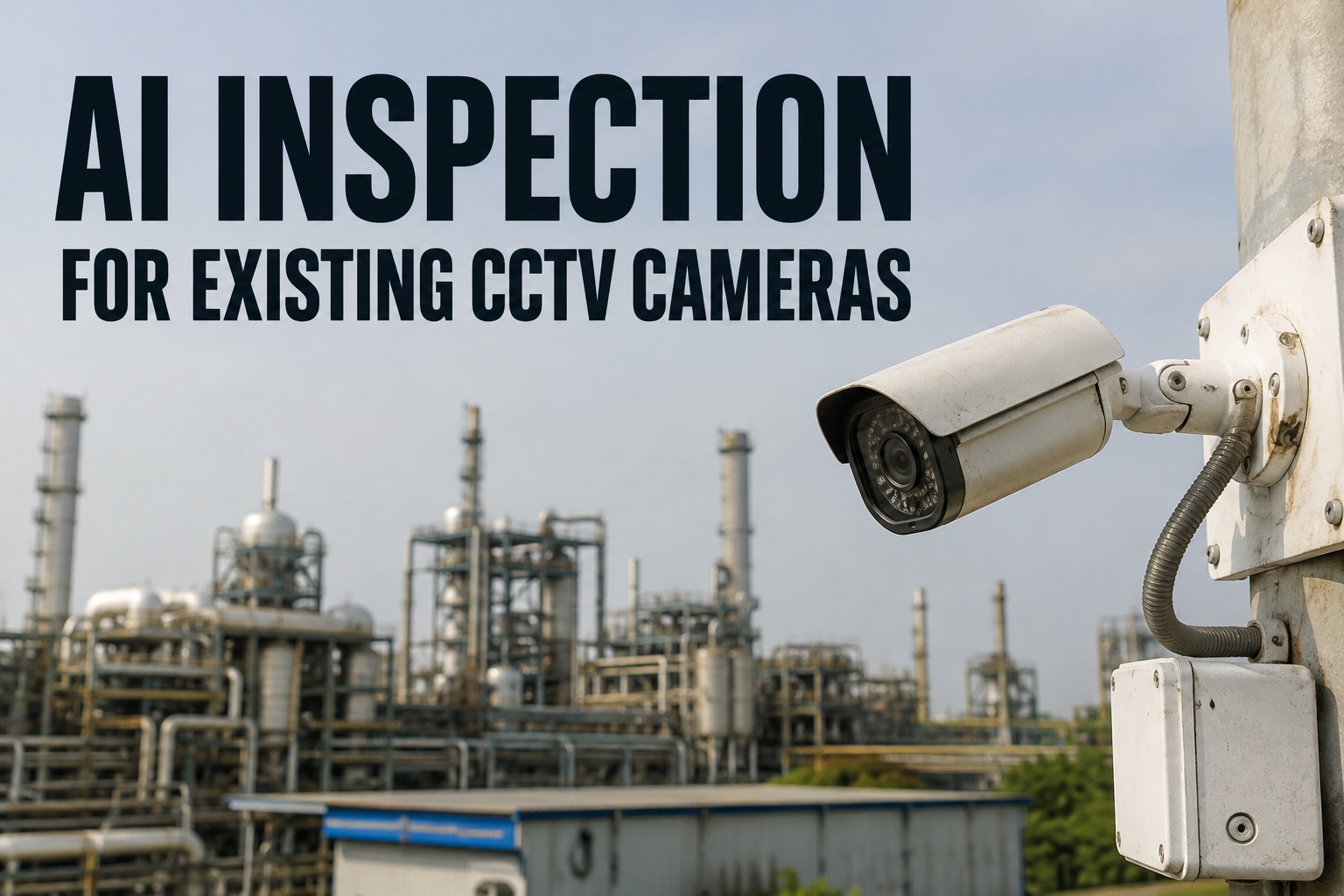
Your site already has the cameras. Most industrial premises are covered by dozens or hundreds of CCTV feeds that record continuously and get looked at only after something has gone wrong. Oxmaint turns that existing camera infrastructure into a continuous AI inspection network — detecting defects, PPE issues, corrosion, thermal anomalies and safety events without ripping out a single camera. Standard ONVIF and RTSP protocols mean retrofit is a software rollout, not a construction project. Alerts land as work orders in your maintenance workflow. Book a demo to see AI inspection on your existing cameras.
1-5
business days from compatibility check to live monitoring on typical single-site retrofit deployments
10 yrs
most IP cameras manufactured in the last decade support the standards needed for retrofit — RTSP, ONVIF, HTTP-MJPEG
2-4 Mbps
per 1080p H.264 camera feed — a 32-camera site adds around 96 Mbps of internal LAN traffic, no external upload
Why Retrofit Beats Rip-and-Replace
The most expensive part of any AI vision project isn't the AI — it's the cameras, the cabling, the mounting and the construction disruption to install them. Most sites walk into a proposal assuming AI monitoring means a new camera network, discover the project economics, and shelve the whole thing. Retrofit inverts that maths: the cameras that already deliver video for security and process monitoring become sensor inputs for AI inspection, and the only new hardware is a compact on-premises appliance that runs the inference.
Rip & Replace
Camera costNew AI-native fleet
InstallationFull cabling & mounting project
Site disruptionAccess, contractors, downtime
Deployment timeMonths
Existing infrastructureWritten off
Risk profileLarge upfront capital commitment
Retrofit AI Vision
Camera costReuse existing ONVIF / RTSP fleet
InstallationSoftware rollout · one appliance
Site disruptionNone — no cabling changes
Deployment timeDays to weeks
Existing infrastructureRepurposed as sensor network
Risk profileSmall footprint, incremental scale
The Compatibility Checklist — What Actually Needs to Be True
Retrofit works on the overwhelming majority of modern IP camera fleets — but not all of them. The five conditions below cover what has to be in place for the AI to read the feed reliably. Most sites tick every box without realising, because ONVIF and RTSP became the de facto industrial standards over the last decade. The compatibility check is typically done inside the first scoping call.
IP camera with ONVIF or RTSP support
Standard on virtually every industrial IP camera manufactured in the last decade — Axis, Bosch, Hikvision, Hanwha, Dahua and equivalent brands. Analogue cameras behind an NVR usually also qualify via the recorder's RTSP output.
Adequate resolution for the inspection task
1080p is the baseline for most detection tasks including PPE, corrosion staging, defect classification and leak identification. Finer inspections (pitting on small pipe surfaces, fine surface cracks) benefit from higher resolutions or macro-optimised positioning.
Wired network connectivity
Ethernet or PoE recommended for reliability. WiFi cameras can work for lower-criticality use cases but aren't advisable for industrial safety-critical detection. VLAN-isolated CCTV networks need a routed bridge to the AI appliance — standard IT work.
Camera positioned to see the target area
The single biggest deployment consideration. Cameras positioned for general area surveillance may not have the angle or proximity for specific inspection tasks. Repositioning an existing camera — or adding one additional in a critical location — is often all that's needed.
Consistent lighting or thermal alternative
Visible-spectrum AI needs enough consistent light for the model to establish a reliable baseline. Poorly lit zones benefit from near-IR illumination or a thermal camera pairing — the same AI pipeline processes both stream types.
Tick most of these and retrofit is a straightforward software rollout rather than an engineering project. Sign up free to run the compatibility check on your camera list in the first scoping session.
The Four Stages of a Retrofit Deployment
The retrofit process follows the same pattern on almost every site — from a scoping call to live AI running against real footage. The engineering effort concentrates on the first stage (compatibility and camera positioning); the technical rollout itself is short because no cabling changes are needed. Below is what the customer's team actually does at each step.
01
Compatibility & use-case scoping
Camera inventory reviewed for ONVIF/RTSP support, resolution and positioning. Priority use cases defined per zone — PPE, corrosion, leak detection, defect classification. Output is a deployment plan with the specific cameras to enable in phase one.
02
Appliance install & ingest
Compact on-premises appliance (NVIDIA Jetson-class for typical sites) installed inside the network. RTSP streams pulled from cameras or NVR. No new cabling, no camera swap, no interruption to existing VMS recording.
03
Zones, rules & models
Regions of interest drawn per camera. Detection models enabled per use case. Zone-specific rules configured — PPE requirements, thresholds, escalation logic — mapped to your existing safety and maintenance policies.
04
CMMS integration & live monitoring
Alerts land as prioritised work orders in Oxmaint CMMS with dated image evidence attached. Detection events feed compliance dashboards and audit exports. First inference typically runs the same day as appliance install.
See Retrofit AI Running on Your Own Cameras
Bring a sample RTSP feed — Oxmaint runs live detection against your actual footage, in your actual site conditions, and shows exactly what alerts, evidence packs and CMMS work orders look like on your assets. Thirty minutes.
What AI Inspection Actually Adds — Reused Cameras, Six New Capabilities
The value of the retrofit isn't the video — you already had that. It's what the AI does with the video. The six capabilities below are what the same underlying camera fleet delivers once the AI layer is running. Each maps to a specific maintenance or safety outcome, and multiple capabilities can run on the same camera at the same time — a single feed simultaneously detecting PPE compliance, monitoring for leaks and flagging equipment defects on a nearby press.
PPE compliance
Safety
Hard hats, hi-vis, eye protection, gloves, harnesses. Zone-based rules per your safety policy. Alerts as CMMS work orders.
Leak & spill detection
Environmental
Water, oil, chemical and steam leaks classified from visual signature. Growth-rate analysis for genuine leak vs cleaning water.
Corrosion & coating
Asset integrity
Pitting, uniform corrosion, coating breakdown on pipes, tanks and steelwork. Time-stamped evidence trail for API/PSSR regimes.
Defect & QA inspection
Production quality
Surface defects, dimensional variance, missing components on production lines. Real-time reject flagging with image evidence.
Zone & exclusion breach
Safety
Restricted zone entry, forklift-pedestrian proximity, unauthorised access to hazardous areas. Sub-second alert to the shift supervisor.
Behaviour & process events
Operations
Unusual dwell time, near-miss patterns, equipment interaction events. Pattern data over time for continuous improvement.
Expert Perspective — Where Retrofit Genuinely Wins
The story of AI inspection over the last three years is that the blockers have shifted. It used to be "can the model see it?" — that question is largely answered. What's held sites back since is the assumption that AI vision required a full camera replacement. The retrofit architecture with on-premises inference, standard protocols and existing camera reuse has closed that gap. Projects that would have been shelved for capital reasons are now running as software rollouts inside a fortnight.
Software project, not construction
No cabling changes, no camera swap, no contractor coordination. Deployment happens inside a normal IT change window.
Incremental scale
Start with 5-10 highest-value cameras. Prove the outcome. Scale to 100+ on the same appliance or add capacity as coverage grows.
Existing VMS keeps running
RTSP is a multi-client protocol. AI subscribes to the same feed the NVR already receives — recording continues undisturbed.
On-premises = data stays put
Inference runs locally. No footage leaves the site. Meets industrial cybersecurity and UK GDPR data-sovereignty expectations by default.
Who Uses Retrofit AI Vision in Practice
The workflow is used by the specific roles that see cameras as underused assets: facilities managers with legacy CCTV estates who want operational value alongside security, HSE managers extending safety monitoring beyond periodic audits without a hardware refresh, IT and OT leads under industrial cybersecurity obligations who need on-premises AI without cloud video egress, and operations directors running multi-site fleets where standardised software deployment beats site-by-site camera projects. Each role sees the same underlying camera-derived intelligence filtered to their view — safety dashboard, asset condition trend, or compliance evidence pack. Sign up free to scope your retrofit pilot, or book a walkthrough to see live detection on your existing camera feeds.
Piloting on a Handful of Cameras Before Scaling
The best-run retrofit deployments don't try to switch on AI across the whole camera fleet on day one. They pick the 5-10 highest-value cameras — a loading bay for forklift-pedestrian safety, a chemical bunded area for spill detection, a production line for PPE monitoring — prove the outcome on those specific use cases, and scale coverage from there. That evidence-based rollout keeps risk low, produces early ROI, and gives the whole business confidence in the technology before it goes site-wide. Sign up free to scope your first 10-camera pilot and see pilot outcomes from similar UK sites.
Turn Your Existing Cameras Into an AI Inspection Network
Oxmaint retrofits AI vision onto your current ONVIF/RTSP camera fleet. No rip-and-replace, no cabling changes, no video leaving the site. Alerts land as work orders — inspection value from cameras you already own.
Frequently Asked Questions
Will retrofit interfere with our existing CCTV recording?
No. RTSP is a multi-client protocol — the AI appliance subscribes to the same stream the NVR already receives, as a parallel client. Recording, playback and VMS operation continue exactly as before. Bandwidth impact stays on the internal LAN (typically 2-4 Mbps per 1080p H.264 camera), so a 32-camera site adds around 96 Mbps of internal traffic and nothing to external upload. No changes to camera settings, no changes to storage, no downtime for your existing surveillance operation.
Which camera brands are compatible?
Any camera supporting ONVIF or RTSP — which covers the vast majority of industrial IP cameras made in the last decade. Axis, Bosch, Hikvision, Hanwha, Dahua, Sony and equivalent brands connect directly. Analogue cameras behind a modern NVR usually work too, via the recorder's RTSP output. Genuinely incompatible cameras are rare and typically consumer-grade or very old proprietary systems — Oxmaint's compatibility check identifies them during scoping so there are no surprises during rollout.
Does the AI run in the cloud or on-premises?
On-premises by default. A compact appliance inside your network processes video locally — footage never leaves the site, alerts fire in under a second, and the appliance continues detecting through any internet outage. For sites under UK GDPR / DPA 2018 workplace-monitoring obligations, industrial cybersecurity policies, or CNI classification, on-premises is typically the correct choice for data sovereignty and latency reasons. Cloud deployment is available where the customer specifically requires it.
How many cameras can one appliance handle?
Depends on the model complexity and camera resolution. As a working guide, an NVIDIA Jetson Orin NX-class appliance (157 TOPS) comfortably handles around 16-32 cameras running a single detection model, or 8-16 cameras running multiple concurrent models. AGX Orin (275 TOPS) roughly doubles that. Larger sites use multiple appliances or centralised GPU servers. The scoping process sizes appliance capacity against your specific camera count, detection use cases and future expansion plans.
What about UK data protection and workforce monitoring?
Retrofit AI vision on workplace CCTV falls under UK GDPR, DPA 2018 and ICO workplace-monitoring guidance. A DPIA is expected before deployment, transparency and workforce consultation are required, and proportionality has to be documented. Oxmaint supports face-blurring in evidence packs where the purpose is compliance rather than individual identification, configurable retention aligned to your DPIA outcomes, and on-premises processing so no footage leaves the site. The AI classifies safety and inspection events without facial recognition unless explicitly required and separately assessed.