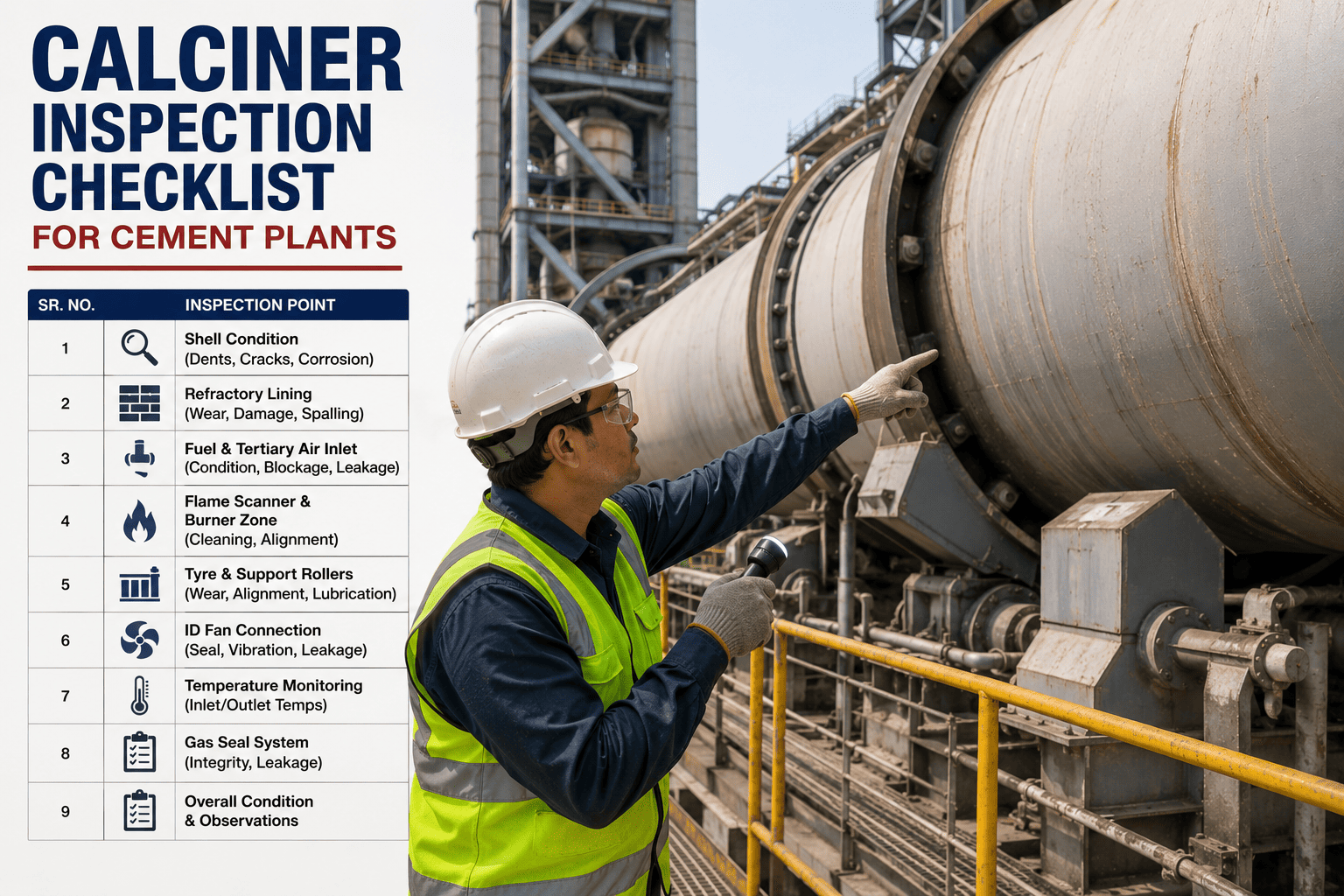
A calciner takes over roughly 60% of the fuel burning duty in a modern cement plant, mixing tertiary air, fuel, and raw meal in a swirling combustion chamber before it ever reaches the kiln. An unbalanced tertiary air damper starves combustion of oxygen, a fuel nozzle running off its spray pattern leaves unburnt fuel to scorch downstream refractory, and a temperature sensor drifting out of calibration can mask a developing hot spot for weeks. This checklist covers what to verify across temperature monitoring, tertiary air, and fuel and combustion. Sign up to turn this checklist into a guided digital procedure your calciner crew follows on every inspection round.
3 Zones Checked
Temperature monitoring, tertiary air, and fuel and combustion covered in this checklist
~60% Fuel Load
Approximate share of total plant fuel burned in the calciner rather than the kiln
Every Shift
How often calciner outlet temperature and oxygen readings should be logged
Zero Tolerance
Room for skipping a sensor calibration check or a fuel nozzle inspection
Why Calciner Checks Can't Be Rushed
The calciner sits at the center of both fuel efficiency and clinker quality, so a drifting sensor or an unbalanced air split rarely announces itself immediately. The same temperature, air, and fuel checks repeated correctly every shift catch a problem while it's still a quick adjustment.
Temperature Monitoring Checks
Outlet & Zone Temperature Trend
Log calciner outlet and internal zone temperatures each shift and compare against the normal operating band
Thermocouple & Sensor Calibration
Verify temperature sensors are calibrated and reading consistently against a reference before trusting the trend
Refractory Hot Spot Scan
Run a thermal scan on the outer shell to catch a hot spot that signals refractory wear from a nearby flame
Make Calciner Checks A Habit, Not A Memory
Oxmaint guides your crew through temperature, tertiary air, and fuel system inspections step by step, with photo proof and sign-off logged against each calciner asset. Sign up for a free trial to build your calciner routine, or book a demo to see it in action.
Tertiary Air System Checks
Tertiary Air Damper Position
Check the tertiary air damper responds smoothly and holds the split ratio the process demands
Duct Leakage & Insulation
Inspect tertiary air ducting for leakage and worn insulation that lets hot air escape before reaching the calciner
Oxygen Level Cross-Check
Compare oxygen analyzer readings against the air split to confirm combustion isn't running starved or excess
Fuel & Combustion System Checks
Fuel Nozzle Spray Pattern
Check fuel nozzles hold their spray pattern and aren't coking or eroding at the tip
Fuel Feed Rate Stability
Verify fuel feed rate holds steady rather than surging, since surges create uneven combustion zones
Unburnt Fuel & Carbon Monoxide Check
Monitor carbon monoxide readings at the outlet, since a rise usually points to incomplete combustion downstream
What A Skipped Check Can Cost You
| Check Skipped |
Likely Consequence |
| Sensor calibration check |
A drifting reading masks a real temperature swing for weeks |
| Tertiary air damper check |
Starved combustion raises fuel consumption and unburnt carbon |
| Fuel nozzle inspection |
A worn spray pattern leaves unburnt fuel to scorch downstream refractory |
| Carbon monoxide monitoring |
Incomplete combustion goes unnoticed, wasting fuel and lowering clinker quality |
Where A CMMS Fits Into Calciner Checks
Oxmaint ties this checklist to the calciner, tertiary air damper, and fuel nozzles as tracked assets, logging temperature and oxygen trends over time so a drifting reading gets flagged before it affects clinker quality.
Frequently Asked Questions
Q
Why does calciner temperature need constant monitoring?
Calciner temperature drives both fuel efficiency and how well raw meal calcines before entering the kiln, so a drift outside the normal band affects clinker quality well before it shows up as a visible problem.
Q
What causes uneven combustion in a calciner?
Uneven combustion usually traces back to an unbalanced tertiary air split, a worn fuel nozzle spray pattern, or a fuel feed rate that surges instead of holding steady.
Q
Can a CMMS track calciner temperature trends automatically?
Yes, a CMMS can log outlet temperature and oxygen readings per shift against the calciner asset and flag a drift outside the normal operating band before it affects combustion.
Keep Your Calciner Running Efficient And On Spec
Oxmaint guides your crew through temperature, tertiary air, and fuel system inspections and logs every reading against the calciner asset automatically. Sign up for a free trial to build your calciner checklist, or book a demo to see it in action.