Brewery & Distillery Maintenance Software | UK CMMS
By Riley Quinn on August 26, 2026
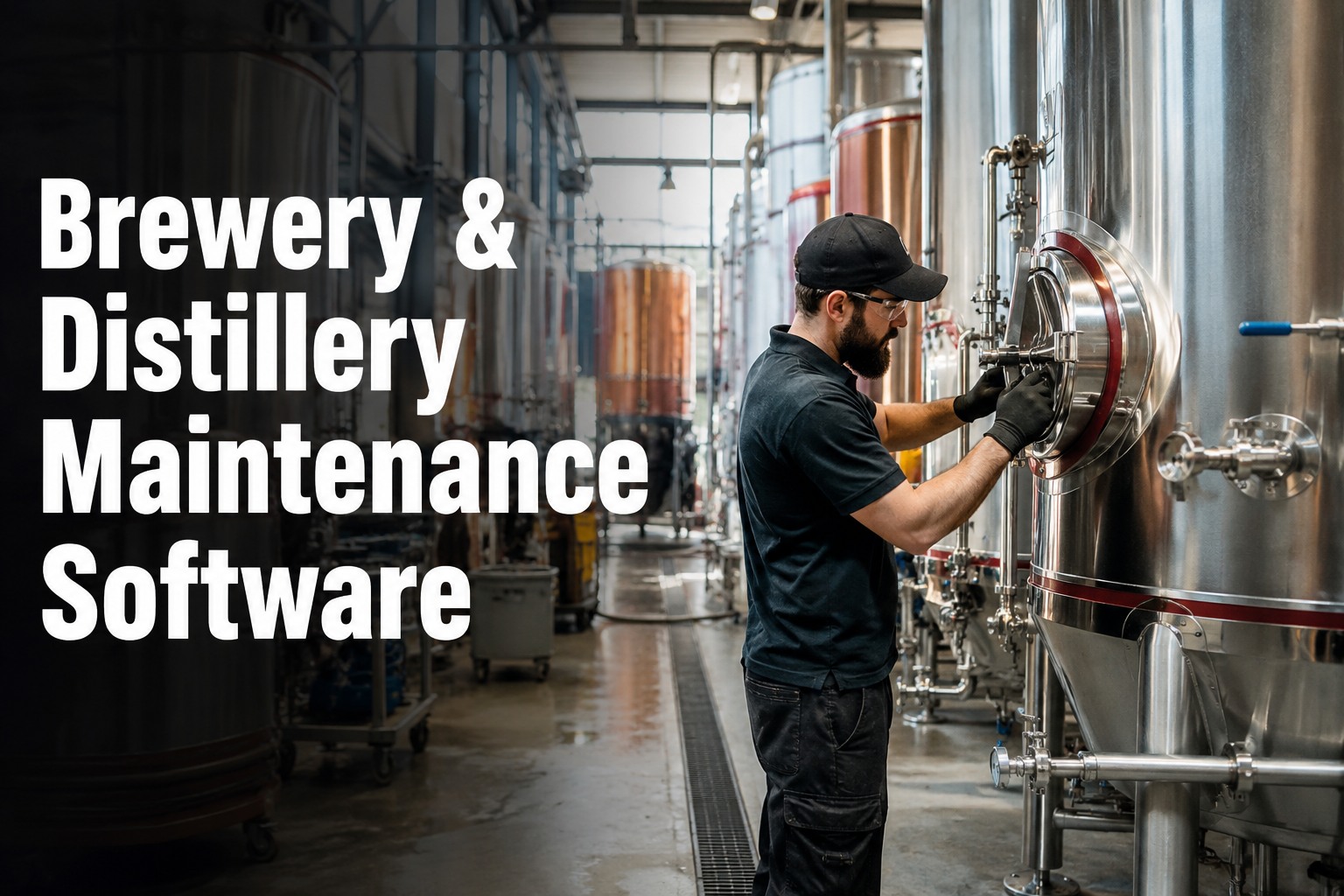
Brewing and distilling look romantic on the label. Behind the swing door it's a food-safety plant running high-pressure steam, glycol, CO₂ and CIP chemistry through stainless steel at temperatures that will burn you. One fermenter losing cooling ruins a £40,000 brew. One bottling jam turns a pallet of glass into cullet. One missed sanitiser cycle triggers a BRCGS non-conformance. Brewery maintenance isn't a workshop function — it's the yield and food-safety story end to end. Book a demo to see brewery workflows in action.
◆ BREWHOUSE · CELLAR · PACK · UTILITIES
A brewery is not one plant. It's four plants sharing a postcode, and every one has to be uptime for the next to earn.
Every mash tun, every fermenter, every filler head, every glycol chiller — sequenced under one maintenance system.
4
Interlocked Plants
Brewhouse → Cellar → Filtration → Pack. One stops, they all stop.
£40k
Typical value of one lost brew
14days
Standard ale fermentation cycle at risk
98%+
Line efficiency target on modern pack lines
The Brewery-to-Bottle Flow — Where Each Failure Actually Bites
The single most useful diagram a new brewery engineer can draw is the production flow with maintenance-critical failure points marked at every stage. The flow below is what a working craft brewery looks like on a shift, and where the CMMS has to hold the asset intelligence to keep it running.
Hygiene Zones — Why Maintenance Rules Change by Location
Food-safety-conscious breweries and distilleries divide the plant into hygiene zones, and every zone has different maintenance rules. Zone 1 is product-contact. Zone 4 is external. The wrench you carry into zone 1 is not the wrench you carry into zone 4. The stainless bolt spec is different. The lubricant is different (food-grade H1 in zones 1-2, industrial H2 only from zone 3 outward). A CMMS that doesn't tag hygiene zones per asset generates work-order histories that a BRCGS or SALSA auditor will find problems with. Sign up free to run zone-aware maintenance across your plant.
Z1
PRODUCT CONTACT
Interior surfaces contacting wort, beer, spirit or ingredient. Fermenter interiors, filler valves, transfer piping, filter internals.
Rule · Industrial standard practice · No CIP interface
The CIP Cycle — Where Product Safety Actually Lives
Cleaning-in-Place is the single most repeated production activity in a brewery or distillery, and the single most audit-scrutinised. Every CIP cycle has to hit the four TACT parameters — Temperature, Action (flow), Concentration, Time — inside the specification the plant validated against. Miss on any of the four, and a bacterial contamination could survive the cycle. Every CIP cycle needs an audit trail: chemical dose logs, flow rate records, temperature curves, contact time, conductivity return-to-baseline. What a CMMS enables is turning this from a paper form into structural workflow.
CIP CYCLE · TACT
Cleaning-in-Place Verification Cycle
01
Pre-Rinse
Ambient water flush · Gross soil removal · Return-to-drain
≤ 5 min · Ambient
02
Caustic Wash
1-3% NaOH · Circulation at flow spec · Full contact-time
15-30 min · 75-85°C
03
Intermediate Rinse
Water flush · Conductivity return to baseline verified
5-10 min · Ambient
04
Acid Wash
Phosphoric/nitric · Beerstone & mineral removal · Weekly cycle
10-15 min · 60-70°C
05
Final Rinse
DI or treated water · Conductivity + pH check · pre-sanitise
5-10 min · Ambient
06
Sanitiser
PAA / hot water · Log-reduction verification · Cycle sign-off
10-15 min · Per spec
Temperature
Action / Flow
Concentration
Time
◆ BREWERY MAINTENANCE DEMO
See the Full Plant Workflow in 30 Minutes
Fermenter and utility asset registers, hygiene-zone tagging, CIP cycle verification workflow, pack-line OEE tracking, BRCGS and SALSA audit evidence packs, mobile fault raise from the cellar floor — configured against your brewery.
Ask a brewhead where they lose most brewing days and the answer is rarely the vessels themselves. It's the utilities that feed them. Steam boiler down means no mash. Glycol chiller down means the cellar warms and the yeast flavour profile changes. CO₂ recovery down means bought-in gas costs triple. Compressed air contamination means microbial contamination downstream. Utilities are the silent yield killer of most craft breweries, and the assets least likely to have a proper PPM programme when a CMMS goes in for the first time. Sign up free to bring utilities under structured PPM.
Steam Boiler
PSSR-regulated
14-monthly TExT under PSSR, weekly water treatment log, monthly blowdown discipline. Boiler down = brewhouse down.
Glycol Chiller
F-Gas regulated
Annual F-Gas leak check, glycol concentration testing, compressor hours PPM. Chiller down = cellar temperature drift = flavour risk.
CO₂ Recovery
Cost-critical
Molecular sieve regeneration cycles, purity monitoring, compressor and dryer PPM. Recovery down = bought CO₂ cost doubles overnight.
Compressed Air
Quality-critical
ISO 8573 quality class per point of use, dryer PPM, filter change on differential pressure, oil-free integrity check.
Expert Perspective — What Brewery CMMS Actually Solves
"
Breweries and distilleries are unusual in food production because the maintenance function sits directly on top of both yield and food safety at the same time. A missed fermenter PPM shows up as a spoiled brew — the P&L reads that number in a fortnight. A CIP cycle where the temperature dropped by 5°C shows up as a BRCGS or SALSA audit finding when the paper log is compared with the plant record. What a proper CMMS changes is that the two disciplines stop being separate. Fermenter PPM is scheduled against the brewing calendar so it never conflicts with a knock-out. CIP verification is captured at the point of execution rather than reconstructed from memory. Utility PPM stops being the thing that gets deferred when the pack line is running hot. And the evidence for the next audit assembles itself from the workflow rather than being pulled together the fortnight before. Small and mid-size producers usually discover that this discipline is worth more than a couple of extra tanks.
— Brewing & Distilling Engineering Practice
01
Hygiene-zone tagging
Every asset carries a Z1-Z4 tag. PPM lubricant, tool and PPE requirements enforce automatically at work-order raise.
02
CIP verification workflow
Every CIP records TACT parameters at execution. Deviations flag before the next fill.
03
Pack line OEE tracking
Downtime reasons captured in-line. Root-cause data feeds preventive plan quarterly.
04
Audit-evidence self-assembly
BRCGS, SALSA and processor audits: PPM, CIP, utility records exportable per asset in seconds.
Who Uses Oxmaint at UK Breweries & Distilleries
The platform is used by the UK roles that keep drinks production running day-to-day: brewery engineering managers running fermenter, cellar and pack asset registers, distillery operations managers coordinating still and warehousing infrastructure, plant managers scheduling PPM around the brewing calendar, technical and quality managers running BRCGS and SALSA evidence trails, packaging line engineers driving OEE improvement on filler-capper-labeller lines, utility engineers running steam, glycol, CO₂ and compressed-air PPM, and directors of craft and mid-size producers looking to industrialise their engineering discipline as production scales. Sign up free to configure brewery maintenance for your plant.
Getting Brewery Maintenance Live in 30-60 Days
Deployment starts with the asset register — brewhouse vessels, fermenters, filtration, pack line, utilities — each tagged with hygiene zone and PSSR/F-Gas/LOLER regulatory scope where relevant. PPM cycles configure per asset with brewing-calendar awareness. CIP verification templates deploy with TACT parameter capture. Pack-line OEE integration ties into downtime reason codes. Mobile fault raise deploys to cellar and pack floor teams. BRCGS/SALSA audit evidence pack templates set up. Utility PPM (boiler PSSR, F-Gas chiller, CO₂ recovery, compressed air) integrates with statutory scheduling. Most craft and mid-size producers see asset register, PPM cycles, CIP verification and mobile workflow live within 30-45 days; larger multi-site operators inside a quarter. Book a walkthrough to see UK brewery deployments.
◆ ONE PLATFORM · FOUR PLANTS · ZERO SPOILED BREWS
Brewhouse to Bottle. All on One System.
Oxmaint gives UK brewery and distillery operators the whole plant in one system — hygiene-zoned asset registers, CIP verification workflow, pack line OEE, utility PPM with PSSR/F-Gas integration, and BRCGS/SALSA audit evidence packs ready on demand.
What is brewery and distillery maintenance software?
Brewery and distillery maintenance software is a CMMS (computerised maintenance management system) configured for the specific asset mix of a working drinks plant — brewhouse vessels, fermenters, cellar and conditioning tanks, filtration, packaging lines, and the utility infrastructure that feeds them (steam boiler, glycol chiller, CO₂ recovery, compressed air, effluent). It holds hygiene-zone tagging per asset so PPM lubricant and tool rules enforce automatically, CIP verification workflow that captures TACT parameters (Temperature, Action, Concentration, Time) at execution, pack line OEE tracking with downtime reason codes, regulatory scheduling for PSSR (pressure boilers) and F-Gas (refrigeration), and audit evidence trails ready for BRCGS, SALSA and dairy/drinks processor programmes.
Does it support BRCGS and SALSA audit evidence?
Directly. BRCGS Food Safety and SALSA (Safe and Local Supplier Approval) both require documented evidence of maintenance, hygiene procedures, cleaning validation and equipment history — typically across a rolling 12-month audit window. When PPM cycles, CIP verification records, hygiene-zone lubricant compliance, utility PSSR/F-Gas records and pack-line breakdown history all run through the platform, the audit evidence assembles itself from the workflow rather than being reconstructed the week before the auditor arrives. Sites move from a stressful pre-audit assembly exercise to on-demand evidence export per asset in seconds — the pattern auditors identify as best practice.
How does hygiene-zone tagging actually work in maintenance workflow?
Every asset in the register carries a hygiene zone tag from Z1 (product-contact) through Z4 (external/utility). When a work order raises against a Z1 or Z2 asset, the system enforces food-grade H1 lubricant selection, requires sanitised tool caddy verification and adds a post-work CIP or sanitisation step to the completion checklist. Z3 assets allow industrial H2 lubricants with standard PPE. Z4 utility assets run standard industrial practice. This means the maintenance history for a fermenter automatically shows compliant lubricant use, verified CIP completion and correct tool discipline — exactly what BRCGS Section 4 (site standards) auditors ask for.
Can it handle CIP cycle verification with TACT parameters?
Yes. CIP templates configure per vessel type and product-contact class, capturing all four TACT parameters — Temperature (per phase, with tolerance), Action / flow rate (verified against validated spec), Concentration (chemical strength verified by titration or conductivity), Time (per-phase contact duration). CIP execution logs against the template and any TACT deviation flags immediately with the next fill blocked until root cause resolution. Multi-stage CIP (pre-rinse → caustic → intermediate rinse → acid → final rinse → sanitiser) tracks each stage with sign-off. This turns CIP verification from a paper form into structural workflow that generates audit evidence automatically.
How long does deployment typically take at a UK brewery?
A craft or mid-size brewery/distillery typically goes live within 30-45 days — asset register import with hygiene-zone tagging, PPM cycle setup with brewing-calendar awareness, CIP verification template deployment, mobile deployment to cellar and pack floor teams, utility PPM with PSSR and F-Gas statutory scheduling, and BRCGS/SALSA audit evidence pack templates configured. Pack line OEE integration typically follows in a phase-two rollout once the maintenance workflow is bedded in. Multi-site producer group deployments typically complete within a quarter. Distilleries with warehousing operations add cask-management workflow which extends timeline modestly.