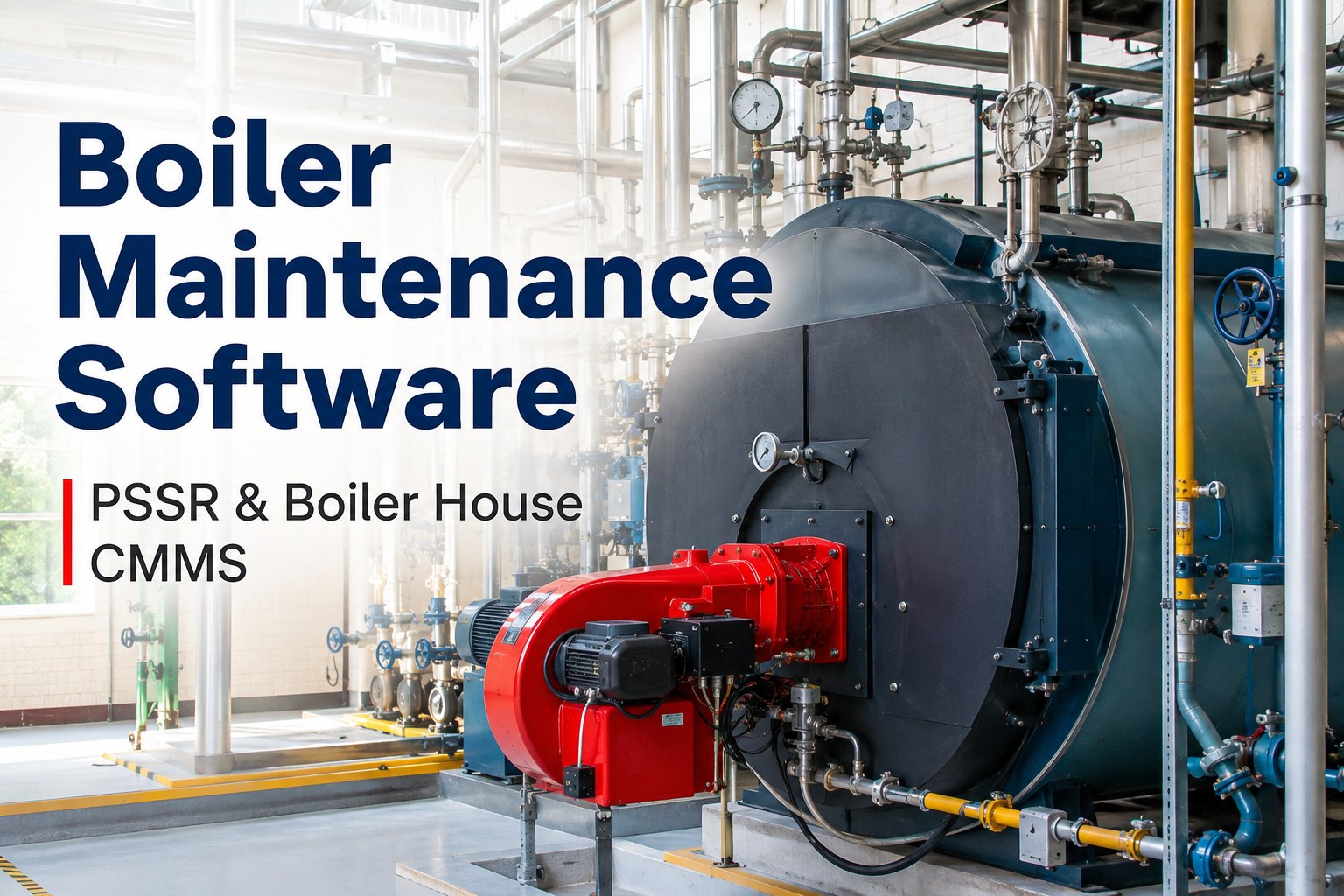
Boiler Maintenance Software | PSSR & Boiler House CMMS
By Riley Quinn on August 26, 2026
Boiler houses are the most concentrated compliance and energy risk on a UK industrial site. Every 1% loss in combustion efficiency on a 5 MW steam boiler burns roughly £6,500 of gas per year. Every degree of stack temperature above optimum costs money continuously. Every millimetre of scale reduces heat transfer. And PSSR 2000 makes the Written Scheme of Examination a criminal-liability document. A boiler house without disciplined maintenance is either quietly losing money or quietly building legal exposure. Book a demo to see boiler house workflows in action.
◆ BOILER HOUSE · PSSR 2000 · COMBUSTION EFFICIENCY
A boiler doesn't waste money in one big number. It wastes it in a hundred small ones — and the meter adds them up every second.
Every burner, every feed pump, every safety valve, every dosing pot — held under one PSSR-integrated maintenance system.
COMBUSTION LOSS BUDGET · TYPICAL 5 MW STEAM BOILER
Stack temperature drift
1°C = 0.5% loss
Excess O₂ drift
1% O₂ = 1% loss
Water-side scale
1mm = 8% loss
Fire-side fouling
Variable · 3-6% loss
Radiation & standby
2-4% permanent loss
£6.5k
Annual gas cost of 1% efficiency loss · 5 MW boiler
14 mo
PSSR maximum examination interval — statutory ceiling
100+°C
Stack temp above saturation is direct loss
The Boiler House Architecture — What the Register Actually Holds
A boiler house is a system, not a single asset. Fuel-in on one side, steam-out the other, and five interlocking sub-systems between them, each with its own PPM cadence, statutory regime and failure-consequence profile. What a working CMMS holds is not one asset but a stack of them.
BOILER HOUSE SUB-SYSTEMS
Fuel → Combustion → Boiler → Steam → Feedwater
FUEL & BURNER
Gas train · Burner head · Pilot · Combustion controls · Air damper · Modulation valves
Regulated · Gas Safety (I&U) · UKCA-approved gas train
Water Chemistry — The Silent Determinant of Boiler Life
Every UK boiler engineer knows the drill on water chemistry, and every UK boiler engineer has seen a plant where the chemistry log is a paper form that gets filled in weekly rather than a live parameter set that shapes maintenance behaviour. Water chemistry is not a paperwork exercise — it's the single largest determinant of tube life, efficiency and safety-valve reliability. The parameter set below is what BSRIA and manufacturer guidance calls out as the daily-and-weekly monitoring floor for a well-run boiler house.
FEEDWATER CHEMISTRY · BS 2486 GUIDANCE
Daily & Weekly Monitoring Floor
TDS
Total Dissolved Solids
Target · < 3500 mg/l
High TDS → carryover → contamination · Manage via blowdown
pH
Alkalinity
Target · 10.5 - 11.5
Low pH → corrosion · High pH → caustic embrittlement
O₂
Dissolved Oxygen
Target · < 20 µg/l
Primary cause of pitting corrosion · Manage via deaeration + scavengers
Oxygen scavenger residual · Proves dosing programme working
Fe
Iron
Target · < 0.5 mg/l
Rising iron → tube-side corrosion in progress · Leading indicator
Chemistry drift is invisible until it becomes a failure — a CMMS that captures readings against target and flags out-of-spec conditions catches problems weeks earlier than a paper log ever could.
The PSSR Compliance Clock — Every Boiler, Every 14 Months, Documented
PSSR 2000 makes the Written Scheme of Examination the boiler house's most important document. The competent person appointed to the scheme certifies which parts of each pressure system will be examined, how, and at what maximum interval — capped at 14 months for the boiler itself, tighter for certain safety devices and higher-consequence installations. Missing the CP examination date isn't a delayed maintenance task; it's a criminal offence that voids insurance the moment it lapses. Sign up free to run PSSR scheduling across every boiler.
Combustion Efficiency — The ROI That Pays for the Software
Combustion tuning is the single most cost-effective activity in a boiler house. A properly executed combustion audit — with flue gas analysis for O₂, CO and CO₂, stack temperature measurement, and adjustment of air-fuel ratios across firing range — typically recovers 2-5% of gas consumption. On a modest UK industrial site, the payback horizon on a combined CMMS + combustion audit programme is normally under 12 months. The table below shows what the numbers actually look like at plant scale. Sign up free to run combustion audit workflow across your boilers.
COMBUSTION ROI · UK GAS PRICING
Efficiency Recovery Value by Boiler Size
Boiler Size
Annual Gas
3% Recovery
5% Recovery
2 MW
£265k
£7,950
£13,250
5 MW
£660k
£19,800
£33,000
10 MW
£1.32m
£39,600
£66,000
20 MW
£2.64m
£79,200
£132,000
Based on 8,000 operating hours/year at £0.055/kWh gas · Efficiency baseline 82% typical for legacy plant · Recovery achievable through combustion audit, chemistry discipline and stack heat recovery
The two things every UK boiler house engineer knows — that PSSR examinations run on a strict clock and that combustion efficiency drifts continuously — should on their own justify a proper CMMS deployment, but on many sites they still don't. What I see repeatedly is that the boiler house is the last plant area to get structured maintenance workflow, precisely because the engineers who run it are experienced enough that everyone assumes they've got it under control. Then a CP visit finds a Category B defect from the previous examination that never became a work order, or an energy audit finds the O₂ trim setpoint that drifted 18 months ago and quietly cost £40,000 in gas. The pattern isn't lack of competence — it's lack of structural memory. What the CMMS provides is exactly that: PSSR dates that surface 90 days out, chemistry readings against target with drift alerts, combustion trend data that generates the work order rather than sitting in a folder. The technical work is what the boiler engineer already knows how to do. What changes is that it stops depending on someone remembering to look.
— Boiler House Engineering & PSSR Practice
01
WSE bound to asset
Every boiler holds its Written Scheme with review dates, CP appointments and examination history structural to the record.
02
Chemistry as live data
TDS, pH, O₂, hardness, sulphite reserve logged against target. Out-of-spec triggers work orders automatically.
03
Combustion audit scheduled
Flue gas analysis and burner tuning on 6-month cycle. Trend data drives adjustment timing.
04
Safety device testing
Safety valve, level trip, low-water alarms all tested to interval. Function-test evidence per event.
Who Uses Oxmaint for Boiler Houses in the UK
The platform is used by the UK roles that own boiler house reliability day-to-day: boiler house engineers running steam and hot-water plant across industrial sites, plant engineers responsible for feedwater treatment and blowdown discipline, facilities managers overseeing hospital, university and commercial boiler installations, energy managers driving combustion efficiency for ISO 50001 and carbon reporting, brewery and food-processing engineers where steam is directly production-critical, textile-finishing engineers running high-duty steam infrastructure, and QSHE directors ensuring PSSR compliance and audit-ready evidence for insurers and HSE. Sign up free to configure boiler house maintenance for your site.
Getting Boiler House Maintenance Live in 30-45 Days
Deployment starts with the boiler house asset register — every boiler, feed pump, softener/RO plant, dosing pot, steam distribution main, PRV and safety device — with PSSR classification and WSE data attached. PPM cycles configure per sub-system with type-appropriate cadence (daily chemistry, weekly blowdown, quarterly trap survey, 6-monthly combustion audit, annual burner strip, 14-monthly CP examination). Chemistry parameter templates deploy with target ranges and alert thresholds. Safety device testing calendars configure. CP report ingestion captures defects with A/B/C classification and remedial workflow. Combustion audit trend data ties to burner PPM. Most industrial and commercial sites see boiler house register, PSSR scheduling and chemistry workflow live within 30-45 days. Book a walkthrough to see UK boiler house deployments.
◆ THE BOILER HOUSE. STRUCTURAL. DEFENSIBLE.
Every Boiler. Every WSE. Every Combustion Audit.
Oxmaint gives UK boiler house engineers the full plant in one system — PSSR-integrated WSE scheduling, chemistry-parameter logging with drift alerts, combustion audit workflow, safety-device testing regimes, and audit-ready evidence packs for HSE, insurers and ISO 50001.
Boiler maintenance software is a CMMS configured specifically for boiler house plant — steam and hot-water boilers, burners and combustion controls, feedwater treatment (softening, RO, deaeration, chemistry dosing), feed pumps, steam distribution and condensate return, safety devices and pressure controls. It holds PSSR-integrated Written Scheme of Examination data per boiler, schedules Competent Person examinations at statutory frequencies, captures chemistry parameter logging (TDS, pH, dissolved oxygen, hardness, sulphite reserve) against target ranges with drift alerts, tracks combustion audit results and burner tuning history, and produces audit-ready evidence packs for HSE, insurers and energy-management standards including ISO 50001.
How does PSSR compliance work through the platform?
PSSR 2000 Regulation 8 requires every pressure system containing a relevant fluid above 0.5 bar to have a Written Scheme of Examination drawn up or certified by a competent person, specifying which parts will be examined, the nature of examination, and the maximum interval — capped at 14 months for boiler shells with tighter intervals for certain safety devices and higher-consequence installations. Oxmaint holds the WSE per boiler with CP appointment records, generates alerts 90 days before the next examination date, ingests CP reports directly against the asset with Category A/B/C/D defect classification, converts defects to tracked work orders with statutory action windows, and retains Regulation 14 records available on demand for HSE inspection. Duty ownership remains with the user or owner; the platform provides structural evidence.
Can it track combustion efficiency and O₂ trim?
Yes. Combustion parameters — flue gas O₂ percentage, CO ppm, CO₂ percentage, stack temperature, combustion efficiency percentage — track against baseline and target ranges. Where BMS or flue gas analyser data feeds are available, live values compare continuously; where audits are periodic (typical 6-monthly), audit results log against boiler with trend visualisation across cycles. Drift beyond threshold (typically excess O₂ rising above 4-5% on gas-fired plant, stack temperature climbing above spec) generates work orders for burner tuning. This turns combustion audits from a periodic tick-box into managed efficiency data that drives the maintenance calendar and, more importantly, catches the drift that quietly erodes plant efficiency between formal audits.
Does it help with feedwater chemistry compliance?
Directly. Feedwater and boiler-water chemistry parameters — TDS (managed via blowdown to keep below carryover threshold), pH (typically 10.5-11.5 for boiler water), dissolved oxygen (below 20 µg/l target with sulphite scavenger residual proving dosing effective), total hardness (below 2 mg/l CaCO₃ post-softener), iron (below 0.5 mg/l as leading corrosion indicator) — log against BS 2486 or manufacturer-specified target ranges. Out-of-spec readings trigger work orders with root-cause tagging (softener regeneration overdue, dosing pump failed, feedwater bypass event). Chemistry compliance evidence packs export for insurers and industry programmes that require documented water treatment discipline (BRCGS, SALSA, dairy processor programmes where steam contacts food-processing surfaces indirectly).
How long does deployment typically take for a UK boiler house?
A single site with 1-4 boilers typically goes live within 30-45 days — boiler house asset register import (boilers with WSE data, feedwater plant, distribution and safety devices), PPM cycle configuration per sub-system (daily chemistry, weekly blowdown, quarterly steam trap survey, 6-monthly combustion audit, annual burner strip, 14-monthly PSSR CP examination), chemistry parameter templates with target ranges and drift alerts, safety device testing calendars, CP report ingestion templates, and mobile deployment to boiler house operators. Multi-site industrial or commercial deployments typically complete within a quarter. BMS or flue gas analyser integration for continuous combustion tracking adds to timeline where those feeds are being brought online alongside the CMMS rollout.