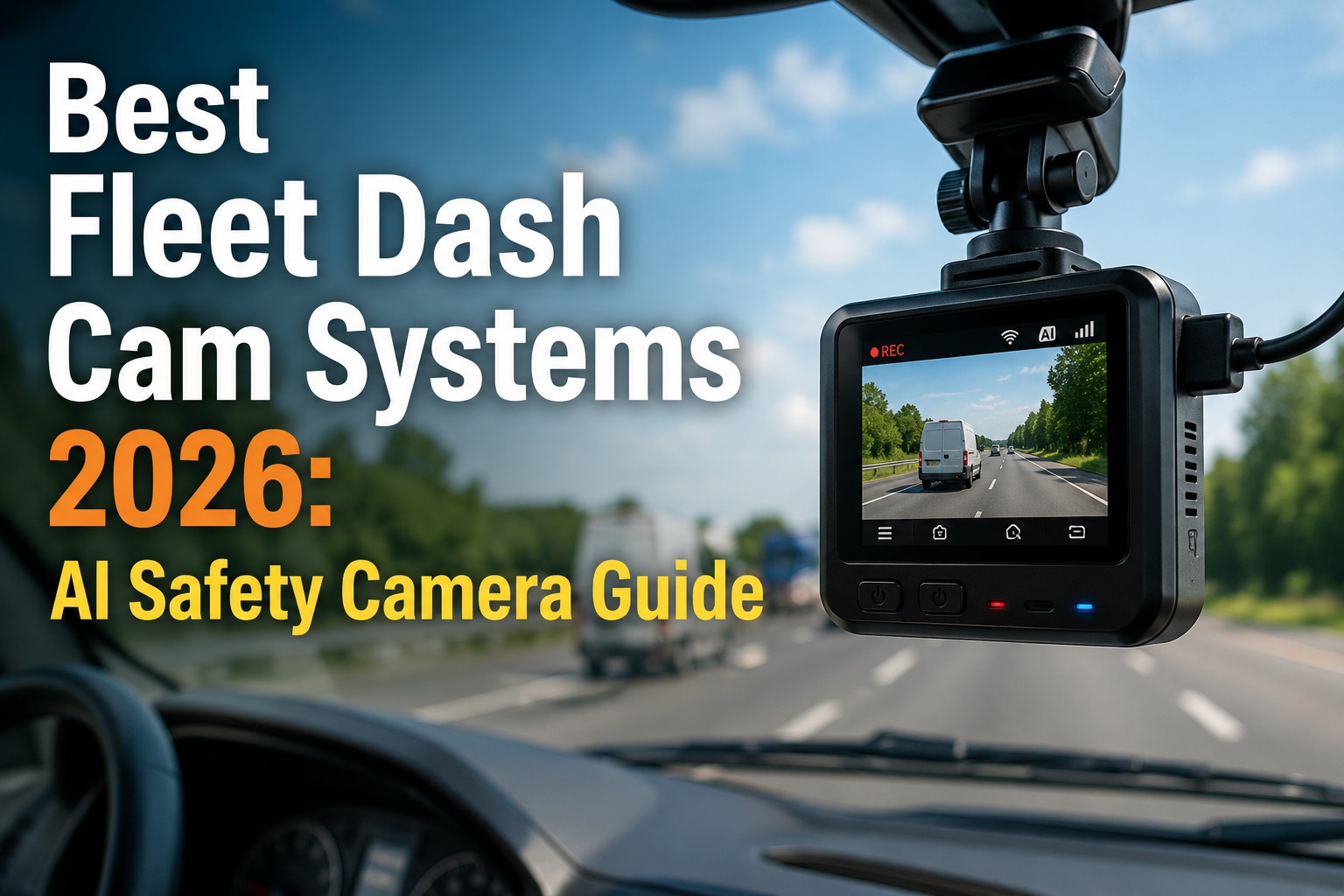
Fleet dash cams have undergone a fundamental transformation. In 2026, the leading systems no longer just record — they think. AI-powered cameras now run 30+ neural network models simultaneously, detecting distracted driving, fatigue, tailgating, lane departures, and collision risks in real time. The shift from passive recording to proactive intervention is delivering results that would have seemed impossible five years ago: UK fleets deploying AI dash cams report 60% fewer distracted-driving incidents within 90 days, 20-30% reduction in preventable collisions, and insurance premium savings of 5-20%. A single exonerated not-at-fault claim saves £4,000-£20,000 — often covering months of camera subscription costs in one event. But with Samsara, Lytx, Motive, Netradyne, and SmartWitness all competing for your business, choosing the right system requires understanding what each platform actually delivers versus what it promises. This guide compares every leading fleet dash cam system head-to-head using real market data and helps you build a business case your finance director will approve. Already managing fleet safety with spreadsheets? Sign up for Oxmaint and connect your camera safety events to maintenance workflows, driver coaching tasks, and fleet-wide safety analytics in one platform — ready for DVSA Earned Recognition audits.
Best Fleet Dash Cam Systems 2026: AI Safety Camera Guide for UK Fleets
Why Passive Dash Cams Are No Longer Enough
First-generation fleet dash cams were passive recorders — they captured footage to an SD card that nobody reviewed until after an incident. By then, the collision had happened, the claim was filed, and the video served only as evidence in a dispute. AI-powered cameras fundamentally change this equation by analysing video in real time and intervening before incidents occur:
Reactive vs. Proactive
Traditional cameras document collisions after the fact. AI cameras detect dangerous behaviours — mobile phone use, drowsiness, close following — and deliver instant in-cab audio alerts that correct the driver in the moment, not during a coaching session days later.
Alert Fatigue vs. Precision
Early systems flagged everything, overwhelming transport managers with false positives. Modern AI running on edge processors achieves 95%+ detection accuracy with minimal false alerts. Texting detection accuracy across vendors ranges from 13% to 100% depending on the system — choose carefully.
Surveillance vs. Coaching
Fleets that position cameras as punishment tools see driver resistance — a genuine risk under UK GDPR and ICO guidance on workplace monitoring. Fleets that use positive reinforcement — like Netradyne's GreenZone rewards for safe driving — see 80%+ driver adoption within 60 days and measurably better safety culture.
Fleets using full AI safety solutions achieve 73% crash rate reductions over 30 months — nearly double the improvement of basic camera systems. Connect your camera events to automated maintenance workflows and driver coaching tasks with Oxmaint's safety management platform and turn every safety event into measurable action — the same evidence trail your Traffic Commissioner and insurers want to see.
AI Dash Cam ROI: The Numbers That Matter
The business case for AI dash cams is no longer theoretical. Here is what fleet-wide deployment data shows across the industry in 2026:
The maths is straightforward: preventing one serious-injury collision — which the DfT values at over £250,000 in prevention terms — can justify the camera investment for an entire fleet. And with the majority of HGV incidents caused by other road users, exoneration video alone delivers massive ROI. One fleet saved approximately £280,000 from a single not-at-fault incident using dash cam footage. Start building your safety data trail today — sign up for Oxmaint to track safety events, generate coaching reports, and demonstrate measurable risk reduction to your insurer at renewal.
Top 5 Fleet Dash Cam Systems Compared: 2026
We evaluated each system on six criteria: AI detection accuracy, video quality, coaching tools, integration capability, pricing, and fleet size fit. Pricing shown below reflects typical UK monthly subscription rates. Here is how the leading platforms stack up:
Samsara CM34 — Best Overall Platform
Dual-facing HD cameras with 2K road-facing video and AI detection for distracted driving, tailgating, rolling stops, and harsh events. Live streaming and instant clip retrieval via cloud. Tight integration with Samsara's telematics suite and third-party platforms including Oxmaint. Recent Samsara research shows 91% of fleet managers have used dash cam footage for driver exoneration, and 96% report reduced costs. Pricing: £24-£36/vehicle/month. Best for: UK fleets of all sizes wanting a single-platform telematics-plus-camera solution.
Lytx DriveCam — Best for Managed Coaching
The pioneer in fleet video safety with over 20 years of driving data powering its risk models. Unique managed services option where Lytx analysts review flagged events and provide coaching recommendations — ideal for fleets without a dedicated safety manager. Lytx Risk Score quantifies driver and fleet-level risk with unmatched depth. Pricing: £28-£44/vehicle/month. Best for: enterprise UK fleets (200+ vehicles) that want outsourced safety coaching and the deepest risk analytics available.
Motive AI Dashcam Plus — Best Value
The new AI Dashcam Plus runs 30+ high-precision AI models on the Qualcomm Dragonwing processor with 3x more processing power than competing devices. Dual-facing cameras, automatic event recording (including tachograph-adjacent evidence capture), and exoneration video. All-in-one design combines Vehicle Gateway and dashcam, cutting install time to under 15 minutes. Features launching through 2026 include stereo vision, ANPR (automatic number plate recognition), and voice-activated commands. Pricing: £20-£28/vehicle/month. Best for: UK fleets of 25-200 vehicles looking for a strong value proposition.
Netradyne Driveri — Best AI Detection
Four-camera system providing 360-degree coverage with the most advanced AI in the market. Detects stop line and traffic light violations, following distance, lane departures, distracted driving, and vulnerable road user proximity — critical for urban HGV work under DVS (Direct Vision Standard) rules in London. Unique GreenZone positive driving recognition rewards safe behaviour — not just penalising risky events. Fleets report highest driver buy-in of any system due to positive reinforcement approach. Pricing: £28-£40/vehicle/month. Best for: safety-obsessed UK fleets wanting comprehensive detection and a coaching culture built on recognition.
SmartWitness CP2-LTE — Best Budget Option
UK-founded provider with strong local support. Solid dual-facing cameras with real-time monitoring and 4G LTE cloud connectivity at a lower price point. G-sensor triggered recording, driver ID integration, and essential AI features covering core safety use cases. Less sophisticated AI compared to Samsara or Netradyne but reliable for fleets that need camera coverage without premium pricing. Pricing: £12-£20/vehicle/month. Best for: cost-conscious UK fleets of 10-100 vehicles that need solid camera coverage without enterprise complexity.
All five systems integrate with Oxmaint's fleet management platform — connecting safety events to maintenance work orders, driver coaching tasks, and fleet-wide safety analytics. Book a free demo to see how camera data flows into your operational workflows and PMI (Preventative Maintenance Inspection) schedules.
Turn Camera Events Into Actionable Workflows
Oxmaint integrates with Samsara, Lytx, Motive, and Netradyne to automatically convert safety events into work orders, coaching tasks, and inspection triggers. See your fleet safety score improve in real time — with a full audit trail for DVSA and your Traffic Commissioner. No spreadsheets required.
What AI Dash Cams Actually Detect in 2026
Modern AI dash cams go far beyond basic event recording. Here are the key detection capabilities that separate real AI systems from marketing hype:
Distracted Driving
AI identifies mobile phone use, eating, smoking, seat-belt violations, and inattention in real time — behaviours that carry significant penalties under UK law (6 points and a £200 fixed penalty for handheld phone use alone). In-cab audio alerts correct behaviour within milliseconds. Fleets report 60% fewer distraction events within 90 days.
Fatigue and Drowsiness
Driver monitoring systems track eye closure, blink rate, yawning, and head position to detect fatigue before it causes an incident. Critical for HGV drivers operating under EU/UK drivers' hours rules. Audio and vibration alerts wake drowsy drivers in the critical moments before microsleep occurs.
ADAS Collision Prevention
Forward collision warnings, headway monitoring, and lane departure alerts use computer vision to detect hazards ahead. These systems intervene seconds before impact — giving drivers the reaction time they need to avoid crashes. Aligns with the EU General Safety Regulation ADAS mandates now filtering through to UK fleet buyers.
Exoneration Video
Automatic cloud upload of incident video with pre- and post-event footage. Protects your fleet from fraudulent claims, staged accidents, and "crash-for-cash" scams that continue to target UK commercial fleets. Exoneration video saves £4,000-£20,000 per incident.
Safety Scoring
Automated per-driver safety scores based on AI-detected events. Identify high-risk drivers for targeted coaching. Track improvement trends over time. Feed scores into Oxmaint for centralised safety performance tracking across your entire fleet.
Insurance Data Packages
AI generates safety trend reports — declining event frequency, coaching completion rates, and exoneration statistics — that UK commercial motor insurers use to assess risk at renewal. Fleets sharing this data achieve 5-20% premium reductions. Some carriers now require camera programmes for coverage.
These detection capabilities work together to build a complete safety ecosystem. Book a demo to see how Oxmaint connects camera-generated safety events with maintenance scheduling, driver coaching, and fleet analytics.
Best Practices for Dash Cam Deployment Success
Technology is only half the equation. UK fleets that get the highest ROI from dash cams follow these operational practices consistently:
Lead with Transparency and Meet UK GDPR Obligations
Communicate the purpose clearly before installation: cameras protect drivers from false claims and improve safety — they are not surveillance tools. Complete a Data Protection Impact Assessment (DPIA) per ICO guidance, update your privacy notice, and consult drivers and any recognised union. Fleets that frame cameras as driver protection see 80%+ acceptance within 60 days.
Start with a Pilot on 10-20% of Your Fleet
Deploy cameras on your highest-risk vehicles first. Measure collision rate, event frequency, and driver feedback for 30-60 days before full rollout. A pilot proves ROI with your actual data and builds internal champions for fleet-wide expansion.
Coach Weekly, Not Monthly
Review AI-flagged safety events weekly and coach the bottom-quartile drivers with specific, data-backed recommendations. Fleets that combine visibility with weekly coaching see 18% better safety outcomes than those using camera tracking alone.
Connect Camera Data to PMI & Maintenance Workflows
Harsh braking events indicate brake inspection needs — critical between 6-weekly safety inspections. Collision alerts trigger vehicle damage assessments. Forward collision warnings on specific vehicles may signal windscreen obstruction or sensor issues. Sign in to Oxmaint to automate these connections — turning safety events into maintenance work orders without manual intervention.
Package Safety Data for Your Insurer
Do not dump raw event logs on your insurance broker. Instead, package declining event trends, coaching completion rates, and exoneration statistics as a safety improvement narrative. UK commercial motor insurers want to see active risk management, not perfection. Present this data 90 days before renewal for maximum negotiating leverage.
Implementing these practices alongside Oxmaint's safety management tools turns camera footage into measurable fleet-wide safety improvement. Book a demo and start building your safety data trail.
Who Benefits from AI Dash Cams
AI dash cams create value for every stakeholder in fleet operations. Here is how different roles benefit from the same system:
Real-time fleet safety scores, automated event alerts, and trend dashboards that show exactly which drivers and vehicles need attention. Quantify safety programme ROI for the board with hard data instead of anecdotes — and defend your O-licence position with Traffic Commissioner-ready evidence.
AI-powered coaching workflows replace manual video review. Focus on high-risk drivers with targeted interventions. Track coaching effectiveness over time. Build the safety improvement narrative that insurers reward at renewal and that supports FORS and DVSA Earned Recognition accreditation.
In-cab alerts prevent incidents before they happen — protecting drivers from collisions and false claims alike. Positive reinforcement programmes reward safe driving. Most drivers become camera advocates once they see exoneration footage protect a colleague from a fraudulent claim.
Measurable insurance savings, reduced claim costs, and lower litigation exposure. Clear before-and-after data justifies technology investment. A single exonerated claim can cover the entire camera programme cost for a quarter.
Whether you manage 15 vehicles or 1,500, AI dash cams scale to fit your operation. Book a demo to see how Oxmaint connects camera safety data to your maintenance, coaching, and cost analytics workflows.
See Everything. Prevent More. Spend Less.
Oxmaint connects your AI dash cam data with maintenance workflows, driver coaching tasks, and fleet safety analytics — turning camera events into measurable safety improvements, lower operating costs, and audit-ready compliance records.
Frequently Asked Questions
How much do fleet AI dash cams actually cost in the UK
Pricing ranges from £12 to £48 per vehicle per month depending on the platform and feature tier. Budget options like SmartWitness start at £12-£20/month. Mid-range platforms like Motive run £20-£28/month. Premium solutions like Samsara, Lytx, and Netradyne range from £24-£48/month. Most vendors include installation in the subscription cost for qualifying contracts. The ROI typically exceeds the cost within 4-6 months through avoided incidents and insurance savings.
Are dash cams legal in the UK and what about GDPR
Yes, dash cams are legal in commercial fleets, but you must comply with UK GDPR and the Data Protection Act 2018. Complete a Data Protection Impact Assessment (DPIA), update your privacy notice, inform drivers in writing, provide clear signage in-cab, define retention periods, and restrict access to footage. The ICO provides specific guidance on workplace monitoring. In-cab audio recording carries additional considerations — many fleets disable it or limit it to event-triggered clips only.
Do drivers resist dash cam installation
Initial resistance is common but manageable. Fleets that frame cameras as a driver protection tool — not surveillance — and communicate transparently see 80%+ acceptance within 60 days. Sharing real exoneration stories where footage cleared a driver from a false claim or a "crash-for-cash" attempt is the most effective adoption strategy. Positive reinforcement programmes like Netradyne GreenZone accelerate buy-in by rewarding safe driving behaviour. Consult any recognised union early in the rollout.
What is the typical ROI timeline for AI dash cams
Most UK fleets see positive ROI within 4-6 months. Insurance premium reductions apply at the next policy renewal. Behaviour improvements and collision reductions begin within the first 30 days. A single exonerated not-at-fault claim saving £4,000-£20,000 can cover several months of subscription costs. Preventing one serious-injury collision, which the DfT values at over £250,000 in prevention terms, can justify the investment across an entire fleet.
Will dash cam footage help with my insurance renewal
Yes — if you use the data actively. UK commercial motor insurers in 2026 no longer just want to see that you have cameras. They want proof you are using camera data to actively reduce risk: declining event frequency, documented coaching, and exoneration statistics. Fleets that package this data as a safety improvement narrative achieve 5-20% premium reductions. Some carriers now require camera programmes for coverage eligibility on HGV fleets.
Do I need a separate telematics device if I have AI dash cams
It depends on the platform. Samsara and Motive offer integrated telematics-plus-camera solutions on a single device. Lytx and Netradyne are camera-focused and typically pair with a separate telematics or tachograph analysis provider. SmartWitness integrates with third-party telematics via API. All five platforms connect with Oxmaint for centralised maintenance and safety management.
How does Oxmaint integrate with dash cam systems
Oxmaint connects via API to Samsara, Lytx, Motive, and Netradyne. Safety events automatically trigger workflows: coaching task assignments, vehicle inspection work orders, driver safety score tracking, and fleet-wide safety analytics. Camera data feeds into the same platform as your PMI schedules, tachograph-related maintenance, fuel tracking, and cost-per-kilometre calculations. Book a demo to see the integration in action.
Can dash cam footage be used as legal evidence in UK courts
Yes. Cloud-stored footage with timestamps, GPS data, and secure audit logs is admissible in UK civil and criminal proceedings, and can be submitted as part of insurance disputes and Traffic Commissioner reviews. Dash cam video has become essential for defending commercial fleets against inflated personal injury claims and staged collisions. In one documented case, a public sector operator saved an estimated £280,000 from a single not-at-fault incident using dash cam footage.