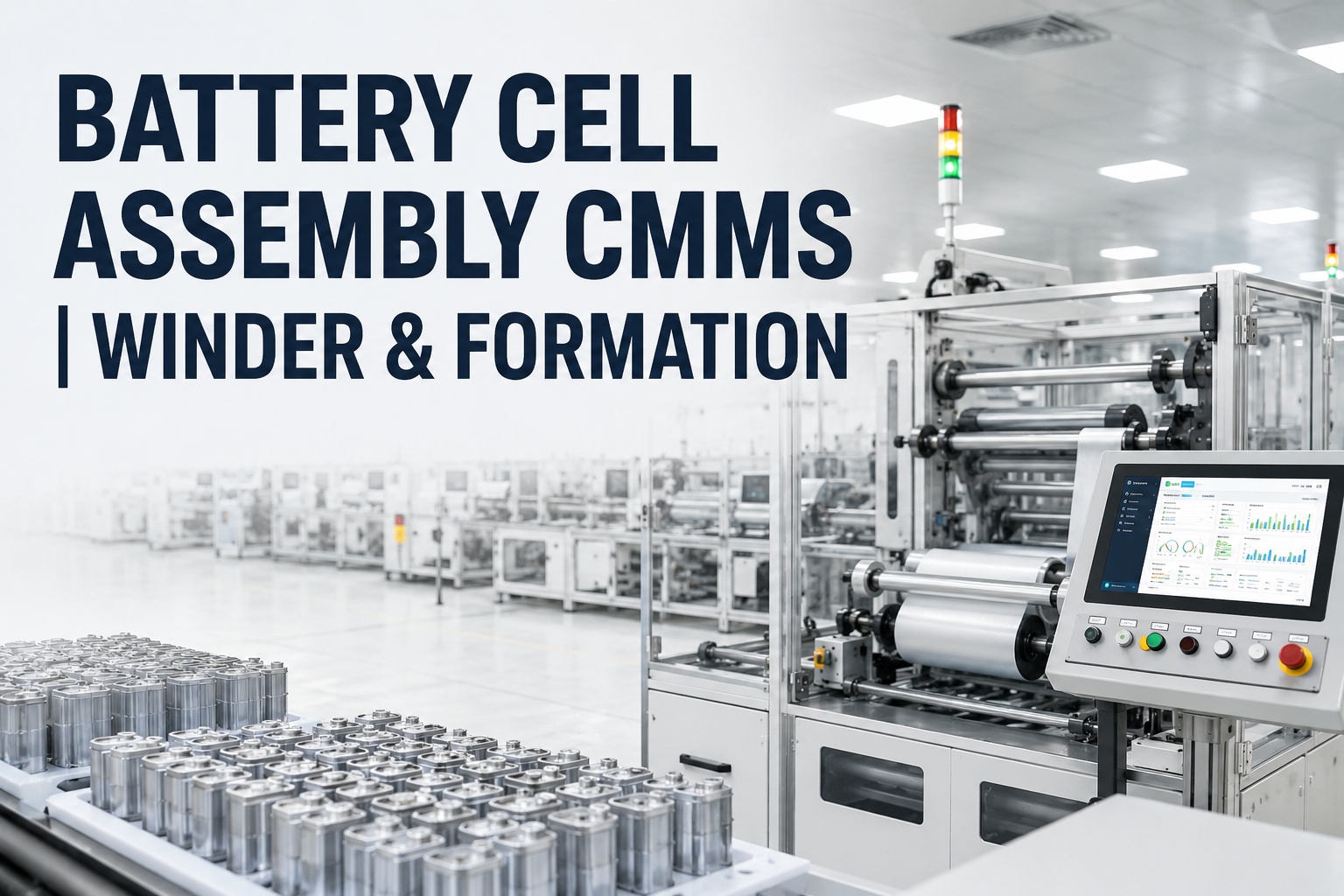
Battery cell assembly is the most unforgiving manufacturing environment in modern industry. A prismatic cell winder cycles every 1.5 to 2.5 seconds. A half-millimetre positional error becomes a recall. Electrolyte filling happens inside a dry room where moisture sits in parts-per-billion — because higher levels generate hydrofluoric acid that eats the cell from inside out. Formation temperature control lives at ±0.5°C. This is a plant where maintenance discipline is what keeps operations from becoming a warranty event. Book a 30-minute demo to see how a battery cell CMMS actually looks in practice.
The Contamination Hierarchy
Four Environmental Zones. Four Different Maintenance Regimes.
Cell assembly's defining constraint · tolerances tighten as the cell approaches the electrolyte stage
Tier 1
Ambient factory
Uncontrolled RH
Case handling · packaging · logistics
Standard PPE and workshop rules · maintenance access as normal · no environmental sign-off required for interventions
Tier 2
Clean room ISO 8
RH 40-50%
Electrode slitting · notching · stacking prep
Gowning required · particle count monitored · maintenance interventions logged with time-in-zone · post-work environmental verification
Tier 3
Dry room class
Dew point -40°C
Winding · stacking · welding · sealing
Full dry-suit gowning · airlock entry · dew point continuously monitored · every human entry logged · desiccant regeneration cadence critical
Tier 4
Ultra dry room
Dew point -60°C · H2O ppb
Electrolyte filling · degassing · final seal
Maintenance access via airlock slide-out · equipment retracted to ambient side for service · never breach zone · single moisture excursion contaminates the batch
The Cell Assembly Line — Four Precision Stages, Four Failure Modes
Cell assembly proper consists of four sequential precision stages after the electrode is prepared. Each has its own maintenance signature, its own critical tolerance, and its own failure consequence. The plants running world-class yield are those that hold each stage as its own maintenance sub-programme with per-stage instrumentation and per-stage cadence. Want to see all four stages configured in one live workspace? Book a demo and we will walk you through each stage's maintenance profile.
01
Winding / stacking
1.5–2.5 sec/cell
Critical tolerance
±0.5 mm alignment
Tension drift · alignment sensor variance · roller bearing vibration · web speed
Failure · Positional error becomes short-circuit risk · recall waiting to happen
02
Laser welding + sealing
Sub-second weld
Critical tolerance
Weld penetration ±10μm
Laser power drift · focal position · assist gas purity · optics contamination
Failure · Weak weld = leak path for electrolyte or moisture ingress
03
Electrolyte filling
Precision dosing
Critical tolerance
Mass ±0.1% · H2O ppb
Dosing needle wear · pump calibration · tank residue · vacuum draw pressure
Failure · HF formation · cell degradation · safety event risk
04
Formation + aging
24–72 hours
Critical tolerance
Temperature ±0.5°C
Contact pin resistance · rack temperature uniformity · voltage per cell · fixture pressure
Failure · SEI layer defective · cell fails cycle-life test at grading
The Dry Room Airlock: Maintenance Without Breaching the Zone
The dry room is where cell assembly's most brutal reality lives. A human entering the dry room brings moisture with them — every breath, every glove, every tool carries H2O molecules that can contaminate a batch. World-class cell plants use airlock maintenance: the malfunctioning equipment retracts from the dry room through an airlock slide, gets serviced on the ambient side while the airlock reseals the zone, and returns without a technician ever crossing the boundary. This is completely unique to battery manufacturing. Teams evaluating how a CMMS handles the airlock work-order flow can book a demo of the dry-room airlock workflow.
The Airlock Maintenance Sequence — Never Breach the Zone
01
Fault detected
Filling apparatus flags out-of-tolerance dosing · CMMS raises blocking work order · adjacent apparatuses continue running
02
Airlock isolation
Dry-room side of airlock closes · dew point maintained in production zone · apparatus retracts on slide toward ambient side
03
Ambient-side service
Ambient side opens · technician services apparatus without dry-suit · no zone breach · full toolkit accessible
04
Verification + return
Post-service calibration test · ambient side closes · dry side opens · apparatus rejoins production · full audit trail logged
The Cell Birth Certificate: Traceability at Individual Cell Level
Every finished cell carries a unique identifier and a complete data lineage back to the electrode roll it came from, the specific winding machine that made it, the dosing apparatus that filled it, the formation rack that cycled it, and every maintenance event that touched any of those assets during its production window. This cell birth certificate is what allows a manufacturer to trace a field failure back to its production origin and quarantine only the affected cells rather than an entire month of output. Teams new to per-cell traceability can sign up free to explore the birth certificate workspace.
Per-Cell Traceability Chain — What Gets Recorded
Cell ID
Unique serial · laser-etched at winding · barcode + QR
Electrode
Roll batch · coating date · calendaring pass · slitting operation
Winder
Machine ID · shift · web tension trace · alignment log · PM status
Weld
Laser ID · power trace · shot count · optics status · gas purity
Fill
Dosing apparatus ID · mass dispensed · dew point during fill · vacuum pressure
Formation
Rack ID · position · pressure · temperature curve · voltage curve · SEI verification
Grading
Capacity · internal resistance · self-discharge · quality band
See a Live Battery Cell Plant Workspace
Watch a 30-minute demo of Oxmaint configured for winders, welders, filling apparatus, formation racks and dry-room environmental control — with cell birth certificate traceability built in.
The Recall Cascade: What Actually Happens When Traceability Fails
Battery recalls are among the most expensive events in modern manufacturing — not just for the direct replacement cost, but for the traceability gap that determines how many cells get quarantined. A plant with per-cell traceability quarantines the specific 8,000 cells produced during the 2-hour window when the dosing apparatus was out of spec. A plant without it quarantines the entire month's production — potentially millions of cells — because it cannot prove which are affected. Teams wanting to see the traceability workflow modelled against their production volume can book a demo of the birth certificate module.
Field Failure Traceback — Two Scenarios
Without traceability
Field failure reported
→
Origin plant unknown
→
Entire month quarantined
→
Millions of cells scrapped
Cost impact · £8-40M direct + brand exposure
With cell birth certificate
Field failure reported
→
Cell traced to specific fill window
→
8,000 cells identified
→
Targeted quarantine only
Cost impact · £150-400k direct + reputation protected
Expert Perspective: Why Battery Manufacturing Punishes Weak CMMS
Battery cell assembly is unforgiving in a way no other manufacturing sector I have worked with matches. In food manufacturing, a bad batch is expensive but bounded. In battery, a single moisture excursion in the ultra dry room during electrolyte filling can invalidate a full shift of output — and the plant may not know for weeks because the failure only manifests at cycle-life testing after formation and aging. This is why the CMMS must hold environmental parameters, per-cell traceability, per-apparatus maintenance history, and airlock cycle logs as one integrated data structure. Anything less means the plant cannot answer the questions that come after every warranty investigation.
Want to see how these four data streams — environmental, cellular, per-asset, airlock — actually converge in one workspace? Book a demo and we will show you the integrated data structure live.
UK Battery Cell Context: Agratas, AESC and the Sector Rebuild
UK battery cell manufacturing is in the middle of a generational rebuild. Agratas at Bridgwater — the Tata Group gigafactory — is scaling toward 40GWh capacity to supply Jaguar Land Rover from 2026 onwards. AESC at Sunderland continues to expand alongside Nissan. Both operate in the demanding customer environment of automotive OEMs where per-cell traceability, IATF 16949-adjacent quality expectations, and battery-specific compliance (UN38.3, UL 1642, IEC 62133) all converge. A CMMS that produces per-cell maintenance evidence and airlock cycle records serves both operational reliability and audit requirements from one backbone. To scope this against your operation, book a demo aligned to UK battery sector requirements.
01
Automotive OEM traceability
JLR, Nissan, Stellantis expectations flow down from IATF 16949 · per-cell birth certificate essential for warranty defence.
02
Battery-specific compliance
UN38.3 transport testing · UL 1642 · IEC 62133 · production evidence chain required for each certification.
03
Sector scale-up pressure
Agratas 40GWh at Bridgwater · AESC Sunderland expansion · reliability discipline is the difference between hitting ramp targets and missing them.
A Realistic Rollout for a UK Battery Cell Plant
A battery cell plant rollout should follow the environmental risk. Dry room first — because that is where the most expensive failures happen. Formation and aging second — because that is where the largest capital sits. Winding and welding third. A phased plan protects the ultra dry room inside the first month. Teams planning a phased deployment can book a demo and we will scope the rollout against your line topology.
Weeks 1–4
Dry room + environmental
Dry room dew point trending live
Airlock cycle logging configured
Desiccant regeneration cadence
Filling apparatus registers per zone
Weeks 5–8
Formation + traceability
Formation rack asset structure
Contact pin PM cadences
Cell birth certificate data flow
Aging shelf temperature monitoring
Weeks 9–12
Winding + welding + audit
Winder alignment sensor cadence
Laser welder optics + power tracking
UN38.3 / UL 1642 evidence filter
IATF 16949 audit readiness pack
Bring Every Cell Onto One Traceable Maintenance Backbone
Let Oxmaint show you a battery cell workspace configured for your winders, welders, filling apparatus and formation racks — with dry room, airlock and birth certificate all connected.
Frequently Asked Questions
Can Oxmaint enforce dry-room and airlock maintenance protocols?
Yes. Each environmental zone (ambient, clean room, dry room, ultra dry room) carries its own maintenance-access rules configured in the CMMS. Work orders on dry-room assets automatically enforce the airlock retraction procedure and log every airlock cycle. Post-service verification tests fire as blocking work orders before the apparatus can rejoin production. Zone breach exceptions raise immediate alerts and trigger environmental verification cadences. This closes the biggest single risk in cell assembly maintenance.
Does the platform support per-cell birth certificate traceability?
Yes. Each cell's unique identifier links to the specific electrode batch, winder machine and shift, welder power trace and shot count, filling apparatus and dosing mass, formation rack and voltage/temperature curves, and grading result. Every maintenance event on any of these assets during the cell's production window is linked to the cell record. Field failure investigations can trace back through this chain to identify the specific production window and quarantine only affected cells rather than entire batches.
How does the CMMS handle formation rack temperature uniformity?
Formation racks are held as multi-position assets with per-position temperature monitoring and per-position voltage tracking. Temperature uniformity across the rack (±0.5°C requirement) is verified continuously with deviations raising blocking work orders. Spring-loaded contact pin condition is tracked per position with usage-based inspection cadence. Each cell's formation curve is captured as part of its birth certificate for downstream SEI verification and cycle-life prediction.
Can we track electrolyte filling precision at production speed?
Yes. Filling apparatuses are held as tracked assets with real-time monitoring of mass dispensed per cell (±0.1% tolerance), dew point in the fill zone, vacuum draw pressure, dosing needle wear count, and tank residue level. Deviations from any parameter trigger the airlock retraction sequence with a blocking work order before the next cell is filled. Full parameter history is retained per cell for warranty investigation and traceability audit.
Does the platform support UK battery-sector compliance requirements?
Yes. Evidence for UN38.3 transport safety testing, UL 1642 cell safety, IEC 62133 rechargeable cell standards, and IATF 16949-adjacent automotive OEM expectations is captured from the underlying maintenance and traceability records. One evidence backbone can be filtered per certification scope on demand. For UK gigafactory operations serving JLR, Nissan and other automotive OEMs, this replaces the reconstruction scramble that used to characterise pre-audit weeks.