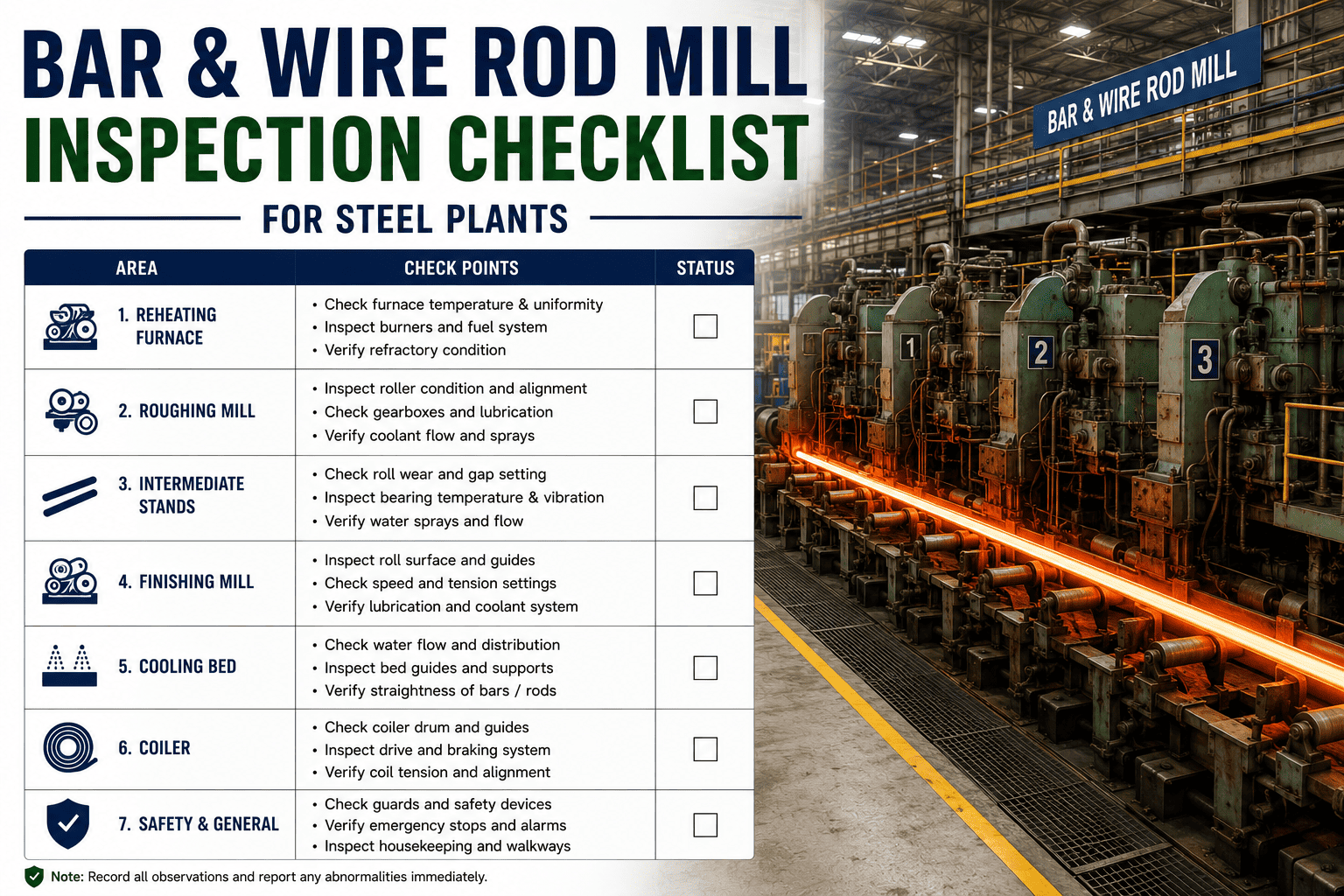
A wire rod mill runs its stands and cooling systems under sustained high-frequency cyclic loading, which means a bearing issue here can go from first detection to a catastrophic break in as little as two to four weeks. The warning rarely looks urgent at first: a chock bearing running a touch warmer, a Stelmor conveyor belt tracking slightly off, a coolant nozzle that's drifted out of alignment. This checklist covers the eight points a bar and wire rod mill inspection route should never skip. Sign up to turn this checklist into a recurring digital inspection your team can't miss a step on.
8 Points
Core checks that belong on every bar and wire rod mill inspection route
2-4 Weeks
Typical window from first bearing detection to catastrophic breakage
500-800 TPD
Typical wire rod production rate coordinated across the mill
Zero Skips
Tolerance for missed checks, since early drift rarely repeats itself
Why Wire Rod Bearings Need Faster Attention Than Other Mills
Wire rod equipment runs under sustained high-frequency cyclic loading rather than the intermittent impacts seen in plate or bar mill stands, so roll wear is linear and fairly predictable, but bearing failures are not forgiving. A bearing that's just starting to show wear can progress to a catastrophic break within a few weeks, which is exactly why bearing condition deserves a faster inspection cadence here than on slower long-product lines.
The Bar & Wire Rod Mill Inspection Checklist
Mill Stand Roll & Chock Bearings
Check roll surface condition and chock bearing housings for contamination ingress or early end-face damage
Gearbox & Drive Spindle
Verify gearbox oil level weekly and watch drive spindle condition closely, since gearbox lead times can run 6 to 18 months
Laying Head & Pinch Roll
Inspect the laying head pipe and pinch roll for wear that would throw off coil ring pattern and lay uniformity
Stelmor Conveyor Belt & Drive
Check conveyor belt tracking, tension, and drive mechanism, since a slow or misaligned belt disrupts controlled cooling instantly
Cooling Bed Fans & Water Boxes
Confirm fan speed and water box flow rate, since cooling failures cascade instantly through the whole production line
Coolant Nozzle Alignment
Verify coolant nozzles are aligned and unobstructed, since misalignment here directly affects roll surface temperature control
Roll Gap & AGC Calibration
Check roll gap reference and automatic gauge control calibration, flagging any profile deviation outside tolerance for regrind
Coil Reforming & Compacting System
Check coil shape, handling, and compacting equipment at the finishing end, since this stage decides final delivered coil quality
Never Miss A Bar & Wire Rod Mill Inspection Point
Oxmaint turns this eight-point checklist into a recurring digital route, capturing readings across mill stands, the Stelmor conveyor, and cooling beds so bearing drift is caught weeks before it becomes a break. Sign up for a free trial to build your bar and wire rod mill inspection route, or book a demo to see it in action.
What An Abnormal Reading Might Be Telling You
| What You Notice |
Possible Cause |
| Chock bearing running warmer than baseline |
Early wear that can progress to a break within weeks if left unaddressed |
| Uneven coil ring pattern off the laying head |
Laying head pipe or pinch roll wear affecting lay uniformity |
| Stelmor belt tracking off-center |
Drive or tensioning issue that risks uneven cooling across the coil |
| Profile deviation outside tolerance |
Roll wear reaching the point where a regrind is due before the next gauge run |
Paper Checklist vs A Digital Inspection Route
Paper Checklist
Bearing and roll readings filed away, hard to compare stand by stand
Easy for a busy shift to skip a check without anyone noticing
No trend line until someone manually pulls old sheets together
Digital Inspection Route
Every reading logged against the exact stand or asset automatically
A skipped point flags itself instead of quietly disappearing
Trend lines build on their own, making slow drift easy to catch early
Where A CMMS Fits Into Bar & Wire Rod Mill Inspections
Oxmaint turns this eight-point checklist into a recurring digital route, capturing each reading against the mill stand, Stelmor conveyor, or cooling bed asset so trends are visible instantly and a missed check never slips through unnoticed.
Frequently Asked Questions
Q
How often should a wire rod mill be inspected?
Chock bearings and coolant nozzles are best checked daily, gearbox oil levels weekly with monthly oil analysis, and a full stand alignment survey is typically done at each campaign end.
Q
Which check on this list matters most?
Chock bearing condition tends to matter most, since bearing failures on wire rod equipment can progress from first detection to a catastrophic break within just a few weeks.
Q
Can a CMMS turn this checklist into a recurring digital inspection?
Yes, a CMMS can schedule the checklist as a recurring route, prompt the technician for each reading by stand or asset, and build a trend history automatically across the mill and cooling systems.
Turn This Checklist Into A Route Your Team Follows Every Day
Oxmaint schedules this eight-point bar and wire rod mill inspection as a recurring digital route, capturing readings and trends automatically across every stand and cooling system. Sign up for a free trial to build your bar and wire rod mill inspection route, or book a demo to see it in action.