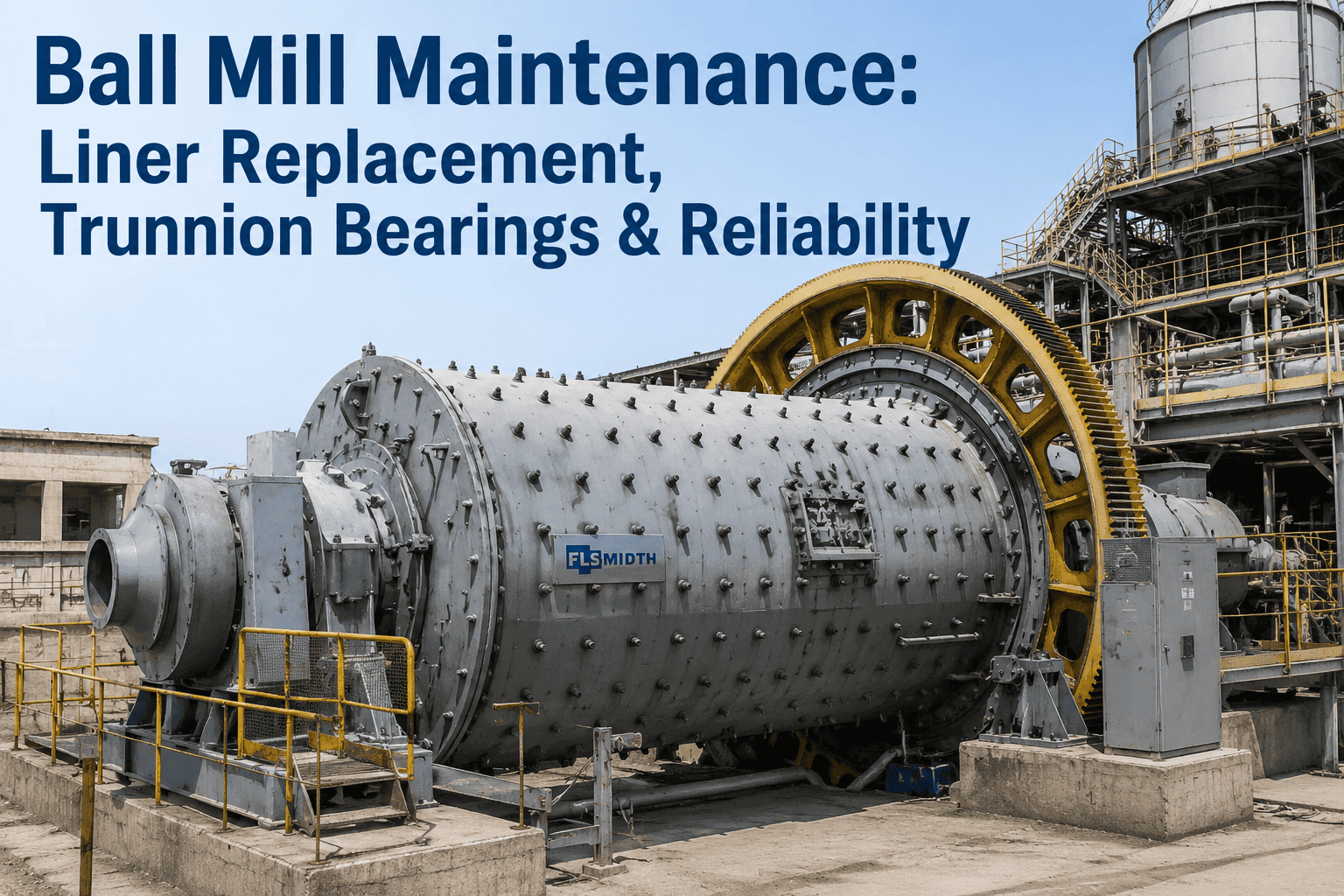
A trunnion bearing rarely fails without warning, the temperature climbs a fraction of a degree a day and the vibration drifts upward for weeks before the oil film finally collapses and metal meets metal. By then a planned bearing swap has turned into a shutdown measured in weeks, not days. Sign up to see how Oxmaint keeps every liner, bearing and oil sample on one trend line.
30-40%
Share of total ball mill maintenance cost that mill liners typically account for
28-35%
Target ball charge as a share of mill volume for consistent grinding efficiency
40-50°C
Recommended trunnion bearing oil operating temperature range
Quarterly
Standard interval for trunnion bearing oil analysis on a healthy mill
What a Missed Warning Sign Actually Costs
One documented trunnion bearing seizure took a mill down for 22 days: nine waiting on an emergency bearing, six on machining and alignment, four on liner repair, three on commissioning. The plant lost tens of thousands of tonnes of production on top of the repair bill. The bearing temperature had been climbing for 40 days and oil analysis three months earlier had already shown iron particle counts three times above baseline, the failure was never unpredictable, only unmonitored.
Where a Ball Mill Actually Breaks Down
| Component |
Common Wear Cause |
Preventive Task |
| Shell & end liners |
Impact and abrasive wear from ball charge thins the liner toward the shell |
Thickness monitoring per zone against the condemn limit |
| Trunnion bearings |
Oil film collapse from viscosity drop, pump wear, or contamination |
Quarterly oil analysis, monthly once particle counts trend up |
| Diaphragm |
Slot wear alters material residence time between chambers |
Slot condition inspection at scheduled intervals |
| Girth gear & pinion |
Misalignment and inadequate lubrication cause pitting and scoring |
Open gear lubrication checks and periodic alignment verification |
| Mill shell & foundation |
Foundation settling and thermal growth differentials cause imbalance |
Vibration trend monitoring against a stable baseline |
Every Liner, Bearing and Oil Sample on One Trend Line
Oxmaint plots liner thickness against cumulative tonnes processed and logs every trunnion bearing oil sample against the bearing asset record, so a rising particle count or a slow temperature climb triggers a work order long before it becomes a shutdown. Sign up for a free trial to see it against your own mill, or book a demo and we'll walk through your grinding circuit.
Set Oil and Vibration Thresholds Before the Bearing Seizes
| Parameter |
Healthy Baseline |
Trigger for Action |
| Oil sample frequency |
Quarterly on a stable bearing |
Move to monthly once metal particle counts trend upward |
| Oil cleanliness |
ISO 18/16/13 target via offline filtration |
Increase filtration cycle when readings drift above target |
| Bearing temperature |
Stable day-to-day reading |
Sustained climb of roughly 0.3°C per day warrants investigation |
Scheduled Relining vs Predictive Bearing Monitoring
Scheduled Relining
Liner thickness plotted against cumulative tonnes, not calendar days
Torque check, ball charge count and bearing temperature logged as the post-relining baseline
Replacement window projected from the plant's actual current production rate
Predictive Bearing Monitoring
Vibration trending catches bearing defects and gear mesh problems weeks or months ahead
Low-frequency signatures under twice running speed usually point to trunnion bearing wear
Oil particle trends correlated with vibration data flag a developing fault before seizure
How Oxmaint Supports Ball Mill Reliability
Each shell and end liner assembly, and every trunnion bearing, is registered as a component under its parent mill asset in Oxmaint. Wear readings and oil analysis results are logged against cumulative tonnes rather than calendar days, and a threshold breach generates the work order automatically with wear history and prior outage duration already attached. Book a demo to see liner and bearing trends built from your own mill's throughput data.
Frequently Asked Questions
Q
Why are trunnion bearings the highest-risk component on a ball mill?
They carry the full mill load through an oil film. Once that film collapses from contamination or overheating, metal-to-metal contact generates heat fast enough that seizure can follow within hours rather than days.
Q
Why does liner thickness need to be tracked by zone instead of one overall reading?
Wear rate is not uniform across a liner, feed end and discharge end zones wear differently. Zone-level tracking against the condemn limit avoids replacing good liner early or running a thin zone into shell damage.
Q
What does vibration analysis actually catch that a visual inspection misses?
Frequency analysis separates trunnion bearing wear, gear mesh faults, loose liners and mill imbalance into distinct signatures, often weeks or months before any of them would be visible during a walkdown.
Q
What's the fastest way to move a ball mill off manual liner and bearing logs?
Register each liner zone and trunnion bearing as a tracked component with a condemn limit, then layer quarterly oil analysis and vibration trending on top once readings are flowing consistently.
Catch the Warning Signs, Not Just the Failure
Oxmaint gives cement plant teams liner wear trending, trunnion bearing oil analysis tracking, lubrication scheduling and predictive maintenance alerts in one platform. Sign up for a free trial to explore it yourself, or book a demo and we'll walk through it against your own mill fleet.