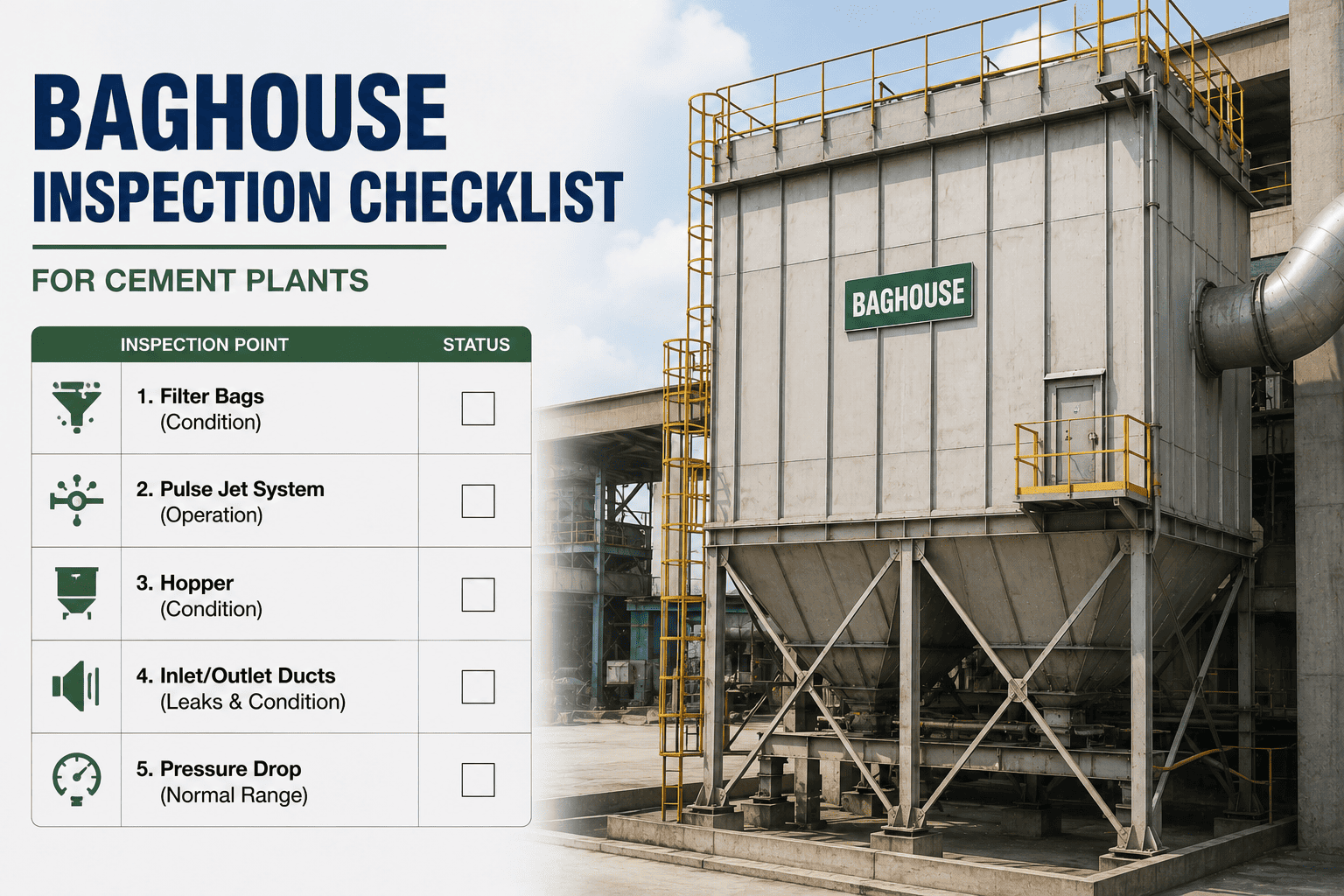
A baghouse strips fine dust from process air before it ever reaches a stack, and it does the job through hundreds of filter bags that clog, wear, and pulse clean thousands of times a day. A rising differential pressure means bags are blinding with dust, a torn bag sends fines straight past filtration and out the stack, and a stuck hopper discharge backs up collected dust until it packs solid. This checklist covers what to verify across differential pressure, filter bag condition, and pulse cleaning and hopper discharge. Sign up to turn this checklist into a guided digital procedure your baghouse crew follows on every shift.
3 Zones Checked
Differential pressure, filter bags, and pulse cleaning and discharge covered in this checklist
Continuous Monitoring
How often differential pressure across the baghouse should be logged
Zero Tolerance
Room for skipping a bag leak test or a hopper discharge check
Compartment By Compartment
Check point for pulse cleaning sequence across every baghouse compartment
Why Baghouse Checks Can't Be Rushed
A baghouse is often the last barrier between process dust and both emissions compliance and equipment downstream. The same pressure, bag, and cleaning checks repeated correctly every shift catch a torn bag or a blinding filter before it becomes a stack opacity violation.
Differential Pressure Monitoring
Total Baghouse Pressure Drop
Log overall differential pressure each shift and compare against the normal operating band for that unit
Compartment-Level Pressure Check
Compare pressure drop across individual compartments to spot one section blinding faster than the rest
Pressure Sensor Calibration
Verify differential pressure sensors are calibrated, since a faulty reading can mask a genuine blinding trend
Make Baghouse Checks A Habit, Not A Memory
Oxmaint guides your crew through pressure, filter bag, and pulse cleaning inspections step by step, with photo proof and sign-off logged against each compartment. Sign up for a free trial to build your baghouse routine, or book a demo to see it in action.
Filter Bag Condition Checks
Bag Leak Detection Test
Run bag leak detection or dust emission checks at the outlet to catch a torn bag before it triggers a stack event
Bag Cage & Seal Condition
Inspect bag cages for bent wires and check tube sheet seals so bags aren't chafing or bypassing filtration
Fabric Wear & Moisture Damage
Check bag fabric for abrasion, brittleness, or moisture damage, since a wet bag blinds faster and tears sooner
Pulse Cleaning & Hopper Discharge
Pulse Valve & Timer Sequence
Confirm pulse valves fire in the correct sequence and timing across every compartment, not just the first few rows
Compressed Air Supply Pressure
Check compressed air header pressure feeding the pulse system, since low pressure gives a weak cleaning pulse
Hopper Discharge & Rotary Valve
Verify hopper discharge and rotary airlock valves clear dust continuously without bridging or packing solid
What A Skipped Check Can Cost You
| Check Skipped |
Likely Consequence |
| Differential pressure logging |
A blinding trend goes unnoticed until airflow drops significantly |
| Bag leak detection test |
A torn bag sends fines past filtration and out the stack |
| Pulse valve sequence check |
Uncleaned compartments blind faster, raising pressure drop across the unit |
| Hopper discharge check |
Packed dust backs up into the baghouse and stops airflow entirely |
Where A CMMS Fits Into Baghouse Checks
Oxmaint ties this checklist to each baghouse compartment, filter bag set, and pulse valve as tracked assets, logging pressure drop trends over time so a blinding filter or failing valve gets flagged before it becomes an emissions issue.
Frequently Asked Questions
Q
What does a rising differential pressure in a baghouse indicate?
A steady rise usually means filter bags are blinding with dust cake faster than the pulse cleaning system clears it, and it's worth checking compressed air supply and pulse valve timing before the pressure climbs further.
Q
How is a torn filter bag usually detected?
A bag leak detection system at the outlet flags a sudden rise in dust concentration, and a sudden drop in that compartment's pressure reading can also point to a torn bag letting air bypass filtration.
Q
Can a CMMS track baghouse pressure drop trends automatically?
Yes, a CMMS can log differential pressure per compartment against the baghouse asset and flag a reading that drifts outside the normal baseline before it points to a blinding or leaking issue.
Keep Your Baghouse Compliant And Running Clean
Oxmaint guides your crew through pressure, filter bag, and pulse cleaning inspections and logs every reading against each compartment automatically. Sign up for a free trial to build your baghouse checklist, or book a demo to see it in action.