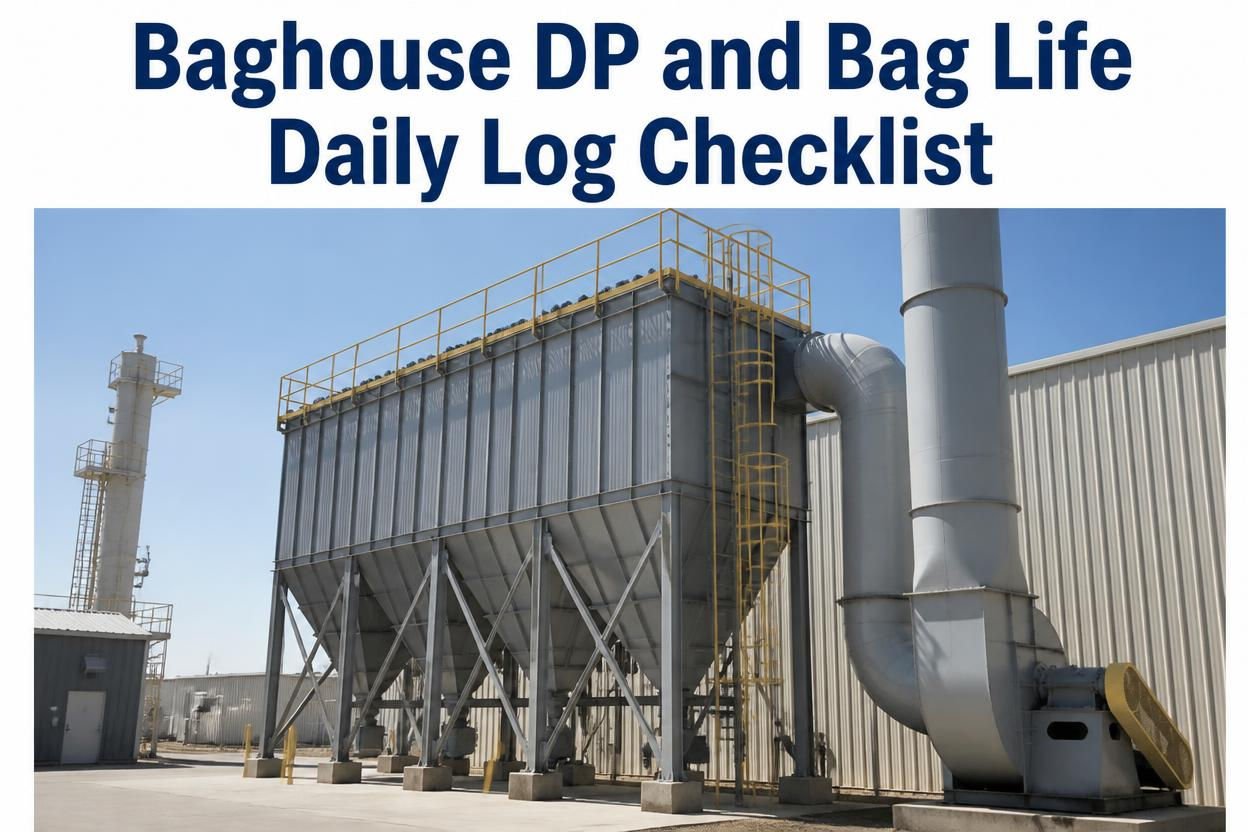
Differential pressure is the single number that tells you the most about a baghouse's health, and it tells a different story depending on which direction it moves. A sudden overnight jump usually means the cleaning system just broke. A slow creep over weeks usually means the bags are approaching the end of their working life. Read the same number the wrong way and you either miss a failing solenoid or replace bags that had months left in them. Sign up to log DP by compartment every shift and let the trend tell you which problem you actually have.
Why It Matters
A sudden DP rise of more than roughly 1.5 in. w.c. overnight signals a pulse cleaning malfunction, a compressed air pressure drop, or a sticking solenoid valve. A gradual rise over days is normal dust cake formation and cleaning cycle wear. Rapid fluctuations point to inlet baffle damage or hopper bridging. Three different problems, three different fixes — and DP is what tells them apart.
The Log In Three Stops
DP By Compartment
Record differential pressure on every compartment individually, not just a single house-wide average that hides which section is actually struggling.
Cleaning & Stack
Listen for the pulse cleaning cycle firing correctly, check compressed air pressure before and after pulses, and check the stack for visible emissions.
Hopper & Sign-Off
Confirm the hopper discharge device is running freely with no bridging, then log every reading with any anomaly flagged for the next shift.
The Daily DP And Bag Life Checklist
Record DP per compartment and compare against yesterday's trend: normal operating range typically runs 3 to 6 inches water column — what matters is the direction and speed of change, not just today's absolute number
Listen to and inspect the pulse cleaning cycle: check pulsing sound and frequency at each unit, and verify compressed air pressure in the cleaning manifold before and after pulses — a sticking solenoid rarely announces itself any other way
Inspect the exhaust stack for visible emissions: any dust plume or opacity change is a critical indicator of a torn or failed bag and should be flagged the same day, not at the next scheduled inspection
Verify the hopper discharge device is flowing freely: dust bridging or a stalled rotary airlock lets material build up toward bag level, raising inlet velocity and shortening bag life fast
Log DP creep after the cleaning cycle, not just the peak reading: if post-cleaning DP keeps rising cycle over cycle, the cake isn't fully releasing, which is the earliest reliable signal that bags are nearing end of life
DP Trended By Compartment, Bag Life Predicted Before It's Critical
Oxmaint logs differential pressure per compartment against yesterday's baseline automatically, flags the difference between a sudden spike and a slow bag-life creep, and raises a work order before either becomes a stack event. Sign up for a free trial to run it on your own baghouse, or book a demo to see it configured for your compartments.
Same Number, Two Completely Different Problems
A high DP reading and a low DP reading are both bad news, just for opposite reasons. High differential pressure usually means filter bags are blinded and the fan is working harder to push air through them — the classic sign of overdue cleaning or bags near end of life. A DP reading that's unexpectedly low can mean the opposite problem: a torn or failed bag letting air bypass with far less resistance than it should. That's why the stack inspection sits right next to the DP reading on this checklist rather than as a separate task — a falling DP paired with visible stack emissions is a much more urgent finding than a falling DP alone.
What A Drifting Reading Usually Means
| Pattern |
What It Looks Like |
Likely Cause |
| Sudden overnight spike |
DP jumps more than about 1.5 in. w.c. between shifts |
Cleaning system malfunction or compressed air drop |
| Gradual rise over weeks |
Post-cleaning DP creeping up cycle over cycle |
Bags approaching end of usable life |
| Rapid fluctuation |
DP swinging inconsistently shift to shift |
Inlet baffle damage or hopper bridging |
| Falling DP with stack dust |
Pressure drop paired with visible opacity |
Torn or failed bag allowing bypass |
Frequently Asked Questions
Q
Should bags be replaced as soon as DP starts rising?
Not immediately. A gradual DP rise is often normal cake formation that clears with a proper cleaning cycle. The better signal for a genuine end-of-life bag is post-cleaning DP that keeps creeping up cycle after cycle, which means the cake isn't fully releasing anymore.
Q
Why log DP per compartment instead of one house-wide number?
A single average can look normal while one compartment is degrading and another is compensating for it. Compartment-level logging catches the localized problem well before it drags the whole baghouse average out of range.
Q
Does a UK power station need a digital record of this daily log?
A digital, technician-attributed log gives a much clearer trend than a paper sheet and provides a solid emissions compliance record. More practically, it's what actually connects a rising DP or a hopper issue to a work order instead of letting the reading sit unreviewed until the next shift.
Read DP Right, And Bag Life Stops Being A Guess
Oxmaint logs differential pressure by compartment, tracks post-cleaning creep against baseline, and flags hopper discharge issues before they strain your bags. Sign up for a free trial to build your own baghouse daily log, or book a demo to see it set up for your compartments.