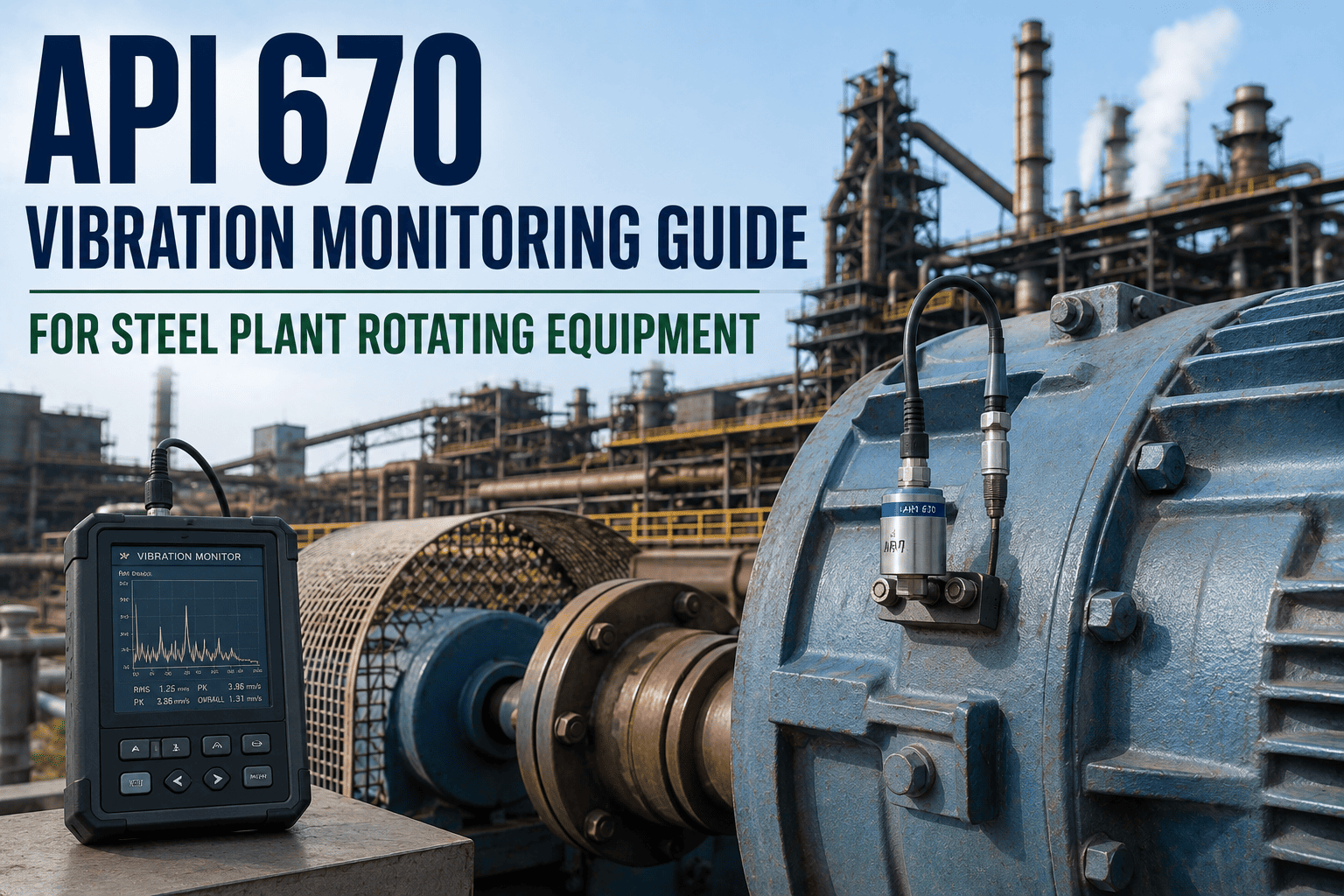
A rolling mill drive or continuous caster roll rarely fails without warning — the bearing was already trending abnormal for weeks before the trip. In a steel plant, where a single mill stoppage can cascade into hours of lost production, API 670 machinery protection isn't optional overhead, it's what keeps a developing fault from becoming a catastrophic failure. The standard defines exactly how vibration sensors, proximity probes, and protection systems must be wired, redundant, and alarmed so the trip happens before the damage does. A CMMS like OxMaint turns API 670 monitoring into scheduled calibration, trip testing, and trend review — sign up free and your first monitoring checklist is running today.
Critical Rotating Equipment That Needs API 670
What API 670 Actually Requires
Accelerometers
Casing-mounted sensors capturing high-frequency vibration on fans, motors, and gearboxes, feeding continuous signal to the protection system.
Proximity Probes
Non-contact eddy current probes on mill drive and compressor shafts that measure radial and axial position per API 670 gap-voltage specs.
Machine Protection System
The monitor rack that processes sensor signal and executes automatic trip or alarm logic, independent from the plant control system.
Alarm and Trip Setpoints
Alert and danger thresholds set per machine class, requiring periodic review as bearing condition and rotor balance shift over time.
Data Historian
Continuous trend storage of vibration and position data used to diagnose developing faults long before a trip event occurs.
Redundant Wiring and Power
Separate cable runs and dual power feeds so a single fault in wiring or supply cannot disable machine protection entirely.
Monitoring Checklist by Frequency
OxMaint auto-assigns these tasks to your team, with sign-off and calibration history per asset.
Common Monitoring Failures and CMMS Prevention
| Failure | Risk | Root Cause | OxMaint Prevention |
|---|---|---|---|
| Probe calibration drift | False readings, missed faults | Skipped monthly calibration | Calibration checklist with due-date alerts |
| Untested trip logic | Trip fails during real fault | Missed protection system test | Monthly trip test with sign-off record |
| Stale setpoints | Late or premature trips | Setpoints never reviewed | Annual setpoint review task with history log |
| Cable or connector fault | Signal loss, blind spots | Unlogged wiring wear | Weekly visual inspection with defect flagging |
| Historian data gaps | Lost trend evidence | Storage or logging failure unnoticed | Weekly data completeness check |
| Missed early trend warning | Unplanned catastrophic failure | No structured trend review process | Digital trend history tied to each asset record |
OxMaint vs. Competitors
| Capability | OxMaint | MaintainX | UpKeep | Fiix | Limble | IBM Maximo |
|---|---|---|---|---|---|---|
| API 670 calibration templates | Yes | No | No | No | No | Custom |
| Protection system trip test logs | Yes | Limited | Limited | No | No | Custom |
| Setpoint review scheduling | Yes | Limited | Limited | Limited | Limited | Yes |
| Vibration trend history linking | Yes | No | Limited | Limited | No | Yes |
| Multi-site fleet view | Yes | Limited | Limited | Yes | Limited | Yes |
| Setup | Minutes | Hours | Hours | Days | Hours | Months |
Implementation Roadmap
Results
Data Security
Frequently Asked Questions
What does API 670 actually cover?
API 670 defines the design, installation, and testing standards for machinery protection systems, including vibration and axial position monitoring on critical rotating equipment.
How often should proximity probes be calibrated?
Proximity probes should have gap-voltage calibration verified monthly, since drift here directly affects trip accuracy.
Why does trip testing matter if alarms already work?
An alarm confirms the sensor reads correctly, but only a trip test confirms the protection system will actually shut the machine down when needed.
Can OxMaint manage API 670 compliance across multiple steel plants?
Yes. OxMaint provides one dashboard across every plant with machine-specific checklists, calibration tracking, and portfolio-wide reporting.